
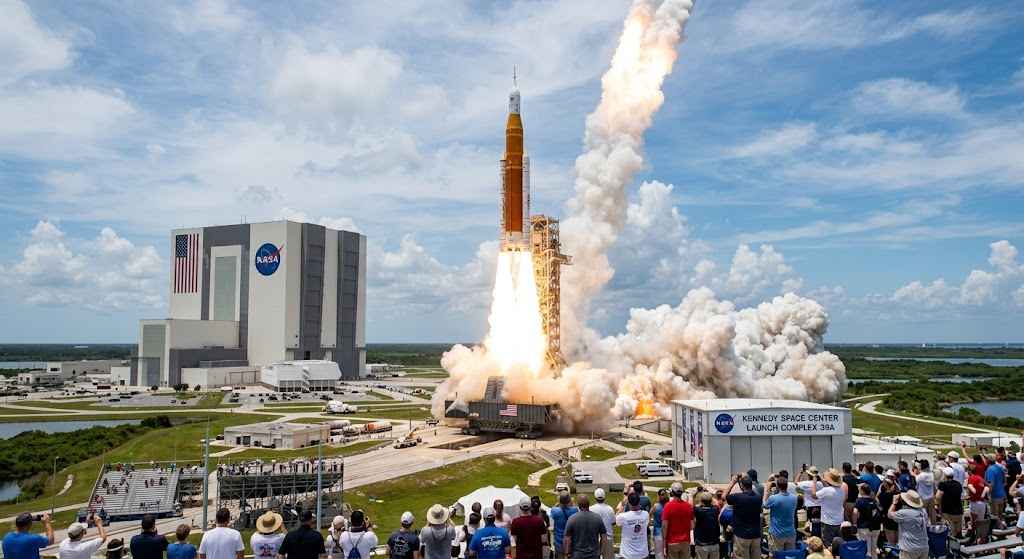
Space exploration has expanded our understanding of the universe through groundbreaking missions, remarkable discoveries, and incredible technological achievements. From historic Moon landings and Mars rovers to powerful space telescopes and astronaut training, there is no shortage of fascinating facts to explore. Whether you’re a space enthusiast, student, science lover, or simply curious about the cosmos, NASA trivia is a fun way to test your knowledge.
This collection of NASA trivia questions and answers covers a wide range of topics, including space missions, astronauts, rockets, satellites, planets, scientific discoveries, and the history of space exploration. With a mix of easy, medium, and challenging questions, there’s something for kids, adults, teachers, students, and trivia enthusiasts alike.
Get ready to challenge yourself, uncover amazing space facts, and explore the incredible achievements that have shaped modern space exploration. Perfect for classrooms, quiz nights, science clubs, family activities, or casual learning, these NASA trivia questions and answers provide an entertaining and educational experience for everyone.
NASA Trivia Questions and Answers
NASA Trivia Study Guide
1. When was NASA founded?
A) 1955
B) 1958
C) 1961
D) 1969
Answer: B) 1958
Explanation: NASA was established on July 29, 1958.
2. What does NASA stand for?
A) National Aeronautics and Space Administration
B) North American Space Agency
C) National Aerospace Science Association
D) New Aeronautics and Space Authority
Answer: A) National Aeronautics and Space Administration
Explanation: NASA is the U.S. government agency responsible for civilian space exploration and aeronautics research.
3. Who was the first American in space?
A) Neil Armstrong
B) Alan Shepard
C) John Glenn
D) Buzz Aldrin
Answer: B) Alan Shepard
Explanation: Alan Shepard flew aboard Freedom 7 on May 5, 1961, becoming the first American in space.
4. Who was the first American to orbit Earth?
A) Alan Shepard
B) John Glenn
C) Neil Armstrong
D) Michael Collins
Answer: B) John Glenn
Explanation: John Glenn completed three orbits of Earth aboard Friendship 7 in 1962.
5. Which mission landed the first humans on the Moon?
A) Apollo 9
B) Apollo 10
C) Apollo 11
D) Apollo 12
Answer: C) Apollo 11
Explanation: Apollo 11 successfully landed astronauts Neil Armstrong and Buzz Aldrin on the Moon on July 20, 1969.
6. Who was the first person to walk on the Moon?
A) Buzz Aldrin
B) Neil Armstrong
C) Michael Collins
D) Alan Shepard
Answer: B) Neil Armstrong
Explanation: Neil Armstrong became the first human to step onto the Moon’s surface.
7. What was the name of NASA’s first Space Shuttle to fly in space?
A) Challenger
B) Columbia
C) Discovery
D) Enterprise
Answer: B) Columbia
Explanation: Columbia launched the first Space Shuttle mission, STS-1, in April 1981. Enterprise was used only for atmospheric test flights.
8. Which Space Shuttle carried Sally Ride, the first American woman in space?
A) Challenger
B) Columbia
C) Discovery
D) Atlantis
Answer: A) Challenger
Explanation: Sally Ride flew aboard Challenger on the STS-7 mission in 1983.
9. What does the acronym “ISS” stand for?
A) International Space Station
B) Interstellar Science Station
C) International Satellite System
D) Interplanetary Space Station
Answer: A) International Space Station
Explanation: The ISS is a permanently inhabited research laboratory orbiting Earth.
10. Which NASA rover found strong evidence that ancient Mars once had liquid water?
A) Spirit
B) Opportunity
C) Curiosity
D) Perseverance
Answer: B) Opportunity
Explanation: Opportunity discovered minerals that formed in water, proving ancient Mars once had wet environments.
11. Which NASA mission made the first close flyby of Pluto in 2015?
A) Voyager 2
B) Cassini
C) New Horizons
D) Pioneer 10
Answer: C) New Horizons
Explanation: New Horizons captured humanity’s first detailed images of Pluto and its moons.
12. What was the first U.S. satellite successfully launched into orbit?
A) Explorer 1
B) Sputnik 1
C) Vanguard 1
D) Telstar
Answer: A) Explorer 1
Explanation: Explorer 1 launched in 1958 and discovered Earth’s Van Allen radiation belts.
13. Which Space Shuttle mission deployed the Hubble Space Telescope?
A) STS-31
B) Apollo 13
C) Gemini 4
D) Skylab 2
Answer: A) STS-31
Explanation: Space Shuttle Discovery deployed Hubble into orbit in April 1990.
14. Which Space Shuttle was lost shortly after liftoff in 1986?
A) Columbia
B) Challenger
C) Atlantis
D) Endeavour
Answer: B) Challenger
Explanation: Challenger broke apart 73 seconds after launch, leading to major changes in NASA’s safety procedures.
15. Which Space Shuttle disintegrated during re-entry in 2003?
A) Columbia
B) Challenger
C) Atlantis
D) Discovery
Answer: A) Columbia
Explanation: Columbia was lost during re-entry because of damage sustained during launch.
16. Which rocket launched astronauts on every Apollo Moon mission?
A) Saturn IB
B) Falcon Heavy
C) Saturn V
D) Atlas V
Answer: C) Saturn V
Explanation: Saturn V remains one of the most powerful rockets ever successfully flown.
17. Which NASA mission returned samples from asteroid Bennu to Earth in 2023?
A) OSIRIS-REx
B) Juno
C) Dawn
D) Voyager 1
Answer: A) OSIRIS-REx
Explanation: OSIRIS-REx successfully delivered asteroid samples that help scientists study the early Solar System.
18. What is the main goal of NASA’s Artemis program?
A) Explore Jupiter
B) Return humans to the Moon
C) Build a Mars colony immediately
D) Study black holes
Answer: B) Return humans to the Moon
Explanation: Artemis aims to land astronauts on the Moon and prepare for future human missions to Mars.
19. Which NASA spacecraft has traveled farther from Earth than any other?
A) Voyager 1
B) Voyager 2
C) Pioneer 10
D) New Horizons
Answer: A) Voyager 1
Explanation: Launched in 1977, Voyager 1 became the first spacecraft to enter interstellar space.
20. What is NASA’s official motto?
A) “Exploring Beyond”
B) “For the Benefit of All”
C) “To the Stars”
D) “Space for Humanity”
Answer: B) “For the Benefit of All”
Explanation: NASA’s motto reflects its mission to advance science, exploration, and technology for the benefit of humanity.
NASA Trivia Questions and Answers for Students
20 NASA Trivia Questions (Multiple Choice) with Answers & Explanations
1. What does NASA stand for?
A) National Aeronautics and Space Administration
B) National Astronomy and Science Agency
C) North American Space Association
D) National Aerospace Science Alliance
Answer: A
Explanation: NASA stands for the National Aeronautics and Space Administration. It was established in 1958 to oversee the United States’ civilian space program and aeronautics research.
2. In what year was NASA founded?
A) 1945
B) 1958
C) 1961
D) 1970
Answer: B
Explanation: NASA was officially created on July 29, 1958, following the launch of Sputnik by the Soviet Union.
3. Which NASA mission first landed humans on the Moon?
A) Apollo 8
B) Apollo 11
C) Apollo 13
D) Gemini 7
Answer: B
Explanation: Apollo 11 landed on the Moon on July 20, 1969, with Neil Armstrong and Buzz Aldrin walking on the lunar surface.
4. Who was the first person to walk on the Moon?
A) Buzz Aldrin
B) Michael Collins
C) Neil Armstrong
D) John Glenn
Answer: C
Explanation: Neil Armstrong became the first human to step onto the Moon, saying the famous words, “That’s one small step for man, one giant leap for mankind.”
5. Which NASA space telescope was launched in 1990?
A) James Webb Space Telescope
B) Chandra X-ray Observatory
C) Hubble Space Telescope
D) Kepler Space Telescope
Answer: C
Explanation: The Hubble Space Telescope has transformed astronomy by capturing detailed images of distant galaxies, nebulae, and planets.
6. What was the name of NASA’s first Space Shuttle?
A) Discovery
B) Atlantis
C) Columbia
D) Endeavour
Answer: C
Explanation: Space Shuttle Columbia made its first flight in 1981, beginning NASA’s Space Shuttle program.
7. Which planet has NASA explored with the Perseverance rover?
A) Venus
B) Mars
C) Jupiter
D) Mercury
Answer: B
Explanation: Perseverance landed on Mars in 2021 to search for signs of ancient microbial life and collect rock samples.
8. What is NASA’s mission control center located in Houston, Texas, commonly called?
A) Space Command
B) Johnson Space Center
C) Kennedy Space Center
D) Marshall Space Flight Center
Answer: B
Explanation: NASA’s Johnson Space Center is home to Mission Control, where many human spaceflight missions are monitored.
9. Which NASA mission famously experienced an oxygen tank explosion in space?
A) Apollo 7
B) Apollo 11
C) Apollo 13
D) Apollo 17
Answer: C
Explanation: Apollo 13 suffered a major in-flight emergency in 1970, but all three astronauts safely returned to Earth.
10. Where are most NASA astronaut launches conducted in the United States?
A) California
B) Texas
C) Florida
D) Arizona
Answer: C
Explanation: Many NASA missions launch from Kennedy Space Center at Cape Canaveral, Florida.
11. Which NASA rover was the first to successfully land on Mars?
A) Curiosity
B) Sojourner
C) Opportunity
D) Spirit
Answer: B
Explanation: Sojourner landed in 1997 as part of the Mars Pathfinder mission and became the first rover to operate on another planet.
12. What is the name of NASA’s newest flagship space telescope launched in 2021?
A) Hubble
B) Kepler
C) James Webb Space Telescope
D) Spitzer
Answer: C
Explanation: The James Webb Space Telescope studies the earliest galaxies, distant stars, and exoplanets using infrared technology.
13. Which astronaut was the first American to orbit Earth?
A) Alan Shepard
B) John Glenn
C) Gus Grissom
D) Neil Armstrong
Answer: B
Explanation: John Glenn orbited Earth aboard Friendship 7 in 1962, becoming the first American to do so.
14. NASA’s Artemis program aims to return humans to which destination?
A) Mars
B) Venus
C) The Moon
D) Jupiter
Answer: C
Explanation: Artemis is NASA’s program to return astronauts to the Moon and prepare for future missions to Mars.
15. What is the International Space Station (ISS)?
A) A satellite used only for weather forecasting
B) A permanently inhabited laboratory orbiting Earth
C) A lunar base
D) A Mars spacecraft
Answer: B
Explanation: The ISS is a collaborative space laboratory where astronauts conduct scientific research while orbiting Earth.
16. Which NASA center is responsible for launching many space missions?
A) Ames Research Center
B) Kennedy Space Center
C) Glenn Research Center
D) Langley Research Center
Answer: B
Explanation: Kennedy Space Center in Florida has been the launch site for Apollo, Space Shuttle, and Artemis missions.
17. What was the primary goal of the Apollo program?
A) Build a space station
B) Land humans on the Moon and return them safely to Earth
C) Explore Mars
D) Study the Sun
Answer: B
Explanation: President John F. Kennedy challenged NASA to land humans on the Moon before the end of the 1960s, a goal achieved by Apollo 11.
18. Which spacecraft carried astronauts to the Moon during the Apollo missions?
A) Dragon
B) Orion
C) Apollo Command and Service Module with the Lunar Module
D) Gemini Capsule
Answer: C
Explanation: Apollo missions used the Command and Service Module for travel and the Lunar Module for Moon landings.
19. NASA studies Earth using satellites for purposes such as:
A) Monitoring weather and climate
B) Tracking natural disasters
C) Observing oceans and forests
D) All of the above
Answer: D
Explanation: NASA’s Earth-observing satellites help scientists monitor weather, climate change, wildfires, hurricanes, and environmental conditions worldwide.
20. What is NASA’s long-term goal for human space exploration beyond the Moon?
A) Building cities on Venus
B) Exploring the Sun
C) Sending astronauts to Mars
D) Colonizing Mercury
Answer: C
Explanation: NASA’s long-term exploration plans focus on sending humans to Mars, building on experience gained through the Artemis program and lunar exploration.
Fun NASA Trivia Questions and Answers
1. What does NASA stand for?
A) National Aeronautics and Space Administration
B) National American Space Agency
C) North American Space Association
D) National Aerospace and Science Authority
Answer: A
Explanation: NASA was established in 1958 as the National Aeronautics and Space Administration, replacing the earlier National Advisory Committee for Aeronautics (NACA).
2. Which NASA mission successfully landed the first humans on the Moon?
A) Apollo 8
B) Apollo 11
C) Apollo 13
D) Gemini 4
Answer: B
Explanation: On July 20, 1969, Apollo 11 astronauts Neil Armstrong and Buzz Aldrin became the first humans to walk on the lunar surface while Michael Collins orbited above.
3. Who was the first American to orbit the Earth?
A) Alan Shepard
B) John Glenn
C) Neil Armstrong
D) Gus Grissom
Answer: B
Explanation: John Glenn orbited the Earth three times on February 20, 1962, aboard Friendship 7 during the Mercury-Atlas 6 mission.
4. What was the name of the first artificial satellite launched by the United States?
A) Explorer 1
B) Sputnik 1
C) Vanguard 1
D) Pioneer 1
Answer: A
Explanation: Explorer 1 was launched on January 31, 1958, and discovered the Van Allen radiation belts. (Sputnik 1 was the first satellite overall, launched by the Soviet Union.)
5. Which NASA space telescope, launched in 1990, has provided some of the most detailed images of the distant universe?
A) Spitzer Space Telescope
B) Hubble Space Telescope
C) James Webb Space Telescope
D) Chandra X-ray Observatory
Answer: B
Explanation: The Hubble Space Telescope has revolutionized astronomy with its high-resolution visible and ultraviolet images for more than three decades.
6. What was the main goal of the Apollo program?
A) To build a space station
B) To land humans on the Moon and return them safely to Earth
C) To send robots to Mars
D) To study the Sun exclusively
Answer: B
Explanation: Announced by President John F. Kennedy in 1961, the Apollo program achieved its goal with six successful crewed lunar landings between 1969 and 1972.
7. Which NASA rover landed on Mars in February 2021 and began searching for signs of ancient microbial life?
A) Curiosity
B) Perseverance
C) Opportunity
D) Spirit
Answer: B
Explanation: The Perseverance rover landed in Jezero Crater and also carried the Ingenuity helicopter, which performed the first powered flight on another planet.
8. Who was the first American woman in space?
A) Sally Ride
B) Mae Jemison
C) Christa McAuliffe
D) Kalpana Chawla
Answer: A
Explanation: Sally Ride flew aboard the Space Shuttle Challenger on the STS-7 mission in June 1983, becoming the first American woman to reach space.
9. What tragedy occurred on January 28, 1986?
A) Apollo 13 explosion
B) Space Shuttle Challenger disaster
C) Columbia disaster
D) Gemini 8 emergency
Answer: B
Explanation: The Space Shuttle Challenger broke apart 73 seconds after launch, killing all seven crew members, including teacher Christa McAuliffe.
10. Which NASA program is currently focused on returning humans to the Moon and eventually sending astronauts to Mars?
A) Apollo
B) Constellation
C) Artemis
D) Mercury
Answer: C
Explanation: The Artemis program aims to land the first woman and the next man on the Moon and establish a sustainable lunar presence as a stepping stone to Mars.
11. What was the name of the first reusable spacecraft system developed by NASA?
A) Apollo Command Module
B) Space Shuttle
C) Gemini capsule
D) Orion
Answer: B
Explanation: The Space Shuttle (officially the Space Transportation System) flew from 1981 to 2011 and was the world’s first reusable crewed spacecraft.
12. Which planet did the Voyager 2 spacecraft fly by that no other spacecraft has visited?
A) Jupiter
B) Saturn
C) Uranus and Neptune
D) Mars
Answer: C
Explanation: Voyager 2 is the only spacecraft to have flown by Uranus (1986) and Neptune (1989). Both Voyager 1 and 2 visited Jupiter and Saturn.
13. What does the “A” in NASA’s famous “A-to-Z” list of astronaut requirements historically emphasize?
A) Age under 30
B) Excellent physical and mental condition (among other strict criteria)
C) Ability to fly any aircraft
D) Advanced degree in literature
Answer: B
Explanation: Early astronaut selection placed heavy emphasis on physical fitness, education (especially engineering or science), flight experience, and psychological suitability.
14. Which NASA mission was famously aborted after an oxygen tank explosion but still returned its crew safely to Earth?
A) Apollo 11
B) Apollo 13
C) Apollo 8
D) Gemini 7
Answer: B
Explanation: Apollo 13 suffered a critical failure in April 1970. Through exceptional problem-solving by the crew and Mission Control, the astronauts returned safely.
15. The International Space Station (ISS) is a collaborative project primarily led by which five space agencies?
A) NASA, Roscosmos, ESA, JAXA, and CSA
B) NASA only
C) NASA and China only
D) ESA and India only
Answer: A
Explanation: The ISS is a partnership between NASA (United States), Roscosmos (Russia), ESA (Europe), JAXA (Japan), and CSA (Canada).
16. What was the name of the first successful Mars rover, which landed in 1997?
A) Sojourner (part of the Mars Pathfinder mission)
B) Curiosity
C) Perseverance
D) Opportunity
Answer: A
Explanation: Sojourner was a small rover that operated for nearly three months on Mars, proving that roving vehicles could explore the planet.
17. Which astronaut holds the record for the most total time spent in space by an American?
A) Scott Kelly
B) Peggy Whitson
C) John Glenn
D) Neil Armstrong
Answer: B
Explanation: Peggy Whitson has accumulated 665 days in space across multiple missions, the most of any American astronaut and any woman worldwide.
18. What is the primary purpose of the James Webb Space Telescope?
A) To study the Moon in detail
B) To observe the universe in infrared light and look further back in time than Hubble
C) To search for planets around the Sun only
D) To communicate with deep-space probes
Answer: B
Explanation: Launched in 2021, the James Webb Space Telescope is designed to study the early universe, galaxy formation, star birth, and exoplanet atmospheres using infrared observations.
19. Which of these is a real NASA “spinoff” technology that benefits everyday life?
A) Memory foam
B) Instant noodles
C) The paperclip
D) The wheel
Answer: A
Explanation: Memory foam was originally developed for NASA aircraft seats and later adapted into consumer mattresses, pillows, and medical applications.
20. In what year was NASA officially established?
A) 1945
B) 1958
C) 1961
D) 1969
Answer: B
Explanation: NASA was created on July 29, 1958, when President Dwight D. Eisenhower signed the National Aeronautics and Space Act into law in response to the Space Race.
Easy NASA Trivia Questions and Answers
1. Question: NASA’s name is an acronym that stands for the National Aeronautics and Space Administration. But what does “Aeronautics” really mean?
Answer: The study or practice of flight and aircraft engineering.
Fun Fact: Basically, NASA’s big on making sure humans can fly or float—whether in jets or rockets!
2. Question: Which NASA mission was the first to land humans on the Moon?
Answer: Apollo 11
Fun Fact: Neil Armstrong and Buzz Aldrin took that giant leap in 1969—famous for their “tiny step,” legendary for the huge impact.
3. Question: NASA’s Mars rover named “Perseverance” was designed to explore what?
Answer: To search for signs of ancient life and collect rock samples.
Fun Fact: Perseverance is basically a high-tech dirt hunter, looking for fossils in Martian dirt—like the universe’s most dedicated archaeologist.
4. Question: What is the name of NASA’s most famous space telescope, launched in 1990?
Answer: Hubble Space Telescope
Fun Fact: Hubble has taken more gorgeous photos of space than a million Instagram influencers.
5. Question: NASA’s space shuttles were like the ultimate space taxis. How many shuttles did NASA fly?
Answer: Five (Columbia, Challenger, Discovery, Atlantis, Endeavour)
Fun Fact: These shuttles combined, traveled over 1.3 billion miles—probably enough to circle the Earth more than 50,000 times!
6. Question: NASA’s “Voyager 1” is famous for what incredible achievement?
Answer: Being the first human-made object to enter interstellar space.
Fun Fact: It’s like humanity’s intergalactic ambassador, still chatting away from beyond the Solar System.
7. Question: Which NASA mission sent astronauts to repair the Hubble Space Telescope in 1993?
Answer: STS-61 (a Space Shuttle mission)
Fun Fact: These spacewalks were so daring, they made Hollywood stunt scenes look boring.
8. Question: NASA’s iconic “meatball” logo features a stylized orbit. What shape is it?
Answer: A circle with a stylized NASA letter and a swooping blue orbit with a red vector.
Fun Fact: It’s like the coolest badge the space agency ever had—and definitely makes you feel like a space explorer.
9. Question: What’s the purpose of NASA’s International Space Station (ISS)?
Answer: To conduct scientific research in microgravity, and collaborate with international partners.
Fun Fact: It’s basically Earth’s giant science lab floating in space—ideally suited for astronauts who love experiments and zero gravity pizza.
10. Question: NASA invented a lot of nifty tech, but which of these was inspired by space suits?
Answer: Memory foam (the stuff that molds to your body for a comfy sleep)
Fun Fact: It was originally designed to cushion astronauts’ bumps—now it’s comforting human bumps everywhere!
11. Question: NASA’s “Artemis” program aims to do what?
Answer: Return humans to the Moon, including the first woman and the next man.
Fun Fact: Artemis isn’t just about moonwalking again—it’s a stepping stone to Mars.
12. Question: NASA’s Mars helicopter, “Ingenuity,” did what for the first time?
Answer: It made the first powered, controlled flight on another planet.
Fun Fact: Think of Ingenuity as the brave little drone making history, one tiny hop at a time.
13. Question: What was the main goal of NASA’s Apollo program?
Answer: To land humans on the Moon and safely return them to Earth.
Fun Fact: It was the ultimate “reach for the stars” project—literally.
14. Question: NASA is working on a mission to study this icy moon of Jupiter, thought to harbor a subsurface ocean. Which moon?
Answer: Europa
Fun Fact: Who knows? Maybe beneath that ice is the universe’s coolest hidden alien ocean.
15. Question: What’s the name of NASA’s robotic spacecraft that studied the Sun up close?
Answer: Parker Solar Probe
Fun Fact: It’s like a solar spy—getting closer to the Sun than any spacecraft ever.
16. Question: NASA’s “New Horizons” spacecraft famously flew by which distant object in 2015?
Answer: Pluto
Fun Fact: It was like a cosmic VIP trip, capturing the first close-up photos of Pluto in decades.
17. Question: What kind of propulsion system is NASA testing that might one day let us travel to Mars faster?
Answer: Nuclear thermal propulsion
Fun Fact: It’s like space’s version of a rocket turbo boost—faster and more efficient.
18. Question: NASA’s Mars rovers often use a specific type of wheel to roll over alien terrain, but what’s special about them?
Answer: They are rugged, multi-layered, and designed to handle rough terrain.
Fun Fact: These wheels are basically the mountain climbers of robots—built tough for alien adventures.
19. Question: NASA’s “James Webb Space Telescope” launched to succeed Hubble is designed to do what?
Answer: Observe the universe in infrared, looking further back in time than ever before.
Fun Fact: It’s like a cosmic time machine, peering into the universe’s deepest past.
20. Question: What’s NASA’s ultimate dream, beyond space exploration?
Answer: To ensure humanity’s future as a multiplanetary species.
Fun Fact: Basically, NASA wants humans to be “space-age travelers”—becoming a kind of galactic bouncer.
NASA Trivia Questions and Answers for Adults
1. Question: NASA wasn’t always called NASA. What was its original name before the space glow-up in 1958?
Answer: NACA – National Advisory Committee for Aeronautics.
Fun Fact: NASA basically started as a flight nerd club before going full rocket mode.
2. Question: Which NASA mission first landed humans on the Moon in 1969, making history and inspiring generations of space geeks?
Answer: Apollo 11.
Fun Fact: Neil Armstrong’s “one small step” was actually broadcast with a slight delay — space lag is real.
3. Question: Which astronaut got to say, “Houston, we’ve had a problem,” during a famously troubled mission?
Answer: Jim Lovell (Apollo 13).
Fun Fact: The movie version gave us Tom Hanks saying it — and somehow made duct tape heroic.
4. Question: NASA’s rover named after a virtue landed on Mars in 2021. What’s its name?
Answer: Perseverance.
Fun Fact: It even brought a helicopter named Ingenuity — because Mars needed a drone buddy.
5. Question: Which space telescope launched in 1990 and has been serving jaw-dropping cosmic photos ever since?
Answer: Hubble Space Telescope.
Fun Fact: It had blurry vision at first — basically the cosmic version of needing glasses.
6. Question: Which NASA spacecraft is currently chilling in interstellar space after saying “peace out” to our solar system?
Answer: Voyager 1.
Fun Fact: It carries a golden record with Earth sounds — just in case aliens dig vinyl.
7. Question: What does NASA stand for (besides “coolest acronym ever”)?
Answer: National Aeronautics and Space Administration.
Fun Fact: It’s the only government agency that makes space suits and memes.
8. Question: Which NASA mission gave us the first close-up images of Pluto in 2015?
Answer: New Horizons.
Fun Fact: It traveled 3 billion miles for a photo op — talk about commitment.
9. Question: Which NASA center is located in Houston and famously helps astronauts “solve problems”?
Answer: Johnson Space Center.
Fun Fact: It’s where Mission Control lives — and where coffee flows like rocket fuel.
10. Question: Which female mathematician, featured in Hidden Figures, helped calculate trajectories for NASA’s early missions?
Answer: Katherine Johnson.
Fun Fact: She crunched numbers so astronauts wouldn’t crash — basically the human GPS of the ’60s.
11. Question: Which NASA rover sang “Happy Birthday” to itself on Mars in 2013?
Answer: Curiosity.
Fun Fact: It was the loneliest birthday party in the solar system — but still adorable.
12. Question: Which NASA mission studied Saturn and its moons for over 13 years before diving into the planet’s atmosphere in 2017?
Answer: Cassini.
Fun Fact: It sent back epic selfies of Saturn’s rings — and went out in a blaze of glory.
13. Question: Which NASA program aims to land the first woman and next man on the Moon by the mid-2020s?
Answer: Artemis.
Fun Fact: Named after Apollo’s twin sister — because space equality is stellar.
14. Question: Which NASA space shuttle was tragically lost in 1986 shortly after launch?
Answer: Challenger.
Fun Fact: Its legacy inspired major safety reforms and countless tributes to the crew’s bravery.
15. Question: Which NASA mission studied Jupiter and its massive magnetic field, launching in 2011?
Answer: Juno.
Fun Fact: Juno’s orbit is so wild, it’s basically doing cosmic rollercoaster loops around Jupiter.
16. Question: Which NASA spacecraft is currently orbiting the Sun closer than any other, studying solar flares up close?
Answer: Parker Solar Probe.
Fun Fact: It’s basically sunbathing at 430,000 mph — SPF not included.
17. Question: Which NASA astronaut spent nearly a year in space aboard the ISS, helping study long-term space effects?
Answer: Scott Kelly.
Fun Fact: He has a twin brother, Mark — perfect for Earth vs. space comparison studies.
18. Question: Which NASA mission launched the James Webb Space Telescope in 2021 to peer deeper into the universe?
Answer: JWST Mission.
Fun Fact: It’s like Hubble’s cooler, more powerful cousin — with infrared vision and serious style.
19. Question: Which NASA program helped launch reusable space shuttles from 1981 to 2011?
Answer: Space Shuttle Program.
Fun Fact: It gave us iconic orbiters like Discovery, Atlantis, and Endeavour — basically the Avengers of spaceflight.
20. Question: Which NASA center is located in Florida and handles rocket launches like a boss?
Answer: Kennedy Space Center.
Fun Fact: It’s where countdowns get real — and where you can watch rockets blast off while eating astronaut ice cream.
Best NASA Trivia Questions and Answers
1. Question: NASA stands for something pretty spacey. What’s the full name of this cosmic agency?
Answer: National Aeronautics and Space Administration
Fun Fact: Founded in 1958, NASA took over from NACA, which was all about planes before space became the cool kid on the block!
2. Question: The Apollo program put humans on the moon, but which mission first achieved that giant leap in 1969?
Answer: Apollo 11
Fun Fact: Neil Armstrong’s “one small step” line was almost flubbed due to radio static. Good thing he nailed it—talk about a mic drop moment!
3. Question: NASA’s got a famous launch site in Florida. What’s the name of this coastal spaceport?
Answer: Kennedy Space Center
Fun Fact: Located on Merritt Island, it’s been launching rockets since the 1960s. The alligators in nearby swamps probably have the best view!
4. Question: The first American in space was a real trailblazer. Who took that historic suborbital flight in 1961?
Answer: Alan Shepard
Fun Fact: Shepard’s 15-minute joyride on Freedom 7 made him a national hero, and he later golfed on the moon. Talk about a cosmic hole-in-one!
5. Question: NASA’s got a knack for naming rovers. What’s the name of the rover that landed on Mars in 2021 to search for ancient life?
Answer: Perseverance
Fun Fact: “Percy” brought along a tiny helicopter named Ingenuity, proving Mars isn’t just for rovers—it’s for chopper stunts, too!
6. Question: The Hubble Space Telescope has been snapping cosmic selfies since 1990. What galaxy was its first deep-space target?
Answer: Andromeda Galaxy
Fun Fact: Hubble’s pics of Andromeda are so sharp, they make your phone’s camera look like a potato. It’s still beaming jaw-dropping images today!
7. Question: NASA’s got a famous control room. What’s the name of the Houston-based center that guided Apollo missions?
Answer: Mission Control Center (Johnson Space Center)
Fun Fact: “Houston, we have a problem” became iconic thanks to Apollo 13. The real heroes were the nerds in Mission Control saving the day!
8. Question: NASA’s Voyager probes are still out there, cruising the cosmos. In what year were Voyager 1 and 2 launched?
Answer: 1977
Fun Fact: Voyager 1 is now over 15 billion miles away, carrying a golden record with Earth’s greatest hits. Aliens, hope you like Chuck Berry!
9. Question: NASA loves acronyms. What’s the name of the reusable spacecraft that flew from 1981 to 2011?
Answer: Space Shuttle
Fun Fact: The shuttles—like Atlantis and Discovery—flew 135 missions, hauling satellites and building the ISS. They were the minivans of space!
10. Question: The International Space Station is a NASA-led collab. How many countries partner on this orbiting lab?
Answer: 15
Fun Fact: Astronauts aboard the ISS see 16 sunrises a day, zipping around Earth at 17,500 mph. Talk about a caffeine-free morning boost!
11. Question: NASA’s got a cinematic side. Which 1995 film dramatized the near-disaster of Apollo 13?
Answer: Apollo 13
Fun Fact: Tom Hanks’ line, “Houston, we have a problem,” is a slight misquote, but it’s so iconic, NASA just rolls with it!
12. Question: NASA’s got a Martian helicopter. What’s the name of the first aircraft to fly on another planet?
Answer: Ingenuity
Fun Fact: In 2021, Ingenuity took off on Mars, proving powered flight isn’t just for Earth. It’s like the Wright brothers went interplanetary!
13. Question: NASA’s Jet Propulsion Laboratory is a hub for space exploration. In which California city is JPL located?
Answer: Pasadena
Fun Fact: JPL’s been behind every Mars rover and even survived a fictional alien attack in War of the Worlds. Real science, sci-fi vibes!
14. Question: The first woman to walk in space was a NASA astronaut. Who made that historic EVA in 1984?
Answer: Kathryn Sullivan
Fun Fact: Sullivan not only spacewalked but also dove to Earth’s deepest point in 2020. She’s basically the queen of extreme adventures!
15. Question: NASA’s got a quirky tradition. What food do astronauts eat for good luck before a launch?
Answer: Steak and eggs
Fun Fact: This hearty breakfast started with Alan Shepard and stuck around. It’s like NASA’s version of a pre-game protein shake!
16. Question: The Chandra X-ray Observatory peers into the universe’s high-energy secrets. What’s it named after?
Answer: Subrahmanyan Chandrasekhar
Fun Fact: This Nobel-winning astrophysicist calculated how stars die. Naming a telescope after him is like giving Einstein a cosmic high-five!
17. Question: NASA’s got a famous test site in the desert. What’s the name of the Nevada facility where rocket engines roar?
Answer: Nevada Test and Training Range (or Area 51 for some tests)
Fun Fact: Area 51’s secrecy fuels UFO rumors, but it’s mostly about rocket tech. Sorry, no alien autopsies—just engineering awesomeness!
18. Question: The Curiosity rover sings itself a tune on Mars. What song does it play every year on its landing anniversary?
Answer: Happy Birthday
Fun Fact: Curiosity belts out “Happy Birthday” to itself via vibrations. It’s the loneliest party in the solar system, but we love it!
19. Question: NASA’s got a lunar legacy. What’s the name of the moon rocks brought back by Apollo missions?
Answer: Lunar samples
Fun Fact: About 842 pounds of moon rocks are stored at Johnson Space Center. They’re so precious, stealing one is a galactic-level oops!
20. Question: NASA’s Artemis program aims to return humans to the moon. What mythological figure is it named after?
Answer: Artemis
Fun Fact: Artemis, Apollo’s twin sister in Greek mythology, is a fitting name for NASA’s push to land the first woman on the moon. Girl power, lunar style!
Conclusion
Exploring NASA through trivia is an exciting way to learn about the missions, discoveries, and technological achievements that have transformed our understanding of space. From legendary astronauts and powerful rockets to planetary exploration and groundbreaking scientific research, every question offers an opportunity to discover something new.
Whether you answered every question correctly or uncovered fascinating facts along the way, these NASA trivia questions and answers provide an enjoyable challenge for students, educators, science enthusiasts, and trivia lovers of all ages. They are perfect for classrooms, science clubs, quiz competitions, family game nights, or anyone who enjoys learning about the universe.
We hope this collection inspired your curiosity about space exploration and encouraged you to keep discovering the wonders of the cosmos. Share these questions with friends and family, challenge each other’s knowledge, and continue exploring the incredible achievements that make space science so inspiring.