
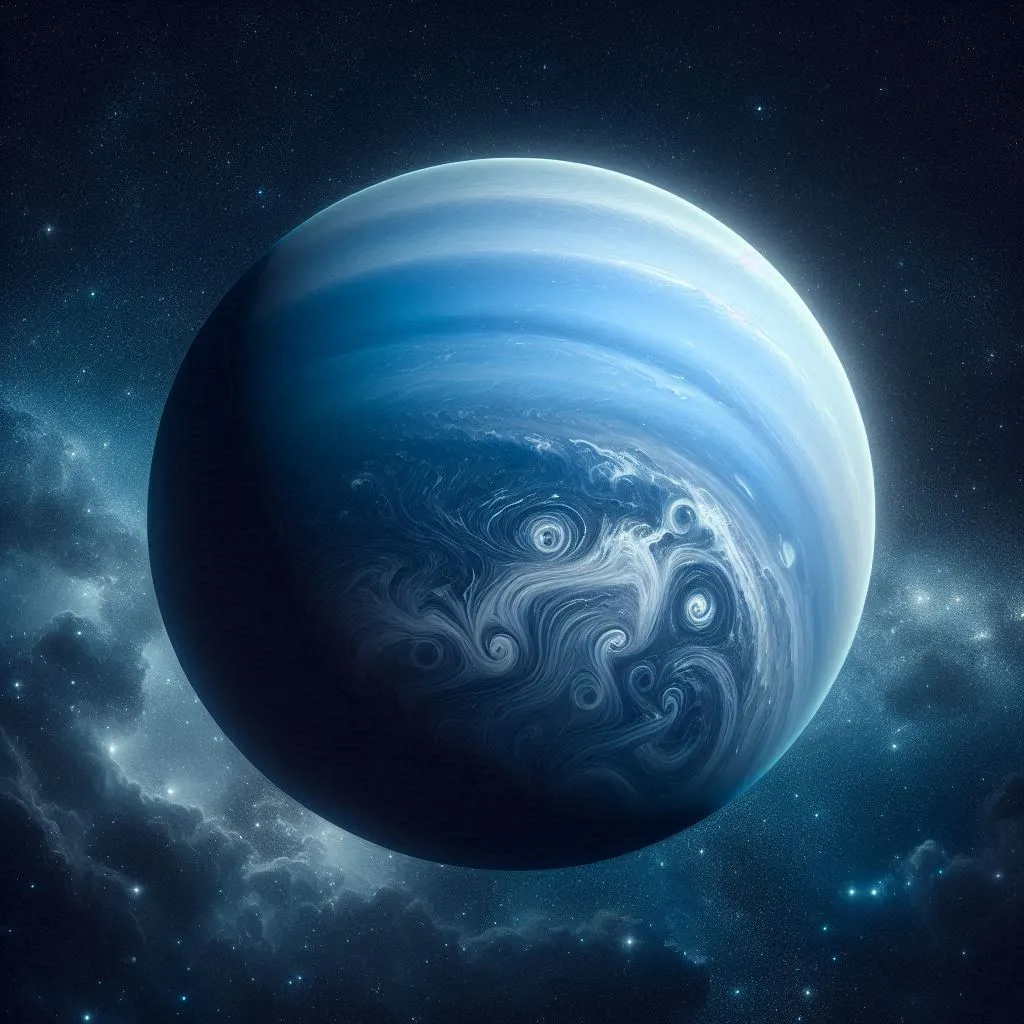
Neptune is the eighth and farthest planet from the Sun in our solar system, known for its stunning blue color and strong winds.
Learning interesting facts about Neptune helps us understand its atmosphere, moons, magnetic field, and extreme weather.
This guide provides key facts about Neptune, from its physical characteristics to its role in the solar system.
Facts About Neptune – Position in the Solar System
1. Eighth Planet: Neptune is the eighth planet from the Sun, making it the most distant recognized planet in the Solar System.
2. Outer Planet: It is classified as an outer gas giant, located beyond the asteroid belt and the orbit of Jupiter, Saturn, and Uranus.
3. Distance from the Sun: Neptune orbits the Sun at an average distance of approximately 4.5 billion kilometers (2.8 billion miles), equivalent to about 30.1 astronomical units (AU).
4. Orbital Period: Neptune completes one orbit around the Sun in roughly 164.8 Earth years, meaning one Neptune “year” is longer than a human lifetime.
5. Orbit Shape: Neptune’s orbit is slightly elliptical, but it remains relatively circular compared to many other planets and dwarf planets.
6. Orbital Speed: Neptune moves around the Sun at an average speed of about 5.43 km/s (19,500 km/h or 12,100 mph).
7. Neighboring Planets: Uranus lies inward from Neptune, while beyond Neptune are the scattered disk objects and the Kuiper Belt, home to Pluto and other dwarf planets.
8. Farther than Uranus: Neptune is the farthest planet from the Sun in the Solar System since Pluto’s reclassification as a dwarf planet in 2006.
9. Position Relative to Earth: When Neptune is at opposition, it is closest to Earth, approximately 4.3 billion kilometers (2.7 billion miles) away.
10. Retrograde Motion: Like other outer planets, Neptune sometimes appears to move backward in the night sky due to relative motion, known as retrograde motion.
11. Influence on Kuiper Belt: Neptune’s gravity affects the orbits of Kuiper Belt objects, creating resonances that shape the region’s structure.
12. Minimal Solar Influence: Being so far from the Sun, Neptune receives only 0.1% of the sunlight that Earth receives, contributing to its extremely cold environment.
13. Discovery Context: Neptune’s position was predicted mathematically due to perturbations in Uranus’s orbit before it was observed telescopically in 1846.
14. Inclination: Neptune’s orbital plane is slightly tilted relative to Earth’s orbital plane by about 1.77°, a minor tilt compared to some planets.
15. Rotation vs Orbit: Despite its distant, slow orbit, Neptune rotates rapidly on its axis, completing a rotation in just about 16 hours.
16. Orbital Resonances: Neptune’s gravity maintains orbital resonances with several dwarf planets, including Pluto, in a 3:2 resonance.
17. Position in Solar System Structure: Neptune marks the outer boundary of the traditional planetary region of the Solar System before transitioning to icy bodies and dwarf planets.
18. Influence on Comets: Neptune’s gravity can alter the paths of long-period comets entering the outer Solar System, sometimes redirecting them inward.
19. Observational Challenges: Due to its great distance and faint appearance, Neptune is not visible to the naked eye and requires telescopes for observation.
20. Scientific Significance: Neptune’s position and distance provide insight into the formation and dynamics of outer planets, the Kuiper Belt, and the edge of the Solar System.
Facts About Neptune – Size and Mass
1. Eighth Planet Size: Neptune is the fourth-largest planet in the Solar System by diameter, following Jupiter, Saturn, and Uranus.
2. Equatorial Diameter: Its equatorial diameter measures approximately 49,244 kilometers (30,598 miles), nearly four times the diameter of Earth.
3. Polar Diameter: Neptune’s polar diameter is slightly smaller at about 48,682 kilometers (30,222 miles) due to its slight oblateness caused by rotation.
4. Circumference: Its equatorial circumference is around 154,704 kilometers (96,180 miles), more than 12 times Earth’s circumference.
5. Surface Area: Neptune has a total surface area of about 7.6 × 10^9 km², making it over 60 times larger than Earth’s surface area.
6. Volume: Neptune’s volume is approximately 6.25 × 10^13 km³, large enough to contain about 57 Earths inside.
7. Mass: Neptune has a mass of roughly 1.024 × 10^26 kilograms, which is about 17 times the mass of Earth.
8. Density: Its average density is 1.638 g/cm³, slightly higher than Uranus, reflecting its composition of hydrogen, helium, water, and other ices.
9. Surface Gravity: Neptune’s gravity at the cloud tops is about 11.15 m/s², or 1.14 times Earth’s gravity.
10. Volume Comparison: Although smaller than Uranus in diameter, Neptune has a slightly higher density, giving it comparable mass and a stronger gravitational influence.
11. Rapid Rotation: Neptune completes one rotation in about 16 hours, contributing to its slightly flattened shape at the poles.
12. Core Mass Estimate: Neptune is believed to have a dense core of rock and metal, estimated at 1.2–1.5 times the mass of Earth, surrounded by icy and gaseous layers.
13. Atmosphere Contribution: Hydrogen, helium, methane, and other gases make up the outer layers, contributing to its total radius and apparent size.
14. Radius: The mean radius of Neptune is approximately 24,622 kilometers (15,299 miles), about 3.9 times Earth’s radius.
15. Comparison to Jupiter: Neptune is roughly 4 times smaller in diameter than Jupiter and only 5.15% of Jupiter’s mass.
16. Volume-to-Mass Ratio: Neptune’s lower density compared to Earth allows it to have enormous size without proportionally higher mass.
17. Influence on Moons: Its mass creates strong gravity capable of maintaining 14 known moons in stable orbits, including Triton.
18. Influence on Rings: Neptune’s gravitational field stabilizes its faint ring system and shepherds ring particles into defined arcs.
19. Solar System Significance: Neptune’s size and mass make it the smallest of the “ice giants,” yet it significantly influences nearby dwarf planets and Kuiper Belt objects.
20. Observation Implications: Knowing Neptune’s size and mass helps scientists calculate its density, internal structure, gravitational field, and orbital effects on other bodies.
Facts About Neptune – Atmosphere and Weather
1. Eighth Planet Size: Neptune is the fourth-largest planet in the Solar System by diameter, following Jupiter, Saturn, and Uranus.
2. Equatorial Diameter: Its equatorial diameter measures approximately 49,244 kilometers (30,598 miles), nearly four times the diameter of Earth.
3. Polar Diameter: Neptune’s polar diameter is slightly smaller at about 48,682 kilometers (30,222 miles) due to its slight oblateness caused by rotation.
4. Circumference: Its equatorial circumference is around 154,704 kilometers (96,180 miles), more than 12 times Earth’s circumference.
5. Surface Area: Neptune has a total surface area of about 7.6 × 10^9 km², making it over 60 times larger than Earth’s surface area.
6. Volume: Neptune’s volume is approximately 6.25 × 10^13 km³, large enough to contain about 57 Earths inside.
7. Mass: Neptune has a mass of roughly 1.024 × 10^26 kilograms, which is about 17 times the mass of Earth.
8. Density: Its average density is 1.638 g/cm³, slightly higher than Uranus, reflecting its composition of hydrogen, helium, water, and other ices.
9. Surface Gravity: Neptune’s gravity at the cloud tops is about 11.15 m/s², or 1.14 times Earth’s gravity.
10. Volume Comparison: Although smaller than Uranus in diameter, Neptune has a slightly higher density, giving it comparable mass and a stronger gravitational influence.
11. Rapid Rotation: Neptune completes one rotation in about 16 hours, contributing to its slightly flattened shape at the poles.
12. Core Mass Estimate: Neptune is believed to have a dense core of rock and metal, estimated at 1.2–1.5 times the mass of Earth, surrounded by icy and gaseous layers.
13. Atmosphere Contribution: Hydrogen, helium, methane, and other gases make up the outer layers, contributing to its total radius and apparent size.
14. Radius: The mean radius of Neptune is approximately 24,622 kilometers (15,299 miles), about 3.9 times Earth’s radius.
15. Comparison to Jupiter: Neptune is roughly 4 times smaller in diameter than Jupiter and only 5.15% of Jupiter’s mass.
16. Volume-to-Mass Ratio: Neptune’s lower density compared to Earth allows it to have enormous size without proportionally higher mass.
17. Influence on Moons: Its mass creates strong gravity capable of maintaining 14 known moons in stable orbits, including Triton.
18. Influence on Rings: Neptune’s gravitational field stabilizes its faint ring system and shepherds ring particles into defined arcs.
19. Solar System Significance: Neptune’s size and mass make it the smallest of the “ice giants,” yet it significantly influences nearby dwarf planets and Kuiper Belt objects.
20. Observation Implications: Knowing Neptune’s size and mass helps scientists calculate its density, internal structure, gravitational field, and orbital effects on other bodies.
Facts About Neptune – Moons and Rings
1. Total Moons: Neptune has 14 known moons, with the largest and most famous being Triton, discovered in 1846 by William Lassell.
2. Triton: Triton is the only large moon in the Solar System that orbits its planet in a retrograde direction, meaning opposite to Neptune’s rotation.
3. Moon Size Range: Neptune’s moons vary dramatically in size, from Triton at 2,710 km in diameter to tiny inner moons like Hippocamp at only about 34 km.
4. Inner Moons: Neptune has six inner moons, including Naiad, Thalassa, Despina, Galatea, Larissa, and Proteus, which orbit close to the planet within 100,000 km.
5. Outer Moons: The remaining moons, including Nereid, Halimede, Psamathe, and others, orbit at much greater distances and often have irregular shapes and inclined orbits.
6. Triton’s Surface: Triton has a frozen, icy surface with geysers of nitrogen gas, making it geologically active despite its extreme distance from the Sun.
7. Retrograde Capture: Triton is believed to be a captured Kuiper Belt object, explaining its unusual retrograde orbit and geologic activity.
8. Small Moon Composition: Most of Neptune’s smaller moons are composed of rock and ice, with irregular, cratered surfaces indicating ancient impacts.
9. Rings Discovery: Neptune has a faint system of five known rings, discovered through stellar occultation and confirmed by Voyager 2 in 1989.
10. Ring Names: The rings are named Galle, Le Verrier, Lassell, Arago, and Adams, honoring astronomers connected to Neptune’s discovery and study.
11. Ring Structure: Neptune’s rings are narrow, dark, and incomplete, with bright arcs within the Adams ring, which are regions of higher particle density.
12. Ring Composition: The rings are primarily made of dust and small ice particles mixed with dark, likely carbon-rich material.
13. Shepherd Moons: Some rings are stabilized by nearby moons, called shepherd moons, whose gravity keeps the ring particles confined.
14. Orbital Periods: Neptune’s inner moons complete an orbit in hours to a few days, while outer irregular moons can take several years to complete one orbit.
15. Tidal Interactions: Neptune’s moons experience tidal forces that can heat their interiors slightly and influence surface features, especially on Triton.
16. Irregular Orbits: Many of the outer moons have highly eccentric and inclined orbits, suggesting they were captured objects rather than formed in place.
17. Ring Lifespan: Neptune’s rings are relatively young and may be replenished or reshaped by impacts on small moons, collisions, and gravitational interactions.
18. Ring Visibility: Due to their dark material and faintness, Neptune’s rings are difficult to observe from Earth without advanced telescopes.
19. Scientific Interest: Studying Neptune’s moons and rings helps scientists understand planetary formation, moon capture processes, and ring dynamics in the outer Solar System.
20. Voyager 2 Legacy: Most detailed knowledge of Neptune’s moons and rings comes from Voyager 2, which flew by in 1989, revealing complex interactions and features still studied today.
Facts About Neptune – Magnetic Field and Gravity
1. Total Moons: Neptune has 14 known moons, with the largest and most famous being Triton, discovered in 1846 by William Lassell.
2. Triton: Triton is the only large moon in the Solar System that orbits its planet in a retrograde direction, meaning opposite to Neptune’s rotation.
3. Moon Size Range: Neptune’s moons vary dramatically in size, from Triton at 2,710 km in diameter to tiny inner moons like Hippocamp at only about 34 km.
4. Inner Moons: Neptune has six inner moons, including Naiad, Thalassa, Despina, Galatea, Larissa, and Proteus, which orbit close to the planet within 100,000 km.
5. Outer Moons: The remaining moons, including Nereid, Halimede, Psamathe, and others, orbit at much greater distances and often have irregular shapes and inclined orbits.
6. Triton’s Surface: Triton has a frozen, icy surface with geysers of nitrogen gas, making it geologically active despite its extreme distance from the Sun.
7. Retrograde Capture: Triton is believed to be a captured Kuiper Belt object, explaining its unusual retrograde orbit and geologic activity.
8. Small Moon Composition: Most of Neptune’s smaller moons are composed of rock and ice, with irregular, cratered surfaces indicating ancient impacts.
9. Rings Discovery: Neptune has a faint system of five known rings, discovered through stellar occultation and confirmed by Voyager 2 in 1989.
10. Ring Names: The rings are named Galle, Le Verrier, Lassell, Arago, and Adams, honoring astronomers connected to Neptune’s discovery and study.
11. Ring Structure: Neptune’s rings are narrow, dark, and incomplete, with bright arcs within the Adams ring, which are regions of higher particle density.
12. Ring Composition: The rings are primarily made of dust and small ice particles mixed with dark, likely carbon-rich material.
13. Shepherd Moons: Some rings are stabilized by nearby moons, called shepherd moons, whose gravity keeps the ring particles confined.
14. Orbital Periods: Neptune’s inner moons complete an orbit in hours to a few days, while outer irregular moons can take several years to complete one orbit.
15. Tidal Interactions: Neptune’s moons experience tidal forces that can heat their interiors slightly and influence surface features, especially on Triton.
16. Irregular Orbits: Many of the outer moons have highly eccentric and inclined orbits, suggesting they were captured objects rather than formed in place.
17. Ring Lifespan: Neptune’s rings are relatively young and may be replenished or reshaped by impacts on small moons, collisions, and gravitational interactions.
18. Ring Visibility: Due to their dark material and faintness, Neptune’s rings are difficult to observe from Earth without advanced telescopes.
19. Scientific Interest: Studying Neptune’s moons and rings helps scientists understand planetary formation, moon capture processes, and ring dynamics in the outer Solar System.
20. Voyager 2 Legacy: Most detailed knowledge of Neptune’s moons and rings comes from Voyager 2, which flew by in 1989, revealing complex interactions and features still studied today.
Facts About Neptune – Exploration and Space Missions
1. First Observation: Neptune was discovered in 1846 by Johann Galle and Heinrich d’Arrest, based on mathematical predictions rather than direct observation.
2. Ground-Based Studies: Early knowledge of Neptune came from telescopic observations from Earth, focusing on its orbit, brightness, and approximate size.
3. Voyager 2 Flyby: The only spacecraft to visit Neptune was Voyager 2, which flew by on August 25, 1989, providing the first close-up images and data.
4. Neptune Imaging: Voyager 2 captured detailed images of Neptune’s atmosphere, revealing dark spots, storms, and rapidly moving clouds.
5. Moon Discovery: Voyager 2 discovered six new moons during its flyby, including Proteus, Larissa, and others, expanding the known moon count.
6. Ring Confirmation: The spacecraft confirmed the existence of Neptune’s faint rings and discovered the bright arcs in the Adams ring.
7. Triton Study: Voyager 2 provided detailed observations of Triton, including its retrograde orbit, icy surface, and nitrogen geysers.
8. Atmospheric Data: Instruments on Voyager 2 measured Neptune’s wind speeds, which reached up to 2,100 km/h (1,300 mph), the fastest in the Solar System.
9. Magnetic Field Analysis: Voyager 2 studied Neptune’s strong, tilted magnetic field, revealing complex interactions with its moons and solar wind.
10. Temperature Measurements: The spacecraft recorded extremely low temperatures in Neptune’s upper atmosphere, averaging around –214°C (–353°F).
11. No Subsequent Flybys: Since Voyager 2, no spacecraft has visited Neptune directly, making it the least explored of the major planets.
12. Hubble Observations: The Hubble Space Telescope has provided high-resolution images and monitoring of Neptune’s weather systems from Earth orbit.
13. Infrared Observations: Space telescopes like Spitzer and ground-based observatories have studied Neptune’s heat emissions and atmospheric composition in infrared light.
14. Planned Missions: Several mission concepts have been proposed, including orbiters and probes to study Neptune and Triton in greater detail, but none are currently funded.
15. Challenges of Distance: Neptune’s extreme distance from Earth, about 4.5 billion km, makes missions expensive and long, with round-trip communications taking about 8 hours.
16. Orbital Mapping: Voyager 2 mapped Neptune’s gravity field and orbital characteristics, helping scientists understand its internal structure.
17. Ring and Moon Dynamics: Observations from Voyager 2 allowed scientists to study interactions between Neptune’s rings and shepherd moons.
18. Legacy Data: The data from Voyager 2 continues to be analyzed today, providing insights into ice giants and serving as a benchmark for future missions.
19. Triton Atmosphere: Voyager 2 discovered a thin atmosphere around Triton, primarily nitrogen with trace methane, one of the few moons in the Solar System with an atmosphere.
20. Future Exploration Importance: Exploring Neptune is key to understanding ice giants, planetary formation, magnetic field dynamics, and extreme weather systems beyond the inner Solar System.
Facts About Neptune – Unique Features and Trivia
1. First Observation: Neptune was discovered in 1846 by Johann Galle and Heinrich d’Arrest, based on mathematical predictions rather than direct observation.
2. Ground-Based Studies: Early knowledge of Neptune came from telescopic observations from Earth, focusing on its orbit, brightness, and approximate size.
3. Voyager 2 Flyby: The only spacecraft to visit Neptune was Voyager 2, which flew by on August 25, 1989, providing the first close-up images and data.
4. Neptune Imaging: Voyager 2 captured detailed images of Neptune’s atmosphere, revealing dark spots, storms, and rapidly moving clouds.
5. Moon Discovery: Voyager 2 discovered six new moons during its flyby, including Proteus, Larissa, and others, expanding the known moon count.
6. Ring Confirmation: The spacecraft confirmed the existence of Neptune’s faint rings and discovered the bright arcs in the Adams ring.
7. Triton Study: Voyager 2 provided detailed observations of Triton, including its retrograde orbit, icy surface, and nitrogen geysers.
8. Atmospheric Data: Instruments on Voyager 2 measured Neptune’s wind speeds, which reached up to 2,100 km/h (1,300 mph), the fastest in the Solar System.
9. Magnetic Field Analysis: Voyager 2 studied Neptune’s strong, tilted magnetic field, revealing complex interactions with its moons and solar wind.
10. Temperature Measurements: The spacecraft recorded extremely low temperatures in Neptune’s upper atmosphere, averaging around –214°C (–353°F).
11. No Subsequent Flybys: Since Voyager 2, no spacecraft has visited Neptune directly, making it the least explored of the major planets.
12. Hubble Observations: The Hubble Space Telescope has provided high-resolution images and monitoring of Neptune’s weather systems from Earth orbit.
13. Infrared Observations: Space telescopes like Spitzer and ground-based observatories have studied Neptune’s heat emissions and atmospheric composition in infrared light.
14. Planned Missions: Several mission concepts have been proposed, including orbiters and probes to study Neptune and Triton in greater detail, but none are currently funded.
15. Challenges of Distance: Neptune’s extreme distance from Earth, about 4.5 billion km, makes missions expensive and long, with round-trip communications taking about 8 hours.
16. Orbital Mapping: Voyager 2 mapped Neptune’s gravity field and orbital characteristics, helping scientists understand its internal structure.
17. Ring and Moon Dynamics: Observations from Voyager 2 allowed scientists to study interactions between Neptune’s rings and shepherd moons.
18. Legacy Data: The data from Voyager 2 continues to be analyzed today, providing insights into ice giants and serving as a benchmark for future missions.
19. Triton Atmosphere: Voyager 2 discovered a thin atmosphere around Triton, primarily nitrogen with trace methane, one of the few moons in the Solar System with an atmosphere.
20. Future Exploration Importance: Exploring Neptune is key to understanding ice giants, planetary formation, magnetic field dynamics, and extreme weather systems beyond the inner Solar System.
Final Thoughts
Neptune is a fascinating and mysterious planet, full of extreme weather, unique moons, and striking features.
Understanding these facts about Neptune gives insight into the outer reaches of our solar system and highlights why scientists continue to study it. Neptune’s beauty and mysteries make it one of the most intriguing planets to explore.