
Looking for fun and educational cherry blossom quiz questions and answers? You’ve come to the right place! Cherry blossoms, also known as sakura, are admired worldwide for their breathtaking beauty and cultural significance, especially in countries like Japan.
Whether you’re a teacher planning a classroom activity, a trivia lover testing your knowledge, or simply curious about these stunning pink blooms, this cherry blossom quiz will challenge and entertain you.
From fascinating facts about cherry blossom festivals to the symbolism behind sakura trees, explore exciting cherry blossom trivia questions and answers designed for kids, students, and adults alike.
Get ready to test your knowledge and learn something new about one of nature’s most beautiful seasonal wonders!
Cherry Blossom Quiz Questions And Answers In English
1. In which country are cherry blossoms nationally celebrated as “sakura”?
a) China
b) South Korea
c) Japan
d) United States
Answer: c
Explanation: Japan celebrates hanami (cherry blossom viewing), a tradition dating back over 1,000 years.
2. What is the Japanese word for cherry blossom viewing festival?
a) Hanami
b) Matsuri
c) Ohanami
d) Sakurafest
Answer: a
Explanation: Hanami literally means “flower viewing” and occurs mainly in late March to early April.
3. What is the most famous variety of cherry blossom in Japan?
a) Yoshino
b) Fuji
c) Somei Yoshino
d) Yamazakura
Answer: c
Explanation: Somei Yoshino is the most common cultivar, covering about 80% of sakura trees in Japan.
4. Approximately how long do cherry blossoms typically bloom?
a) 1-2 weeks
b) 3-4 weeks
c) 6-8 weeks
d) 2-3 months
Answer: a
Explanation: Full bloom lasts just 7-10 days before petals scatter, creating the famous sakura fubuki (blossom storm).
5. In which U.S. city is the famous National Cherry Blossom Festival held?
a) New York
b) San Francisco
c) Washington, D.C.
d) Seattle
Answer: c
Explanation: Started in 1912, it celebrates 3,000 Yoshino trees gifted by Japan to mark U.S.-Japan friendship.
6. When was Japan’s first recorded cherry blossom festival?
a) 710 AD
b) 812 AD
c) 1000 AD
d) 1200 AD
Answer: a
Explanation: Emperor Saga held the first hanami banquet in 812 AD in Kyoto’s Heian period.
7. What do cherry blossoms symbolize in Japanese culture?
a) Long life
b) Eternal love
c) Transience of life
d) Good fortune
Answer: c
Explanation: The brief bloom represents mono no aware – beauty in impermanence and fleeting nature of life.
8. Which Japanese city has the most cherry trees (about 1,400)?
a) Kyoto
b) Tokyo
c) Nara
d) Osaka
Answer: a
Explanation: Kyoto features Philosopher’s Path and Maruyama Park with spectacular sakura displays.
9. What is the scientific name for cherry blossoms?
a) Sakura japonica
b) Prunus serrulata
c) Malus domestica
d) Prunus avium
Answer: b
Explanation: Prunus serrulata refers to the ornamental Japanese flowering cherry species.
10. In what month do cherry blossoms typically peak in Tokyo?
a) March
b) Late March to early April
c) May
d) April only
Answer: b
Explanation: Peak bloom (mankai) usually occurs around March 25-April 5, tracked by sakura forecasts.
11. How many cherry trees line Washington’s Tidal Basin?
a) 300
b) 1,200
c) 3,000+
d) 5,000
Answer: c
Explanation: Over 3,700 trees, mostly Yoshino, surround the Tidal Basin and Potomac River.
12. What gift prompted America’s cherry blossom tradition?
a) 1912 gift of 3,020 trees from Japan
b) Post-WWII gift
c) 1980s donation
d) 1900 gift
Answer: a
Explanation: Japan sent 3,020 trees in 1912; first two shipments had pests, so 1912 trees survived.
13. Which Korean city holds a major cherry blossom festival?
a) Seoul (Yeouido)
b) Busan
c) Jeju Island
d) Gyeongju
Answer: a
Explanation: Yeouido Spring Flower Festival features 1,400+ trees along Yeouido Park and Han River.
14. What is sakura fubuki?
a) Cherry blossom rain
b) Flower dance
c) Tree planting
d) Petal storm
Answer: a
Explanation: Sakura fubuki describes petals falling like snow, creating a magical pink carpet effect.
15. How old can sakura trees live?
a) 30-50 years
b) 100 years
c) Up to 1,000 years
d) 10-20 years
Answer: c
Explanation: Somei Yoshino trees live about 100 years, but wild varieties can reach 1,000 years.
16. Which castle in Japan is famous for its sakura moat?
a) Himeji Castle
b) Osaka Castle
c) Hiroshima Castle
d) Nagoya Castle
Answer: b
Explanation: Osaka Castle’s moat reflects 500+ cherry trees, creating stunning “floating” sakura photos.
17. What is the Japanese forecast called that predicts bloom times?
a) Sakura zensen
b) Hanami map
c) Bloom watch
d) Flower line
Answer: a
Explanation: Sakura zensen (cherry blossom front) tracks the bloom wave from south to north Japan.
18. How many varieties of sakura exist in Japan?
a) 100
b) 300+
c) 168
d) 50
Answer: b
Explanation: Over 300 cultivars exist, from single petal to double-flowered and weeping varieties.
19. Which month celebrates cherry blossoms in Vancouver’s famous park?
a) March
b) April
c) May
d) June
Answer: b
Explanation: Vancouver’s Cherry Blossom Festival features 40,000 trees, mostly in April bloom.
20. What do Japanese students traditionally do under sakura trees?
a) Study
b) Party and drink
c) Meditate
d) Dance
Answer: b
Explanation: Sakura matsuri includes picnics, drinking, and hanami parties under blooming trees.
Funny Cherry Blossom Quiz Questions And Answers
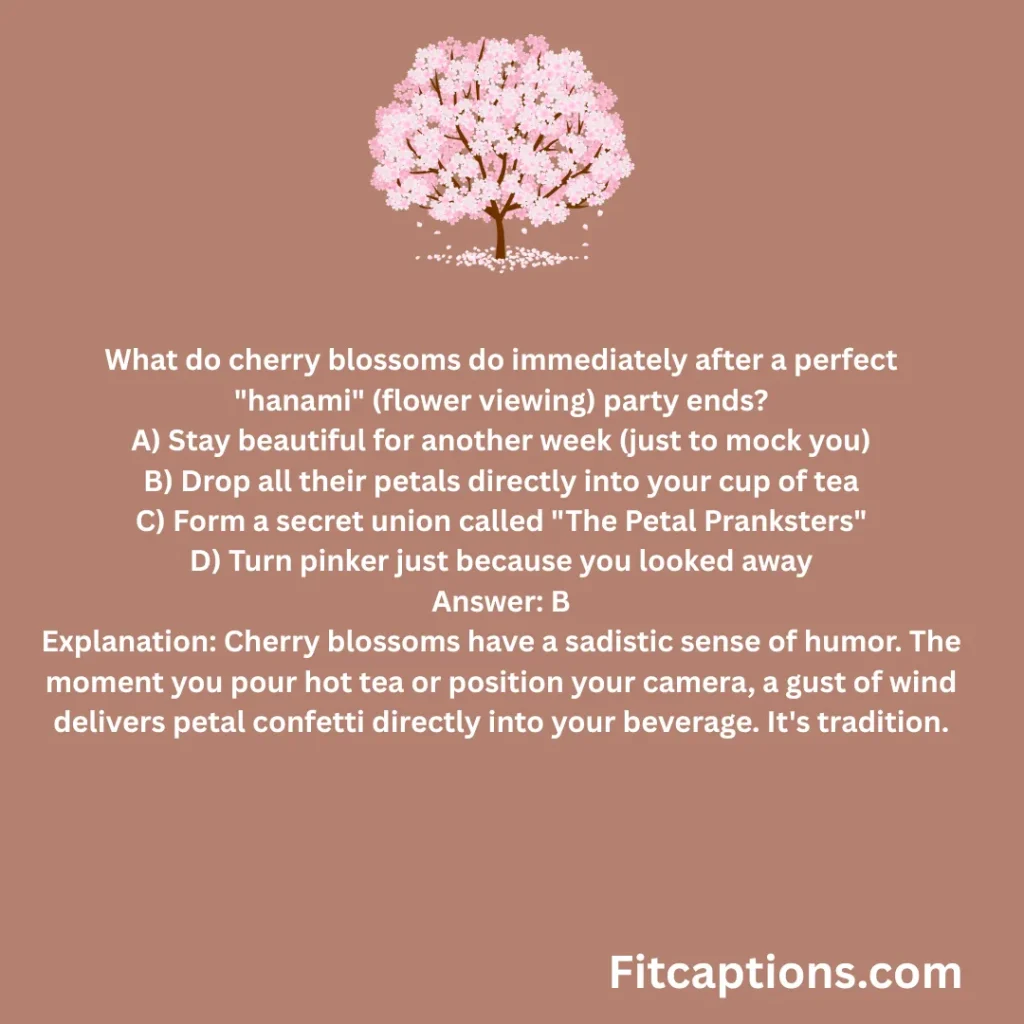
1. What do cherry blossoms do immediately after a perfect “hanami” (flower viewing) party ends?
A) Stay beautiful for another week (just to mock you)
B) Drop all their petals directly into your cup of tea
C) Form a secret union called “The Petal Pranksters”
D) Turn pinker just because you looked away
Answer: B
Explanation: Cherry blossoms have a sadistic sense of humor. The moment you pour hot tea or position your camera, a gust of wind delivers petal confetti directly into your beverage. It’s tradition.
2. Why do Japanese cherry blossoms bloom for only about one week?
A) They have union rules about overtime
B) They’re dramatic introverts who hate crowds
C) Godzilla sneezes every April
D) Their contract with spring is “one week, no extensions”
Answer: D
Explanation: Sakura are the freelancers of the flower world. They show up, look stunning for exactly seven days, then ghost you until next year. No voicemails, no second chances.
3. What is the official snack of cherry blossom viewing parties?
A) Dandelion sandwiches
B) Sakura mochi (pink rice cake wrapped in a pickled cherry leaf)
C) Anything that turns your tongue pink
D) Whatever falls off the tree first
Answer: B
Explanation: Sakura mochi is traditional. But the real snack is desperation: tourists fighting over the last convenience store bento box while petals fall on their heads like nature’s timer.
4. What happens to your brain when you stare at cherry blossoms for too long?
A) You develop a sudden urge to buy expensive camera lenses
B) You start speaking only in haiku
C) You forget how to fold a map
D) You become convinced the petals are whispering your name
Answer: A
Explanation: Cherry blossoms are secretly sponsored by camera companies. You’ll arrive with a phone. By day three, you’re researching $3,000 lenses and arguing about aperture settings with strangers.
5. If a cherry blossom petal falls into your sake, what is the proper etiquette?
A) Remove it immediately and apologize to the tree
B) Drink it and say “extra flavor”
C) Blame your friend for blowing it there
D) Pour the sake back into the bottle to “recycle” the petal
Answer: B
Explanation: Etiquette says you drink it. The petal adds a subtle “dirt and regret” flavor. It’s considered good luck. Or bad luck. No one remembers, but everyone drinks it anyway to avoid waste.
6. Why do Japanese weather forecasts include “cherry blossom front” predictions?
A) To help farmers plan their rice planting
B) To create nationwide anxiety about missing a one-week flower event
C) Because the government has a flower budget
D) So TV anchors can wear pink ties
Answer: B
Explanation: The sakura forecast is the most stressful weather report of the year. Millions of日本人 check it hourly, panic-booking flights and canceling plans over a three-day shift in predicted bloom. It’s meteorological performance art.
7. Which of these is NOT a real cherry blossom variety?
A) Somei-Yoshino (the classic pale pink)
B) Shidare-zakura (weeping cherry)
C) Donald Trump-yama Zakura (blooms orange and never stops talking)
D) Kanzan (double-flowered hot pink)
Answer: C
Explanation: There is no Trump cherry tree. But wouldn’t it be funny? It would probably bloom late, claim it bloomed bigger than any other tree, and demand a recount of the petals.
8. What do cherry blossoms do at night when no one is watching?
A) Practice synchronized falling for the morning
B) Have secret meetings with maple trees to plan autumn
C) Glow faintly to confuse drunk hanami partiers
D) All of the above
Answer: D
Explanation: Night-blooming sakura (yozakura) are lit by paper lanterns, which is how they hypnotize humans into staying until 2 AM eating cold bento. The maple meetings are unconfirmed but suspected.
9. A “hanami” party without alcohol is called?
A) A picnic
B) A nature appreciation session
C) A work retreat
D) A sad gathering of people who forgot their flasks
Answer: D
Explanation: Hanami translates to “flower viewing,” but everyone knows it means “day drinking under pink clouds.” Show up without sake and you’ll be handed a cup faster than a petal falls.
10. Why do cherry blossom petals sometimes fall in slow motion?
A) Physics is showing off
B) The tree is being dramatic for Instagram
C) They’re stalling because they know you have to work tomorrow
D) Time actually slows down near beauty (Einstein said this)
Answer: C
Explanation: Sakura petals are passive-aggressive. They fall slowly on Sunday evening right as you realize work starts in 8 hours. They want you to suffer. It’s working.
11. Foreign tourists often make the mistake of trying to…
A) Bring home a cherry blossom branch (illegal and cursed)
B) Shake the tree for a “perfect photo” (immediately banned from Japan)
C) Eat a raw petal expecting flavor (tastes like nothing, disappointment ensues)
D) All of the above, plus attempting to hug the tree
Answer: D
Explanation: Every year, a tourist pulls a branch for a selfie. Every year, an elderly Japanese man appears from nowhere to scold them. The petals don’t forgive. The tree remembers.
12. What is the cherry blossom’s opinion of windy days?
A) “Finally, I can show off my drifting skills.”
B) “Time to ruin every outdoor lunch within a mile.”
C) “Let’s pretend we’re snow. They’ll love that.”
D) All of the above, plus “Watch this.”
Answer: D
*Explanation: Sakura on a windy day are absolute chaos agents. They form pink tornadoes, blind cyclists, and somehow land inside your car even with the windows up. They call it “performance art.”
13. If a cherry blossom tree could talk, what would it say to the person camping under it for 12 hours?
A) “You brought a tarp? Really?”
B) “I’ve seen you take 400 photos. Touch grass. I mean, touch me. Actually, don’t touch me.”
C) “The bathroom is over there, please go.”
D) All of the above, plus “You missed a petal on your shoulder. Yes, that one. Still there.”
Answer: D
Explanation: Cherry trees are passive-aggressive commentators. They judge your snacks, your camera angles, and your life choices. But they’ll still let you nap under them – out of pity.
14. What do you call the pink snow-like piles of fallen cherry petals on the ground?
A) Sakura fubuki (cherry blossom blizzard aftermath)
B) Nature’s pink carpet that stains your white shoes instantly
C) The reason your vacuum is crying
D) All of the above
Answer: D
Explanation: Fallen petals look romantic. Then you step in a pile and your white sneakers become “rose-tinted” forever. The vacuum is in therapy.
15. Why do some Japanese offices hold “night hanami” meetings under lit cherry trees?
A) To discuss quarterly reports in a “relaxing” environment
B) Because drinking under pink light makes bad news sound better
C) The boss thinks it’s “team building” (it’s just drinking)
D) All of the above, plus the trees don’t judge PowerPoints
Answer: D
Explanation: Japanese work culture + cherry blossoms = drunk salarymen singing karaoke under pink lanterns. The trees have heard more apologies for missed deadlines than any HR department.
16. What is the cherry blossom’s biggest rival in Japanese culture?
A) The maple leaf (too showy in autumn)
B) The bamboo (too tall and skinny)
C) The plum blossom (blooms earlier, smells better, less drama)
D) The office water cooler (nobody gathers around it with beer)
Answer: C
Explanation: Ume (plum) blossoms bloom in February, smell amazing, and last longer. Sakura are the popular mean girls who show up, steal all attention for one week, then leave a mess. Plums are quietly superior.
17. What happens to your social media feed during cherry blossom season?
A) It becomes 90% pink photos with captions like “sakura season is healing”
B) Everyone suddenly becomes a haiku poet
C) Your non-Japan friends unfollow you out of jealousy
D) All of the above, plus at least one “live, laugh, bloom” meme
Answer: D
Explanation: Cherry blossoms turn normal people into insufferable influencers. Expect close-ups of petals in sunlight, blurry backgrounds, and the same Monet quote 47 times. Mute button recommended.
18. A cherry blossom tree planted in your yard will…
A) Attract every tourist within a 5-mile radius
B) Drop petals into your pool filter until it explodes
C) Mock your grass maintenance skills
D) All of the above, and then die a week after you fall in love with it
Answer: D
Explanation: Owning a sakura tree is a relationship with a flaky artist. It’s gorgeous, then it ghosts you. The pool filter will never recover. The neighbors will never leave.
19. Which of these is a real cherry blossom-themed product in Japan?
A) Sakura-flavored KitKats (tastes like soap, but pretty soap)
B) Sakura Coke (pink sugar water that stains teeth)
C) Sakura Pepsi (it existed. It was weird)
D) All of the above, plus sakura toothpaste (so your breath matches the trees)
Answer: D
Explanation: Japan will put sakura flavor into anything. It tastes faintly of flowers, salt, and disappointment. But it’s pink, so you buy it. The KitKat is the least offensive option.
20. What is the cherry blossom’s final message to humans as the last petals fall?
A) “See you next year, suckers.”
B) “You took me for granted. Again.”
C) “Go buy a broom. I made a mess.”
D) All of the above, delivered via a gust of wind to your eye.
Answer: D
Explanation: The final day of sakura season is nature’s mic drop. A sudden breeze blows petals into your face, your coffee, and your hair. The trees laugh. Then they go silent for 51 weeks. See you in April.
Short Cherry Blossom Quiz Questions And Answers
1. What country is most famous for cherry blossoms?
A) China
B) Japan
C) Korea
D) Thailand
Answer: B) Japan
Explanation: Japan is world-renowned for its cherry blossom festivals, called Hanami.
2. What is the Japanese word for cherry blossom?
A) Sakura
B) Hanami
C) Bonsai
D) Fuji
Answer: A) Sakura
Explanation: “Sakura” refers to cherry blossoms, while “Hanami” means flower viewing.
3. When do cherry blossoms typically bloom in Japan?
A) January
B) March–April
C) June
D) September
Answer: B) March–April
Explanation: Blossoms usually peak in spring, depending on the region.
4. What does “Hanami” mean?
A) Flower viewing
B) Spring festival
C) Tree planting
D) Mountain climbing
Answer: A) Flower viewing
Explanation: Hanami is the tradition of enjoying cherry blossoms with picnics.
5. Which U.S. city is famous for cherry blossoms?
A) New York
B) Washington, D.C.
C) Los Angeles
D) Chicago
Answer: B) Washington, D.C.
Explanation: Japan gifted cherry trees to Washington, D.C. in 1912.
6. What do cherry blossoms symbolize in Japanese culture?
A) Wealth
B) Beauty and impermanence
C) Power
D) Eternity
Answer: B) Beauty and impermanence
Explanation: They represent the fleeting nature of life.
7. Which Japanese city is especially famous for cherry blossoms?
A) Tokyo
B) Kyoto
C) Osaka
D) Nagoya
Answer: B) Kyoto
Explanation: Kyoto’s temples and gardens are iconic cherry blossom spots.
8. What color are most cherry blossoms?
A) Blue
B) Pink and white
C) Yellow
D) Red
Answer: B) Pink and white
Explanation: They range from pale pink to bright white.
9. How long do cherry blossoms usually last once they bloom?
A) 1–2 days
B) 1–2 weeks
C) 1 month
D) All summer
Answer: B) 1–2 weeks
Explanation: Their short blooming period adds to their symbolism of impermanence.
10. What type of tree produces cherry blossoms?
A) Maple
B) Cherry
C) Plum
D) Peach
Answer: B) Cherry
Explanation: Cherry trees produce the blossoms, though not all varieties bear fruit.
11. Which Japanese island sees the earliest cherry blossoms?
A) Hokkaido
B) Honshu
C) Kyushu
D) Shikoku
Answer: C) Kyushu
Explanation: Warmer southern regions bloom earlier than the north.
12. Which Japanese island sees the latest cherry blossoms?
A) Hokkaido
B) Honshu
C) Kyushu
D) Okinawa
Answer: A) Hokkaido
Explanation: Northern Hokkaido blooms last, often in May.
13. What year did Japan gift cherry trees to Washington, D.C.?
A) 1900
B) 1912
C) 1925
D) 1945
Answer: B) 1912
Explanation: The gift symbolized friendship between Japan and the U.S.
14. What is the scientific name for cherry blossom trees?
A) Prunus serrulata
B) Prunus domestica
C) Prunus avium
D) Prunus persica
Answer: A) Prunus serrulata
Explanation: This species is commonly known as Japanese cherry.
15. What traditional Japanese food is often enjoyed during Hanami?
A) Sushi
B) Sakura mochi
C) Tempura
D) Ramen
Answer: B) Sakura mochi
Explanation: Sakura mochi is a pink rice cake wrapped in a cherry leaf.
16. Which Japanese castle is famous for cherry blossoms?
A) Osaka Castle
B) Himeji Castle
C) Nagoya Castle
D) Matsumoto Castle
Answer: B) Himeji Castle
Explanation: Himeji Castle is surrounded by hundreds of cherry trees.
17. What do falling cherry blossoms symbolize?
A) Eternal life
B) The fleeting nature of existence
C) Wealth
D) Victory
Answer: B) The fleeting nature of existence
Explanation: Their short life reflects Buddhist themes of impermanence.
18. Which Japanese mountain is often pictured with cherry blossoms?
A) Mount Fuji
B) Mount Hiei
C) Mount Tate
D) Mount Ontake
Answer: A) Mount Fuji
Explanation: Mount Fuji with cherry blossoms is an iconic image of Japan.
19. Which Japanese city hosts the largest cherry blossom festival?
A) Tokyo
B) Kyoto
C) Osaka
D) Hirosaki
Answer: D) Hirosaki
Explanation: Hirosaki Castle Park has thousands of cherry trees.
20. What is the cultural meaning of cherry blossoms in samurai tradition?
A) Eternal strength
B) Honor and the shortness of life
C) Wealth and prosperity
D) Peace and harmony
Answer: B) Honor and the shortness of life
Explanation: Samurai saw blossoms as a metaphor for life’s fragility.
Related: 141+ 2000s Trivia Questions And Answers
Cherry Blossom Quiz Questions And Answers For Adults
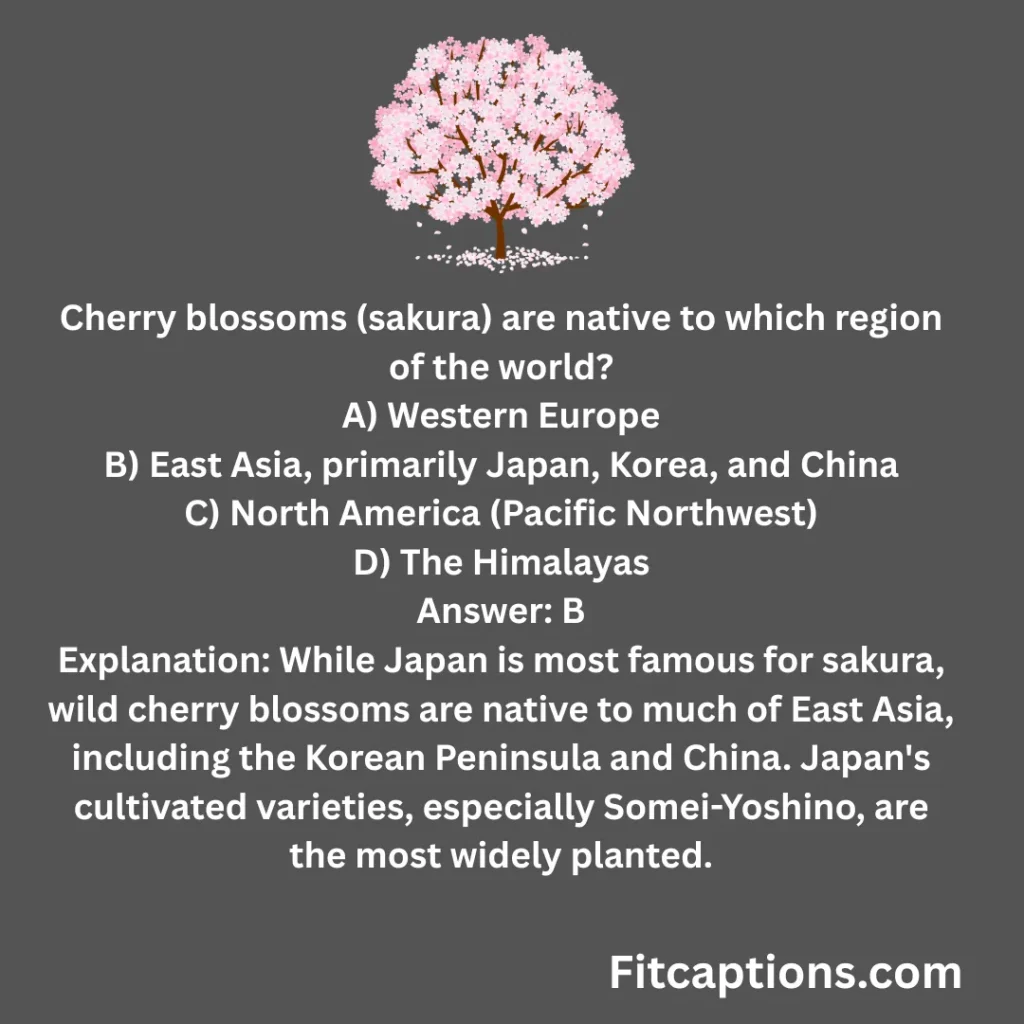
1. Cherry blossoms (sakura) are native to which region of the world?
A) Western Europe
B) East Asia, primarily Japan, Korea, and China
C) North America (Pacific Northwest)
D) The Himalayas
Answer: B
Explanation: While Japan is most famous for sakura, wild cherry blossoms are native to much of East Asia, including the Korean Peninsula and China. Japan’s cultivated varieties, especially Somei-Yoshino, are the most widely planted.
2. The famous Somei-Yoshino cherry tree variety was developed in which century?
A) 12th century
B) 17th century
C) Late 19th century (Edo to Meiji period)
D) 1950s
Answer: C
Explanation: Somei-Yoshino (Prunus × yedoensis) was first cultivated in the village of Somei (now part of Tokyo) during the late Edo or early Meiji period (mid-to-late 1800s). It became Japan’s most common sakura due to its rapid growth and pale pink flowers.
3. What is the average lifespan of a Somei-Yoshino cherry tree?
A) 20-30 years
B) 60-80 years
C) 100-150 years
D) Over 300 years
Answer: B
Explanation: Somei-Yoshino trees typically live about 60-80 years, though some have reached 100. Older trees become susceptible to disease and rot. Japan regularly replants to maintain the iconic landscapes.
4. The Japanese word “hanami” literally translates to:
A) Flower viewing
B) Cherry party
C) Petal counting
D) Spring drinking
Answer: A
Explanation: “Hana” means flower, “mi” means to view. Hanami originally referred to plum blossoms but shifted to cherry blossoms by the Heian period (794-1185). The drinking part came later.
5. According to historical records, which Japanese emperor popularized cherry blossom viewing parties?
A) Emperor Jimmu (legendary first emperor)
B) Emperor Saga (early Heian period, 9th century)
C) Emperor Meiji (late 19th century)
D) Emperor Hirohito (20th century)
Answer: B
Explanation: Emperor Saga (reigned 809-823) held flower-viewing parties at the Imperial Court in Kyoto, planting cherry trees and hosting poetry gatherings. This set the trend for aristocrats.
6. During World War II, cherry blossoms were used as a symbol for:
A) Peace and anti-war protests
B) The kamikaze pilots’ short, beautiful sacrifice
C) US-Japan friendship
D) Agricultural reform
Answer: B
Explanation: The Japanese military promoted sakura as a metaphor for young soldiers who died gloriously for the emperor, like falling petals. Kamikaze pilots painted cherry blossoms on their planes. Post-war, the symbol was reclaimed for peace.
7. What is the scientific name for the most common wild cherry blossom species in Japan?
A) Prunus serrulata
B) Prunus avium
C) Prunus cerasus
D) Prunus domestica
Answer: A
Explanation: Prunus serrulata refers to the Japanese hill cherry, a wild species. Most cultivated varieties (cultivars) like Somei-Yoshino are hybrids derived from this and other species.
8. The “cherry blossom front” (sakura zensen) is forecasted by which Japanese government agency?
A) Ministry of Agriculture
B) Japan Meteorological Agency (JMA)
C) National Tourist Organization
D) Imperial Household Agency
Answer: B
Explanation: The JMA monitors temperature and bloom progress in over 50 reference trees across Japan. The forecast moves northward from Okinawa (January) to Hokkaido (May).
9. Approximately how many cherry blossom trees are planted in Washington, D.C., as a gift from Japan?
A) 1,000
B) 3,000
C) 5,000
D) 10,000
Answer: B
Explanation: In 1912, Tokyo mayor Yukio Ozaki donated 3,020 trees to D.C. Today, there are about 3,800 around the Tidal Basin. The annual festival draws 1.5 million visitors.
10. What is the name of the cherry blossom variety that has drooping (weeping) branches, often planted near water?
A) Kanzan
B) Shidare-zakura
C) Fugenzo
D) Ukon
Answer: B
*Explanation: “Shidare” means weeping. Shidare-zakura (Prunus pendula) has cascading branches and pink flowers. It’s often called the “weeping cherry.”
11. In Japanese folklore, cherry blossoms are sometimes associated with which mythical creature?
A) Kappa (river imp)
B) Tengu (mountain goblin)
C) Konohana-sakuya-hime (goddess of blossoms)
D) Yuki-onna (snow woman)
Answer: C
Explanation: Konohana-sakuya-hime is the Shinto goddess of Mount Fuji and all cherry blossoms. She represents fragile earthly life. Legend says she gave birth to three sons in a burning hut to prove fidelity – the fire didn’t harm her or the blossoms.
12. What is the most common non-Japanese country for cherry blossom tourism?
A) South Korea
B) China
C) United States
D) Germany
Answer: A
Explanation: South Korea has its own cherry blossom festivals (Jinhae Gunhangje), though some Korean varieties are distinct. However, many Korean cherry trees were originally planted during Japanese colonial rule (1910-1945), making the topic culturally sensitive. Today, festivals are celebrated with Korean pride.
13. Which part of the cherry blossom tree is actually poisonous to humans if ingested in large quantities?
A) Petals
B) Stems and bark (contain cyanogenic glycosides)
C) Pollen
D) The sap
Answer: B
Explanation: Cherry tree stems, leaves, and bark contain compounds that can release cyanide. The petals are generally safe (and used in tea and sweets), but eating twigs or bark is dangerous. Livestock have been poisoned by wilted cherry leaves.
14. The “National Cherry Blossom Festival” in Washington, D.C., commemorates what historical event?
A) End of World War II
B) The gift of trees from Japan in 1912
C) The signing of the US-Japan Security Treaty
D) The first Japanese embassy visit (1860)
Answer: B
Explanation: The festival began in 1935 to honor the 1912 gift. It was interrupted during WWII but revived in 1947. Today it includes parades, cultural events, and the iconic blooming around the Tidal Basin.
15. What is the traditional meaning of “yozakura” (night cherry blossoms)?
A) Cherry blossoms that bloom only at night (mythical)
B) The practice of viewing cherry blossoms under paper lanterns at night
C) A variety that glows in the dark
D) Cherry blossom-themed nightclubs
Answer: B
Explanation: Yozakura refers to nighttime hanami, with lanterns hung in trees. The effect is considered more romantic and melancholic than daytime viewing. Famous spots include Maruyama Park in Kyoto and Takada Castle in Niigata.
16. Which famous Japanese poet wrote, “The cherry blossoms of Yoshino / Have hidden their snow / Only the peak remains”?
A) Matsuo Bashō (haiku master)
B) Saigyō (12th-century monk-poet)
C) Yosa Buson
D) Kobayashi Issa
Answer: B
Explanation: Saigyō (1118-1190) was a warrior-turned-Buddhist monk who wrote extensively about cherry blossoms as a metaphor for impermanence. His poems deeply influenced Japanese aesthetics.
17. Why do some cherry blossom trees in Tokyo have green leaves appearing at the same time as blossoms?
A) They are a different species (like Kanzan)
B) Climate change causing early leafing
C) The tree is diseased
D) That’s normal for late-blooming varieties
Answer: A
Explanation: Somei-Yoshino typically flowers before leaves emerge. But other varieties like Kanzan (double-flowered) bloom simultaneously with coppery-green leaves. Observers mistake this for “early leaves,” but it’s just a different cultivar.
18. What is “hanafubuki” (literally “flower snowstorm”)?
A) A rare weather event where petals freeze mid-air
B) The dramatic falling of cherry blossom petals en masse in wind
C) Snow that falls during cherry blossom season
D) A type of sakura-flavored shaved ice
Answer: B
Explanation: Hanafubuki describes the breathtaking moment when a gust of wind dislodges thousands of petals, creating a blizzard of pink. It signals the end of the bloom and is considered both beautiful and sad (mono no aware).
19. Cherry blossom viewing parties under the trees often include a specific grilled food. What is it?
A) Yakitori (chicken skewers)
B) Dango (sweet rice dumplings on a skewer)
C) Takoyaki (octopus balls)
D) Yakisoba (fried noodles)
Answer: B
Explanation: Hanami dango are colorful sweet dumplings (pink, white, green) skewered together. They are the traditional snack, along with bento boxes, sake, and tea. Pink represents cherry blossoms, white snow, and green new grass.
20. According to a 2020 study, what is the estimated economic impact of cherry blossom tourism in Japan annually?
A) $500 million
B) $1.5 billion
C) $6 billion (over 600 billion yen)
D) $12 billion
Answer: C
Explanation: The Japan Tourism Agency estimated cherry blossom season brings about ¥600 billion (approx. $6 billion USD) in domestic and international spending, including travel, dining, and merchandise. That’s not counting “sakura economics” for brands.
Related : 119+ Fun Radio Trivia Questions And Answers
Cherry Blossom Quiz Questions And Answers For Kids
1. What are cherry blossoms also called?
A) Sunflowers
B) Sakura
C) Roses
D) Tulips
Answer: B) Sakura
Explanation: Cherry blossoms are famously known as “Sakura” in Japan.
2. Cherry blossoms are the national flower of which country?
A) China
B) Japan
C) India
D) Australia
Answer: B) Japan
Explanation: Japan loves cherry blossoms so much that they are the country’s national flower.
3. What color are most cherry blossoms?
A) Red and yellow
B) Pink and white
C) Blue and purple
D) Orange and black
Answer: B) Pink and white
Explanation: Cherry blossoms are usually soft pink or white in color.
4. When do cherry blossoms usually bloom?
A) Winter
B) Spring
C) Summer
D) Autumn
Answer: B) Spring
Explanation: Cherry blossoms bloom beautifully in spring, signaling the start of the season.
5. What do people in Japan call the tradition of having a picnic under cherry blossom trees?
A) Sushi party
B) Hanami
C) Karate time
D) Tea time
Answer: B) Hanami
Explanation: “Hanami” means “flower viewing” — a fun picnic under the blooming trees.
6. How long do cherry blossoms usually stay on the trees?
A) One month
B) About 1 to 2 weeks
C) All year
D) Six months
Answer: B) About 1 to 2 weeks
Explanation: Cherry blossoms bloom for a very short time, usually just 1–2 weeks.
7. Cherry blossom trees are mainly grown for their:
A) Sweet fruits
B) Beautiful flowers
C) Big leaves
D) Tall trunks
Answer: B) Beautiful flowers
Explanation: Most cherry blossom trees are ornamental — grown for flowers, not cherries to eat.
8. Which American city has a big cherry blossom festival every year?
A) New York
B) Washington D.C.
C) Los Angeles
D) Chicago
Answer: B) Washington D.C.
Explanation: Washington D.C. has thousands of cherry blossom trees gifted by Japan.
9. What do cherry blossoms symbolize in Japan?
A) Wealth and money
B) Beauty and the shortness of life
C) Strength and power
D) Darkness and night
Answer: B) Beauty and the shortness of life
Explanation: They remind people that life is beautiful but passes quickly.
10. What is the most famous type of cherry blossom tree?
A) Somei-Yoshino
B) Big Apple
C) Golden Flower
D) Red Rose
Answer: A) Somei-Yoshino
Explanation: Somei-Yoshino is the most popular pink cherry blossom variety in the world.
11. Cherry blossoms belong to the same family as:
A) Apple trees
B) Banana trees
C) Pine trees
D) Cactus
Answer: A) Apple trees
Explanation: Cherry trees are part of the same plant family as apples and plums.
12. In which season do cherry blossoms fall like pink snow?
A) When the wind blows in spring
B) In winter
C) During summer rain
D) In autumn
Answer: A) When the wind blows in spring
Explanation: When the petals fall, it looks like beautiful pink snow!
13. What is a popular food eaten during Hanami?
A) Hamburgers
B) Bento boxes and sakura rice
C) Pizza
D) French fries
Answer: B) Bento boxes and sakura rice
Explanation: Families enjoy special picnic lunches under the trees.
14. Cherry blossom trees can live for how many years?
A) About 5 years
B) More than 50 to 100 years
C) Only 1 year
D) 2000 years
Answer: B) More than 50 to 100 years
Explanation: Some cherry blossom trees can live for many decades.
15. Which country gifted cherry blossom trees to Washington D.C.?
A) China
B) Japan
C) South Korea
D) France
Answer: B) Japan
Explanation: Japan gave over 3,000 trees to the USA as a symbol of friendship.
16. What do people write on pieces of paper and hang on cherry blossom trees?
A) Wishes
B) Grocery lists
C) Homework
D) Phone numbers
Answer: A) Wishes
Explanation: In some places, people hang wish papers on the trees.
17. Cherry blossoms are used to make:
A) Sakura tea and mochi
B) Chocolate
C) Ice cream only
D) Bread
Answer: A) Sakura tea and mochi
Explanation: People make pink cherry blossom tea and sweets.
18. What should you never do to cherry blossom trees?
A) Look at them
B) Pick the flowers
C) Take pictures
D) Sit under them
Answer: B) Pick the flowers
Explanation: It’s respectful not to pick the flowers so everyone can enjoy them.
19. Which festival celebrates cherry blossoms in many countries?
A) Cherry Blossom Festival
B) Summer Beach Festival
C) Winter Snow Festival
D) Halloween Festival
Answer: A) Cherry Blossom Festival
Explanation: Many cities hold special festivals when the trees bloom.
20. Why do people love cherry blossoms so much?
A) Because they are beautiful and make everything look magical
B) Because they are good for football
C) Because they are very tall
D) Because they make noise
Answer: A) Because they are beautiful and make everything look magical
Explanation: Their beauty brings happiness and peace to people every spring.
Related : 119+ Fun Black Trivia Questions and Answers
Easy Cherry Blossom Quiz Questions And Answers
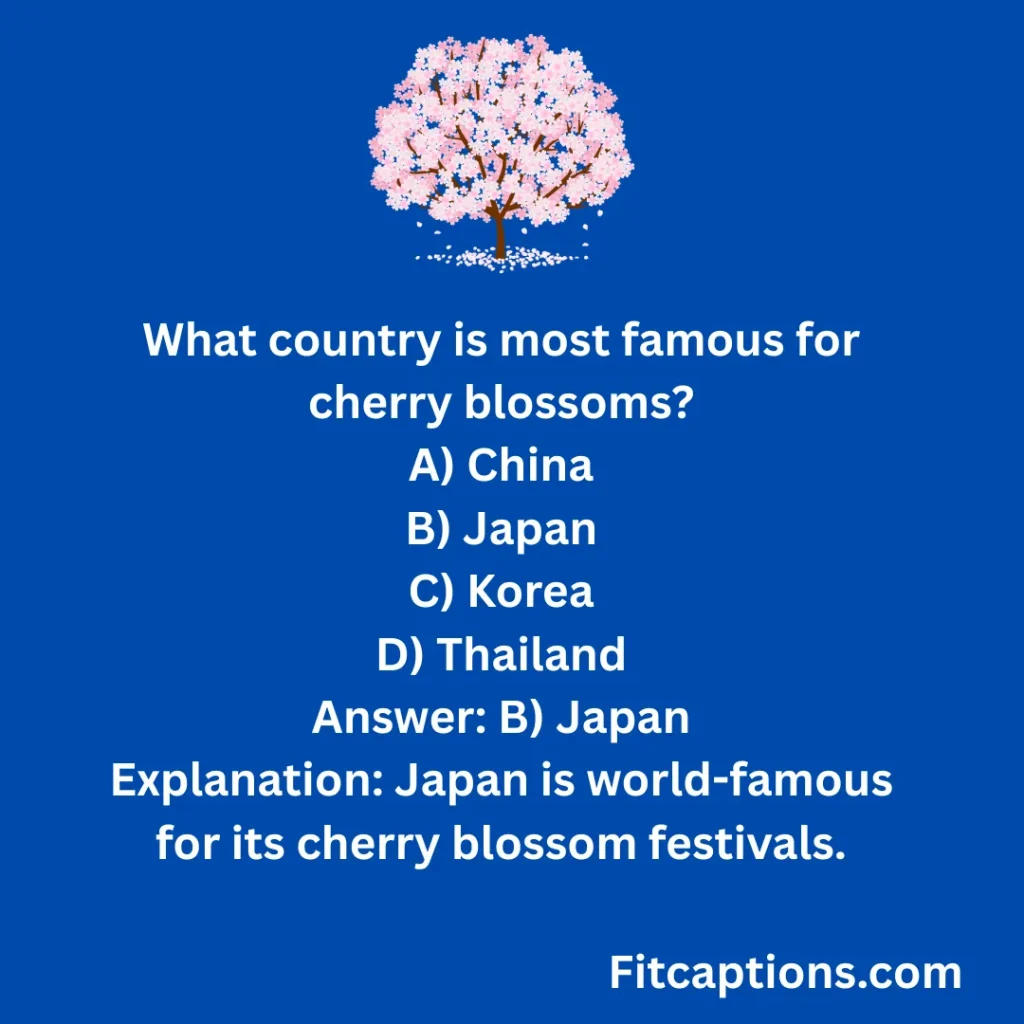
1. What country is most famous for cherry blossoms?
A) China
B) Japan
C) Korea
D) Thailand
Answer: B) Japan
Explanation: Japan is world-famous for its cherry blossom festivals.
2. What is the Japanese word for cherry blossom?
A) Hanami
B) Sakura
C) Bonsai
D) Fuji
Answer: B) Sakura
Explanation: “Sakura” means cherry blossom in Japanese.
3. What does “Hanami” mean?
A) Flower viewing
B) Spring festival
C) Tree planting
D) Mountain climbing
Answer: A) Flower viewing
Explanation: Hanami is the tradition of enjoying cherry blossoms outdoors.
4. When do cherry blossoms usually bloom in Japan?
A) January
B) March–April
C) June
D) September
Answer: B) March–April
Explanation: Blossoms peak in spring depending on the region.
5. Which U.S. city is famous for cherry blossoms?
A) New York
B) Washington, D.C.
C) Los Angeles
D) Chicago
Answer: B) Washington, D.C.
Explanation: Japan gifted cherry trees to Washington, D.C. in 1912.
6. What do cherry blossoms symbolize in Japanese culture?
A) Wealth
B) Beauty and impermanence
C) Power
D) Eternity
Answer: B) Beauty and impermanence
Explanation: They represent the fleeting nature of life.
7. What color are most cherry blossoms?
A) Blue
B) Pink and white
C) Yellow
D) Red
Answer: B) Pink and white
Explanation: Blossoms range from pale pink to bright white.
8. How long do cherry blossoms last once they bloom?
A) 1–2 days
B) 1–2 weeks
C) 1 month
D) All summer
Answer: B) 1–2 weeks
Explanation: Their short blooming period adds to their symbolism.
9. What type of tree produces cherry blossoms?
A) Maple
B) Cherry
C) Plum
D) Peach
Answer: B) Cherry
Explanation: Cherry trees produce blossoms, though not all bear fruit.
10. Which Japanese city is especially famous for cherry blossoms?
A) Tokyo
B) Kyoto
C) Osaka
D) Nagoya
Answer: B) Kyoto
Explanation: Kyoto’s temples and gardens are iconic blossom spots.
11. Which Japanese island sees the earliest blossoms?
A) Hokkaido
B) Honshu
C) Kyushu
D) Shikoku
Answer: C) Kyushu
Explanation: Warmer southern regions bloom first.
12. Which Japanese island sees the latest blossoms?
A) Hokkaido
B) Honshu
C) Kyushu
D) Okinawa
Answer: A) Hokkaido
Explanation: Northern Hokkaido blooms last, often in May.
13. What year did Japan gift cherry trees to Washington, D.C.?
A) 1900
B) 1912
C) 1925
D) 1945
Answer: B) 1912
Explanation: The gift symbolized friendship between Japan and the U.S.
14. What is the scientific name for Japanese cherry blossom trees?
A) Prunus serrulata
B) Prunus avium
C) Prunus domestica
D) Prunus persica
Answer: A) Prunus serrulata
Explanation: This species is commonly known as Japanese cherry.
15. What traditional sweet is enjoyed during Hanami?
A) Sushi
B) Sakura mochi
C) Tempura
D) Ramen
Answer: B) Sakura mochi
Explanation: Sakura mochi is a pink rice cake wrapped in a cherry leaf.
16. Which Japanese castle is famous for cherry blossoms?
A) Osaka Castle
B) Himeji Castle
C) Nagoya Castle
D) Matsumoto Castle
Answer: B) Himeji Castle
Explanation: Himeji Castle is surrounded by hundreds of cherry trees.
17. What do falling cherry blossoms symbolize?
A) Eternal life
B) The fleeting nature of existence
C) Wealth
D) Victory
Answer: B) The fleeting nature of existence
Explanation: Their short life reflects Buddhist themes of impermanence.
18. Which Japanese mountain is often pictured with cherry blossoms?
A) Mount Fuji
B) Mount Hiei
C) Mount Tate
D) Mount Ontake
Answer: A) Mount Fuji
Explanation: Mount Fuji with blossoms is an iconic image of Japan.
19. Which Japanese city hosts one of the largest cherry blossom festivals?
A) Tokyo
B) Kyoto
C) Osaka
D) Hirosaki
Answer: D) Hirosaki
Explanation: Hirosaki Castle Park has thousands of cherry trees.
20. What did samurai associate cherry blossoms with?
A) Wealth
B) Honor and shortness of life
C) Eternal strength
D) Peace
Answer: B) Honor and shortness of life
Explanation: Samurai saw blossoms as a metaphor for life’s fragility.
Final Thoughts
We hope these cherry blossom quiz questions and answers helped you learn more about the beauty, history, and cultural importance of these iconic blooms.
From their deep connection to Japanese traditions to fascinating facts about cherry blossom festivals around the world, sakura trees continue to capture hearts everywhere.
Whether you used this quiz for fun, education, or a friendly challenge, we hope you enjoyed testing your knowledge. Keep exploring more cherry blossom trivia questions and answers and share the fun with friends and family to celebrate the magic of cherry blossom season!
121+ Fun Coffee Quiz Questions and Answers
101+ Hard & Tough Trivia Questions And Answers