
Looking to test your knowledge of sepsis? This comprehensive collection of Sepsis Quiz Questions and Answers is designed to help healthcare professionals, nursing students, medical students, and anyone interested in improving their understanding of this life-threatening condition.
Sepsis is a serious medical emergency that occurs when the body’s response to an infection causes widespread inflammation and organ dysfunction. Early recognition and timely treatment are essential for improving patient outcomes.
These sepsis quiz questions cover important topics such as symptoms, causes, risk factors, diagnosis, treatment protocols, and prevention strategies.
Whether you’re preparing for exams, professional certifications, clinical practice, or simply expanding your medical knowledge, these questions and answers will help reinforce key concepts and enhance your understanding of sepsis management.
Sepsis Quiz Questions And Answers In English
1. What is sepsis?
A) A minor skin rash
B) A life-threatening organ dysfunction caused by a dysregulated response to infection
C) A vitamin deficiency
D) A type of allergy
Answer: B
2. Which best describes septic shock?
A) Mild infection with fever only
B) Sepsis with persistent low blood pressure needing vasopressors and high lactate despite fluids
C) Any infection with cough
D) A fever that lasts one day
Answer: B
3. Which of the following is a qSOFA criterion?
A) Blood sugar over 200
B) Respiratory rate of 22 or more per minute
C) Headache
D) Rash
Answer: B
4. Which is another qSOFA criterion?
A) Altered mental status
B) Ear pain
C) Sneezing
D) Itchy eyes
Answer: A
5. Which is the third qSOFA criterion?
A) Systolic blood pressure of 100 mmHg or less
B) Fever above 38.5 C
C) Nausea
D) Joint pain
Answer: A
6. What is one common early sign of sepsis?
A) Very fast breathing
B) Hair loss
C) Tooth sensitivity
D) Increased appetite
Answer: A
7. Which treatment is usually started quickly in suspected sepsis?
A) Antibiotics
B) Only rest at home
C) Antihistamines
D) Eye drops
Answer: A
8. Which fluid treatment is commonly given in sepsis?
A) IV fluids
B) Saline nasal spray
C) Ear drops
D) Oral vitamins only
Answer: A
9. Which organ system is often affected by confusion in sepsis?
A) Brain
B) Nails
C) Hair
D) Teeth
Answer: A
10. True or False: Sepsis only happens in older adults.
A) True
B) False
C) Sometimes
D) Not sure
Answer: B
11. Which lab test may be elevated in severe sepsis or septic shock?
A) Lactate
B) Cholesterol
C) Calcium only
D) Hemoglobin A1c
Answer: A
12. What can sepsis do to blood pressure?
A) Raise it always
B) Lower it dangerously
C) Never affect it
D) Make it normal instantly
Answer: B
13. Which symptom can suggest sepsis in adults?
A) Confusion
B) Perfect vision
C) Strong appetite
D) Faster hair growth
Answer: A
14. Which is a possible skin sign of sepsis?
A) Pale, blotchy, or blue skin
B) Sun tan
C) Dry elbows only
D) Freckles
Answer: A
15. What should happen if sepsis is suspected?
A) Wait and see for a week
B) Get urgent medical help
C) Drink only tea
D) Skip treatment
Answer: B
16. Which of the following can cause sepsis?
A) Infection
B) Broken fingernail
C) Sleepiness alone
D) Exercise
Answer: A
17. Which breathing change is concerning in sepsis?
A) Fast or difficult breathing
B) Slow blinking
C) Loud snoring only
D) Yawning
Answer: A
18. What is a common warning sign in children with sepsis?
A) Difficulty waking up
B) Better mood than usual
C) Extra energy
D) Needing more homework
Answer: A
19. Which of these is part of older SIRS-type warning signs?
A) Fast heart rate
B) Strong hair
C) Itchy skin only
D) Ear popping
Answer: A
20. What is the best overall description of sepsis treatment timing?
A) Delay treatment until results are back
B) Early recognition and rapid treatment are important
C) Treat only if pain is severe
D) No treatment is needed
Answer: B
Related : 128+ Superhero Quiz Questions and Answers
Funny Sepsis Quiz Questions And Answers
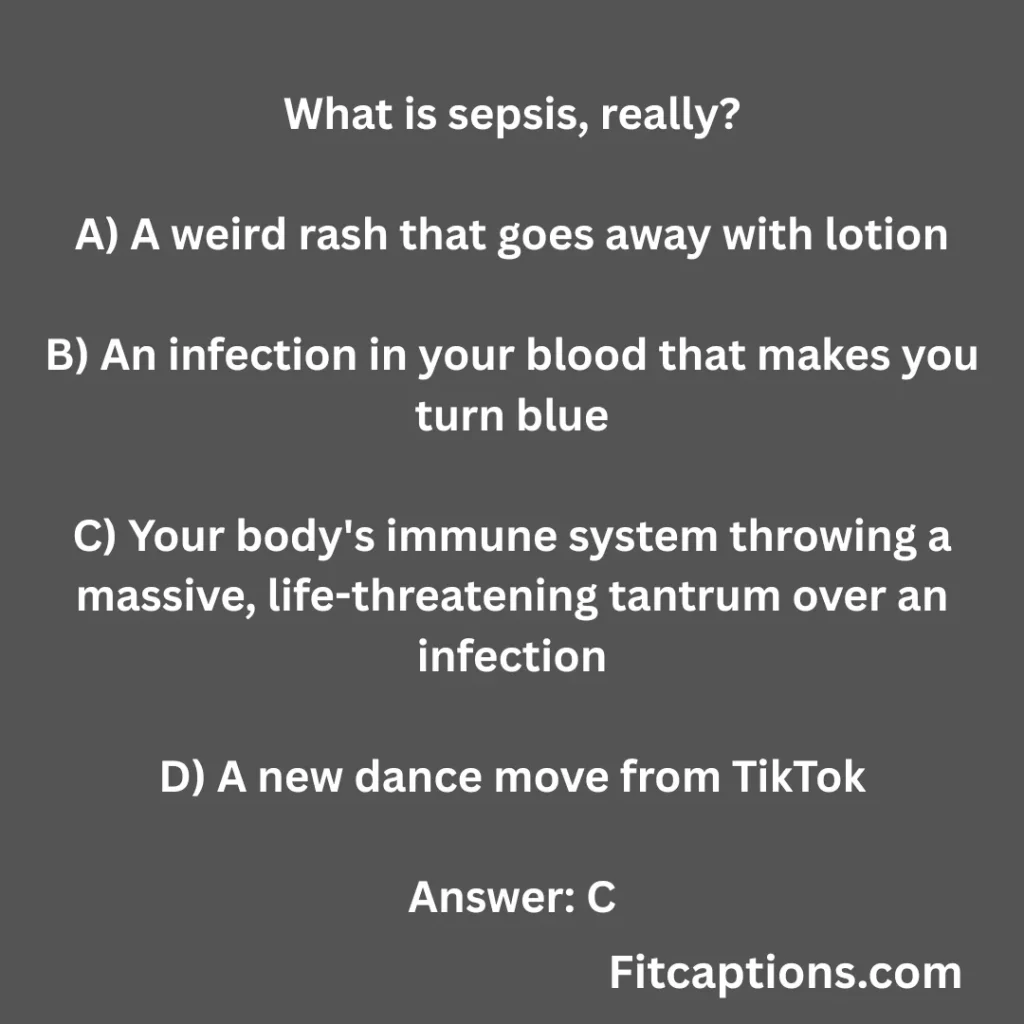
1. What is sepsis, really?
A) A weird rash that goes away with lotion
B) An infection in your blood that makes you turn blue
C) Your body’s immune system throwing a massive, life-threatening tantrum over an infection
D) A new dance move from TikTok
Answer: C
2. Can you catch sepsis from someone who has it?
A) Yes, it’s highly contagious — avoid all eye contact
B) No, but you might catch the infection that triggered it if you share a toothbrush
C) Only if you sneeze on them first
D) Yes, but only on Tuesdays
Answer: B
3. Which group of people is at the highest risk for developing sepsis?
A) People who just watched a sad movie
B) Newborn babies, pregnant women, people with cancer, and adults over 65
C) Anyone who has ever eaten a suspicious gas station hot dog
D) People who can’t find their car keys
Answer: B
4. What types of infections can lead to sepsis?
A) Only bacterial infections — viruses are too weak
B) Bacterial, viral, fungal, and even parasitic infections
C) Only infections you get from stepping on a rusty nail
D) Only the ones that sound scary in Latin
Answer: B
5. For every hour sepsis treatment is delayed, a patient’s chance of survival drops by how much?
A) 1% — it’s not that serious
B) As much as 8% — time is not on your side
C) 50% — you might as well start writing a will
D) 0% — sepsis is patient and will wait
Answer: B
6. Approximately how many people in the U.S. die from sepsis each year?
A) About the population of a small town (25,000)
B) Over a quarter of a million people
C) Exactly 12 — and they were all named Bob
D) More than the number of people who dislike pineapple on pizza
Answer: B
7. Which of the following is NOT a common sign of sepsis?
A) Fever or feeling chilled
B) Confusion or difficulty waking up
C) A sudden craving for pickles and ice cream
D) Extreme pain or discomfort (“worst ever”)
Answer: C
8. Sepsis is more deadly than which of the following combined?
A) Bad hair days and Monday mornings
B) Breast cancer, AIDS, and prostate cancer — all three together
C) Soggy french fries and cold coffee
D) People who talk in movie theaters
Answer: B
9. Which famous celebrity died of sepsis?
A) Jim Henson, the creator of the Muppets
B) Muhammad Ali
C) Patty Duke
D) All of the above
Answer: D
10. True or False: If you’re young and healthy, you don’t need to worry about sepsis.
A) True — sepsis only attacks grandmas and grandpas
B) False — even healthy people can develop sepsis from a minor infection
C) True — my immune system is basically a superhero
D) False — but only if you eat your vegetables
Answer: B
11. What is the most common site where sepsis begins in the body?
A) The left big toe
B) The respiratory system (lungs)
C) The part of your brain that remembers embarrassing moments from high school
D) The kitchen after eating leftover sushi
Answer: B
12. Which beloved puppeteer and creator of the Muppets tragically died of sepsis?
A) Walt Disney
B) Jim Henson
C) Sesame Street’s Big Bird (he’s a national treasure)
D) The guy who voiced Elmo
Answer: B
13. What is the first-choice medication used to treat septic shock?
A) A strong cup of coffee and a nap
B) Norepinephrine (also known by the brand name “Levo”)
C) Essential oils and positive thinking
D) Whatever the patient’s horoscope recommends
Answer: B
14. In the TV show House, M.D., Dr. House once diagnosed sepsis caused by a bite from which common pet?
A) A goldfish
B) A hamster
C) A dog
D) A parrot that watched too much medical drama
Answer: C
15. Which lab value measures the byproduct of anaerobic cellular activity in sepsis patients?
A) The “please wake up” score
B) Lactate
C) The amount of regret in the patient’s eyes
D) The number of times the patient said “I’m fine”
Answer: B
16. Which world leader was hospitalized with recurrent lung infections and sepsis, contributing to his death at age 95?
A) Winston Churchill
B) Nelson Mandela
C) Abraham Lincoln (time traveler)
D) The guy who invented the salad fork
Answer: B
17. What is the goal mean arterial pressure (MAP) for patients being treated for sepsis?
A) Whatever feels right in the moment
B) Greater than 65 mmHg
C) The same as the patient’s bowling score
D) High enough to keep the patient from floating away
Answer: B
18. Which of the following is a common myth about sepsis?
A) Sepsis only happens in hospitals
B) Sepsis is just a bad infection
C) Only older adults get sepsis
D) All of the above are myths
Answer: D
19. If you suspect sepsis, what should you do?
A) Wait and see if it goes away on its own
B) Post about it on social media for likes
C) Seek immediate medical care — it’s a medical emergency
D) Drink some water and call your mom
Answer: C
20. What is one way to help prevent sepsis?
A) Stay up to date on vaccines and practice good hygiene
B) Never leave your house again
C) Wear a tinfoil hat to block the sepsis rays
D) Only eat foods that start with the letter “S”
Answer: A
Related : 131+ Desert Quiz Questions and Answers
Short Sepsis Quiz Questions And Answers
1. What is sepsis?
A) Viral infection
B) Body’s extreme response to infection
C) Genetic disorder
D) Nutritional deficiency
Answer: B) Body’s extreme response to infection
2. Which organ system is most often affected first in sepsis?
A) Respiratory
B) Digestive
C) Nervous
D) Musculoskeletal
Answer: A) Respiratory
3. What is the most common cause of sepsis?
A) Bacterial infection
B) Viral infection
C) Fungal infection
D) Genetic mutation
Answer: A) Bacterial infection
4. Which vital sign is often elevated in sepsis?
A) Heart rate
B) Height
C) Vision
D) Hearing
Answer: A) Heart rate
5. What is septic shock?
A) Low blood pressure despite fluids
B) High blood sugar
C) Sudden fainting
D) Muscle cramps
Answer: A) Low blood pressure despite fluids
6. Which lab test helps detect sepsis?
A) Blood culture
B) X‑ray
C) ECG
D) Ultrasound
Answer: A) Blood culture
7. Which symptom is common in sepsis?
A) Fever
B) Hair loss
C) Rash only
D) Weight gain
Answer: A) Fever
8. Which scoring system is used for sepsis?
A) qSOFA
B) BMI
C) APGAR
D) GCS
Answer: A) qSOFA
9. What is the first line of treatment for sepsis?
A) Antibiotics
B) Vitamins
C) Painkillers
D) Exercise
Answer: A) Antibiotics
10. Which organ failure is most dangerous in sepsis?
A) Kidney
B) Skin
C) Hair
D) Nails
Answer: A) Kidney
11. What is a key sign of septic shock?
A) Low blood pressure
B) High cholesterol
C) Muscle pain
D) Sneezing
Answer: A) Low blood pressure
12. Which age group is most at risk?
A) Infants & elderly
B) Teenagers
C) Middle‑aged adults only
D) Athletes
Answer: A) Infants & elderly
13. Which fluid is given in sepsis?
A) IV saline
B) Soda
C) Juice
D) Milk
Answer: A) IV saline
14. Which organ is often monitored closely in sepsis?
A) Lungs
B) Hair follicles
C) Teeth
D) Nails
Answer: A) Lungs
15. What is the mortality risk of untreated sepsis?
A) High
B) Low
C) None
D) Moderate only
Answer: A) High
16. Which symptom may indicate worsening sepsis?
A) Confusion
B) Clear vision
C) Strong appetite
D) Hair growth
Answer: A) Confusion
17. Which blood marker rises in sepsis?
A) Lactate
B) Calcium
C) Vitamin D
D) Iron
Answer: A) Lactate
18. What is the “golden hour” in sepsis care?
A) First 60 minutes for antibiotics
B) First 60 minutes for sleep
C) First 60 minutes for exercise
D) First 60 minutes for hydration only
Answer: A) First 60 minutes for antibiotics
19. Which infection site often leads to sepsis?
A) Lungs (pneumonia)
B) Hair roots
C) Nails
D) Skin only
Answer: A) Lungs (pneumonia)
20. What is the best prevention for sepsis?
A) Early treatment of infections
B) Ignoring symptoms
C) Skipping antibiotics
D) Sleeping more
Answer: A) Early treatment of infections
Sepsis Quiz Questions And Answers For Nurses
1. What is the current Sepsis-3 definition of sepsis?
A) A systemic inflammatory response to infection
B) Life-threatening organ dysfunction caused by a dysregulated host response to infection
C) Elevated white blood cell count with fever
D) Positive blood cultures with hypotension
Answer: B) Life-threatening organ dysfunction caused by a dysregulated host response to infection
2. Which of the following is NOT a component of the qSOFA score?
A) Respiratory rate ≥22 breaths per minute
B) Altered mentation
C) Systolic blood pressure ≤100 mmHg
D) Temperature greater than 38°C
Answer: D) Temperature greater than 38°C
3. A qSOFA score of 2 or higher in a patient with suspected infection indicates:
A) No further action is needed
B) Increased risk of poor outcomes and need for rapid evaluation
C) The patient definitely has septic shock
D) Antibiotics are not yet required
Answer: B) Increased risk of poor outcomes and need for rapid evaluation
4. According to guidelines, broad-spectrum antibiotics for sepsis should be administered:
A) Within 4 hours of recognition
B) As soon as possible, ideally within 1 hour
C) Only after culture results are available
D) Within 24 hours
Answer: B) As soon as possible, ideally within 1 hour
5. Which statement about SIRS criteria is true?
A) They are the primary screening tool in Sepsis-3
B) They are no longer the main focus for sepsis diagnosis
C) They are more specific than SOFA
D) They include lactate measurement
Answer: B) They are no longer the main focus for sepsis diagnosis
6. What lab value is commonly used to assess tissue hypoperfusion in sepsis?
A) Hemoglobin level
B) Serum lactate
C) Platelet count
D) Blood glucose
Answer: B) Serum lactate
7. What is the recommended initial fluid resuscitation volume for sepsis-induced hypoperfusion?
A) 10 mL/kg crystalloid
B) 30 mL/kg crystalloid
C) 50 mL/kg colloid
D) 500 mL bolus only
Answer: B) 30 mL/kg crystalloid
8. If a patient’s MAP remains below 65 mmHg after adequate fluid resuscitation, the nurse should prepare to:
A) Administer more fluids immediately
B) Initiate vasopressors (usually norepinephrine first-line)
C) Wait another 2 hours
D) Give steroids immediately
Answer: B) Initiate vasopressors (usually norepinephrine first-line)
9. An early subtle sign of sepsis in elderly or immunocompromised patients is often:
A) High fever
B) Altered mental status or confusion
C) Bradycardia
D) Hypertension
Answer: B) Altered mental status or confusion
10. The SOFA score is used to evaluate:
A) Only respiratory function
B) Organ dysfunction across six body systems
C) Risk of hospital readmission
D) Nutritional status
Answer: B) Organ dysfunction across six body systems
11. Septic shock is best defined as:
A) Sepsis with fever only
B) Sepsis with circulatory and cellular/metabolic abnormalities requiring vasopressors and elevated lactate
C) Mild infection with low blood pressure
D) Positive cultures without organ dysfunction
Answer: B) Sepsis with circulatory and cellular/metabolic abnormalities requiring vasopressors and elevated lactate
12. The most critical nursing action in the first hour (“golden hour”) of sepsis recognition includes:
A) Obtaining blood cultures before antibiotics
B) Delaying fluids until cultures return
C) Only documenting vital signs
D) Waiting for physician orders before any action
Answer: A) Obtaining blood cultures before antibiotics
13. Source control in sepsis management primarily involves:
A) Giving antibiotics only
B) Identifying and eliminating the infection source promptly
C) Increasing fluid intake
D) Monitoring temperature hourly
Answer: B) Identifying and eliminating the infection source promptly
14. In a sepsis patient who develops acute kidney injury, the nurse should closely monitor:
A) Only blood pressure
B) Urine output, fluid balance, and creatinine
C) Daily weights only
D) Respiratory rate exclusively
Answer: B) Urine output, fluid balance, and creatinine
15. Steroids in septic shock should be used:
A) Routinely in all patients
B) Cautiously, mainly in refractory cases not responding to fluids and vasopressors
C) As first-line therapy
D) Never
Answer: B) Cautiously, mainly in refractory cases not responding to fluids and vasopressors
16. Which of the following is part of the Surviving Sepsis Campaign Hour-1 Bundle?
A) Measure lactate, obtain cultures, give antibiotics, start fluids
B) Order a chest X-ray only
C) Start enteral nutrition immediately
D) Perform a full physical exam and wait
Answer: A) Measure lactate, obtain cultures, give antibiotics, start fluids
17. True or False: Infection prevention practices (such as hand hygiene) help prevent sepsis.
A) True
B) False
C) Only in surgical patients
D) Only in ICU settings
Answer: A) True
18. Early compensatory signs in sepsis often include:
A) Bradycardia and hypertension
B) Tachycardia and tachypnea
C) Hypothermia and bradypnea
D) Normal vital signs
Answer: B) Tachycardia and tachypnea
19. After initial resuscitation, ongoing monitoring should include:
A) Serial lactate levels and organ function
B) Vital signs once per shift only
C) Antibiotics for 3 days only
D) No further labs
Answer: A) Serial lactate levels and organ function
20. Important discharge teaching for sepsis survivors includes:
A) Signs of recurrence, follow-up care, and possible long-term effects
B) No need for follow-up
C) Only wound care instructions
D) Immediate return to full activity
Answer: A) Signs of recurrence, follow-up care, and possible long-term effects
Sepsis Quiz Questions And Answers For Students
1. Which best describes sepsis?
A) A life-threatening reaction to infection
B) A stomach virus only
C) A bone injury
D) A skin allergy
Answer: A
2. What usually starts sepsis?
A) An infection
B) A headache
C) A sunburn
D) A sprained ankle
Answer: A
3. Which body system helps fight infection and can overreact in sepsis?
A) Immune system
B) Digestive system
C) Skeletal system
D) Nervous system
Answer: A
4. Which of these is a warning sign of sepsis?
A) Confusion
B) Strong eyesight
C) Bigger muscles
D) More hair
Answer: A
5. What can happen to breathing in sepsis?
A) It may become fast or difficult
B) It always stops completely
C) It becomes stronger only after exercise
D) It never changes
Answer: A
6. Which can be a skin sign of sepsis?
A) Pale, blotchy, or blue skin
B) A tan line
C) Freckles
D) A small scar
Answer: A
7. What is one common treatment given through a vein in sepsis?
A) IV fluids
B) Vitamins only
C) Cough syrup
D) Antacids
Answer: A
8. Which medicine is often given early for sepsis?
A) Antibiotics
B) Pain gel only
C) Allergy drops
D) Eye lotion
Answer: A
9. Is sepsis a medical emergency?
A) Yes
B) No
C) Only sometimes
D) Only in children
Answer: A
10. What can happen to a person’s blood pressure in sepsis?
A) It may drop too low
B) It always rises
C) It never changes
D) It becomes normal instantly
Answer: A
11. Which is a possible symptom of sepsis in adults?
A) Slurred speech
B) Better handwriting
C) Stronger eyesight
D) More appetite
Answer: A
12. Which is a possible symptom of sepsis in children?
A) Being very sleepy or hard to wake
B) Growing taller quickly
C) Laughing more than usual
D) Needing new shoes
Answer: A
13. What may be seen in severe sepsis because organs are not getting enough blood?
A) Organ failure
B) Faster hair growth
C) Better digestion
D) Sharper vision
Answer: A
14. Which test may help show poor tissue oxygen use in sepsis?
A) Lactate level
B) Vision test
C) Hearing test
D) Skin allergy test
Answer: A
15. What should happen if sepsis is suspected?
A) Seek urgent medical help
B) Wait until tomorrow
C) Drink only water and sleep
D) Ignore it
Answer: A
16. Which infection can lead to sepsis?
A) Lung infection
B) A haircut
C) A paper cut alone
D) A bruise
Answer: A
17. Can viruses cause sepsis?
A) Yes
B) No
C) Never
D) Only in adults
Answer: A
18. Can fungi cause sepsis?
A) Yes
B) No
C) Only in winter
D) Only in children
Answer: A
19. Which breathing rate is part of qSOFA warning signs?
A) 22 or more breaths per minute
B) 8 or fewer breaths per minute
C) 10 exactly
D) 15 exactly
Answer: A
20. Why is early treatment important in sepsis?
A) It can save lives
B) It helps with homework
C) It changes eye color
D) It makes people taller
Answer: A
Best Sepsis Quiz Questions And Answers
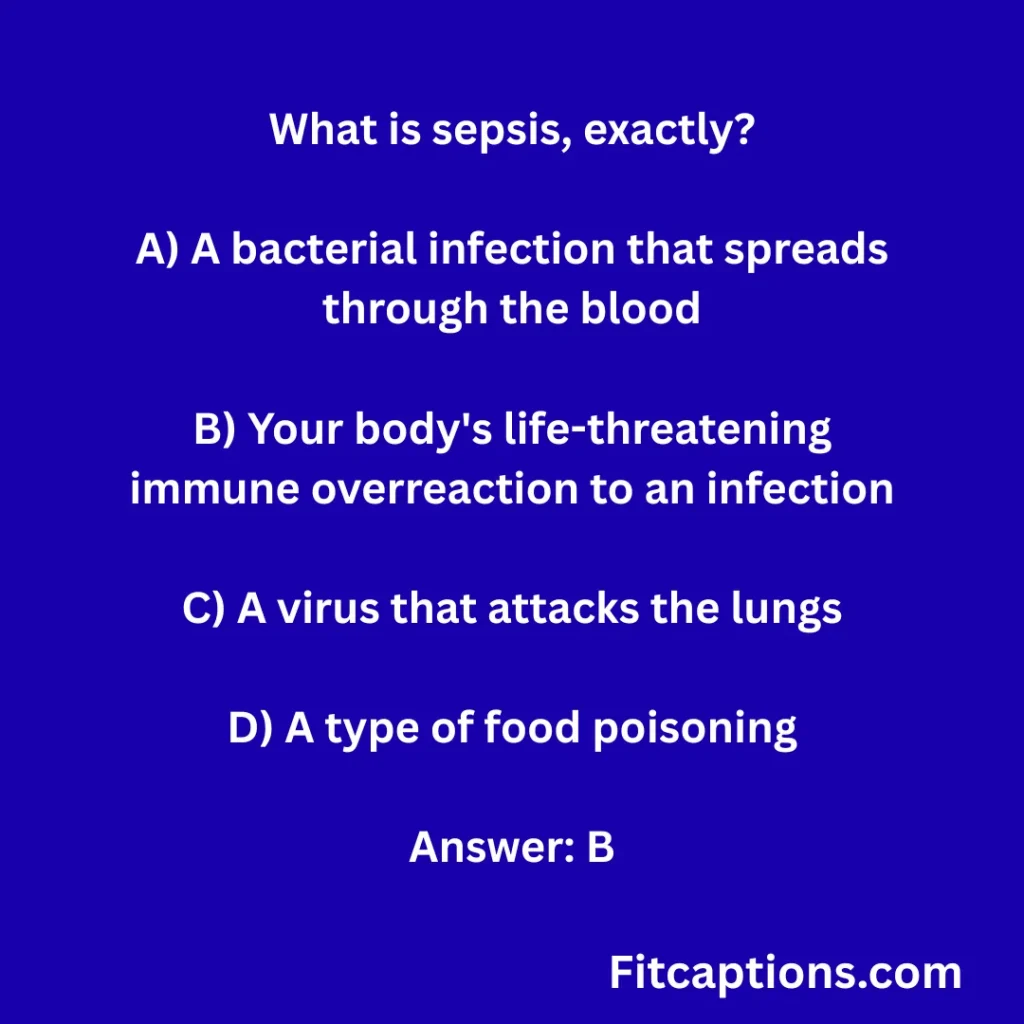
1. What is sepsis, exactly?
A) A bacterial infection that spreads through the blood
B) Your body’s life-threatening immune overreaction to an infection
C) A virus that attacks the lungs
D) A type of food poisoning
Answer: B
2. Which of the following is NOT a potential outcome of sepsis?
A) Tissue damage
B) Organ failure
C) Full recovery with no lasting effects (always happens)
D) Death
Answer: C
3. For every hour sepsis treatment is delayed, a patient’s chance of survival drops by approximately how much?
A) 1-2%
B) 4-8%
C) 15-20%
D) 30-40%
Answer: B
4. Which group is at highest risk for developing sepsis?
A) Teenage athletes
B) Adults over 65, newborns, pregnant women, and people with chronic illnesses
C) Middle-aged office workers
D) Only hospitalized patients
Answer: B
5. Which of the following is a common early symptom of sepsis?
A) Unusually high heart rate
B) Increased appetite
C) Sudden hair loss
D) Enhanced vision
Answer: A
6. True or False: Sepsis is contagious and can be spread from person to person.
A) True – you can catch it like a cold
B) False – the underlying infection may be contagious, but sepsis itself is not
C) True – only through direct blood contact
D) False – it’s completely harmless to others
Answer: B
7. Which type of infection can lead to sepsis?
A) Bacterial infections only
B) Viral infections only
C) Bacterial, viral, and fungal infections
D) Only infections acquired in hospitals
Answer: C
8. Sepsis is more deadly than which of the following combined?
A) Car accidents and lightning strikes
B) Breast cancer, AIDS, and prostate cancer combined
C) Heart disease and stroke
D) All forms of cancer
Answer: B
9. Which lab value is commonly elevated in sepsis and measures tissue hypoxia?
A) Hemoglobin
B) White blood cell count
C) Lactate
D) Platelet count
Answer: C
10. What is the qSOFA score used for in sepsis?
A) To diagnose the type of infection
B) To quickly identify patients at risk of poor outcomes
C) To measure blood sugar levels
D) To determine which antibiotic to prescribe
Answer: B
11. Which famous Muppets creator tragically died of sepsis?
A) Walt Disney
B) Jim Henson
C) Fred Rogers
D) Stan Lee
Answer: B
12. What is the most common source of infection leading to sepsis?
A) The skin
B) The urinary tract
C) The respiratory system (lungs)
D) The digestive system
Answer: C
13. Which of the following is a common myth about sepsis?
A) It only happens in hospitals
B) It’s just a bad infection
C) Only older adults get it
D) All of the above
Answer: D
14. Approximately how many people in the U.S. die from sepsis each year?
A) About 10,000
B) Over 250,000
C) About 50,000
D) Less than 5,000
Answer: B
15. What is the first-line vasopressor commonly used to treat septic shock?
A) Epinephrine
B) Dopamine
C) Norepinephrine
D) Phenylephrine
Answer: C
16. Which of the following is NOT a common cause of sepsis?
A) Gram-negative bacteria
B) Gram-positive bacteria
C) Viruses
D) Cancer
Answer: D
17. What percentage of sepsis survivors are left with life-changing after-effects?
A) 10%
B) 25%
C) 40%
D) 60%
Answer: C
18. What should you do if you suspect someone has sepsis?
A) Wait and see if symptoms improve
B) Give them fluids and rest at home
C) Seek immediate emergency medical care
D) Call a pharmacist for advice
Answer: C
19. Which celebrity death was caused by sepsis?
A) Robin Williams
B) Muhammad Ali
C) Prince
D) David Bowie
Answer: B
20. What is the goal mean arterial pressure (MAP) target for a patient being treated for septic shock?
A) Greater than 65 mmHg
B) Greater than 80 mmHg
C) Greater than 50 mmHg
D) Greater than 100 mmHg
Answer: A
FAQS
What are the key facts about sepsis?
Sepsis is a life-threatening medical condition that occurs when the body’s response to an infection damages its own tissues and organs. It can develop from bacterial, viral, fungal, or parasitic infections and requires immediate medical attention.
Key Facts:
- Sepsis is a medical emergency.
- It can begin with infections in the lungs, urinary tract, skin, or digestive system.
- Symptoms may include fever, rapid heart rate, confusion, shortness of breath, and extreme discomfort.
- Severe sepsis can lead to septic shock, organ failure, and death.
- Early diagnosis and treatment significantly improve survival rates.
- People with weakened immune systems, older adults, infants, and those with chronic illnesses are at higher risk.
- Treatment often includes antibiotics, intravenous fluids, and supportive care.
How many questions are in the sepsis quiz?
The number of questions in a sepsis quiz varies depending on its purpose and audience. Common formats include:
- 10–15 questions for quick knowledge checks.
- 20–30 questions for educational or training purposes.
- 50+ questions for medical students, nursing exams, and healthcare certification preparation.
- 100+ questions for comprehensive review and exam practice.
What is sepsis & septicemia?
Sepsis
Sepsis is the body’s extreme and potentially dangerous response to an infection. Instead of fighting the infection normally, the immune system triggers widespread inflammation that can damage organs and tissues.
Septicemia
Septicemia, often called “blood poisoning,” refers to the presence of harmful microorganisms, especially bacteria, in the bloodstream. Septicemia can lead to sepsis if the body’s response becomes uncontrolled.
Key Difference
- Septicemia: Infection present in the bloodstream.
- Sepsis: The body’s overwhelming and harmful response to an infection, which may or may not involve bloodstream infection.
How many MCQs for Medicos on sepsis & septic shock?
For medical students, nursing students, and healthcare professionals, MCQ collections on sepsis and septic shock commonly contain:
- 25–50 MCQs for classroom assessments.
- 50–100 MCQs for exam preparation.
- 100–200+ MCQs for comprehensive revision and competitive medical examinations.
These MCQs typically cover:
- Definitions and diagnostic criteria
- Pathophysiology
- Risk factors
- Clinical signs and symptoms
- Laboratory investigations
- Sepsis management guidelines
- Fluid resuscitation
- Antibiotic therapy
- Vasopressor use
- Septic shock treatment protocols
Such question banks help medicos strengthen their understanding of sepsis recognition, emergency management, and critical care principles.
Final Thoughts
Mastering the fundamentals of sepsis is crucial for healthcare providers and students alike, as early detection can save lives. These Sepsis Quiz Questions and Answers offer an effective way to assess your knowledge, identify learning gaps, and strengthen your understanding of this critical condition.
Regularly practicing sepsis-related quizzes can improve clinical decision-making skills and increase confidence in recognizing and managing sepsis in real-world situations. Continue exploring medical quizzes and educational resources to stay updated with the latest guidelines and best practices in sepsis care.
You May Also Like:
145+ Fun Father’s Day Quiz and Answers
128+ Epic Superhero Quiz Questions and Answers
126+ Fun Folk Heroes Trivia Questions and Answers