
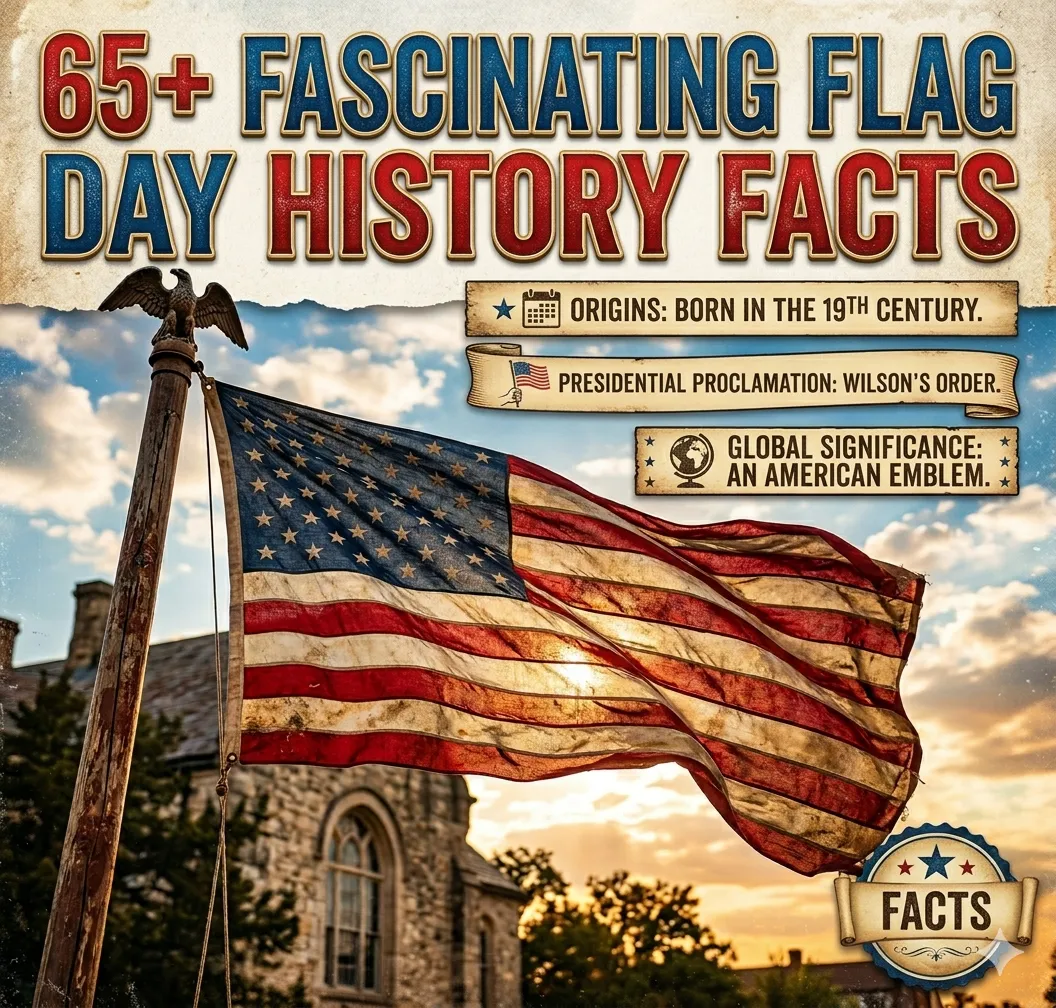
Flag Day is a special occasion that honors the history, symbolism, and enduring legacy of the American flag. Celebrated annually on June 14, this patriotic holiday commemorates the adoption of the Stars and Stripes as the official flag of the United States in 1777.
From its humble beginnings to becoming one of the nation’s most cherished symbols, the American flag has witnessed centuries of history, sacrifice, and progress.
In this collection of Flag Day history facts, you’ll discover fascinating stories, surprising milestones, and little-known details about Old Glory that showcase its importance in American culture.
Whether you’re a history enthusiast, student, or proud patriot, these Flag Day facts offer a deeper appreciation for the flag and what it represents.
Surprising Flag Day History Facts
The Birth of the Flag (History of June 14, 1777)
1. On June 14, 1777, the Second Continental Congress passed the Flag Resolution declaring:
“the flag of the thirteen United States be thirteen stripes, alternate red and white; and the union be thirteen stars, white in a blue field.”
2. This was created during the Revolutionary War to establish a unified national symbol distinct from Britain.
3. The exact designer of the first Stars and Stripes is still unknown.
4. The flag was likely first carried into battle on September 11, 1777, at the Battle of Brandywine.
5. The first foreign naval salute occurred on February 14, 1778, by John Paul Jones’ ship Ranger in France.
6. The flag first flew over foreign territory in Nassau, Bahamas in early 1778.
7. The Continental Army was also authorized on June 14, 1775 — making it both Flag Day and U.S. Army Birthday.
8. The new flag design was not widely publicized until September 3, 1777.
9. Before it, the Grand Union Flag was used and first raised by George Washington on January 1, 1776.
10. The famous Betsy Ross story remains unconfirmed by historians.
🇺🇸 Flag Day Origins & Recognition
11. First proposed in 1861 in Hartford, Connecticut during the Civil War.
12. Bernard J. Cigrand is known as the “Father of Flag Day.”
13. He held the first Flag Birthday celebration in 1885 with his students.
14. The 100th anniversary in 1877 marked the first national observance.
15. President Woodrow Wilson officially proclaimed Flag Day in 1916.
16. President Calvin Coolidge reinforced it in 1927.
17. Flag Day became officially recognized in 1949 by President Harry S. Truman.
18. Pennsylvania is the only state to recognize it as an official state holiday.
19. National Flag Week was established in 1966 (June 14–20).
20. Every U.S. president since Wilson has issued Flag Day proclamations.
21. Flag Day 2026 aligns with America’s 250th anniversary celebrations.
🇺🇸 Flag Design Evolution
22. The U.S. flag has had 27 official versions.
23. The current 50-star flag has been in use since July 4, 1960.
24. The 1818 Flag Act fixed 13 stripes permanently and added a star per state.
25. The 15-star, 15-stripe flag inspired the “Star-Spangled Banner.”
26. Robert G. Heft designed the 50-star flag as a school project in 1958.
27. Early flags had many star patterns before standardization in 1912.
28. Stars are arranged in staggered rows with one point upward.
29. During the Civil War, multiple flag versions existed.
30. The U.S. flag has been planted on the Moon during Apollo missions.
🇺🇸 Symbolism of the Flag
31. 13 stripes = original 13 colonies.
32. 50 stars = 50 states.
33. Red = valor and hardiness.
34. White = purity and innocence.
35. Blue = vigilance, perseverance, and justice.
36. The union (blue field) is called the “canton.”
37. The stars represent a “new constellation” of nations.
38. The nickname “Old Glory” originated in the 1820s.
39. The flag is never dipped except for military honors.
40. It may fly 24 hours if properly illuminated.
🇺🇸 Traditions & Flag Code
41. The U.S. Flag Code is advisory for civilians.
42. The flag should never touch the ground.
43. It is flown at half-staff on Memorial Day until noon.
44. Flag burning is protected free speech (U.S. law).
45. Dignified burning is the proper disposal method.
46. The White House and major memorials fly the flag continuously.
47. Schoolchildren often recite the Pledge of Allegiance on Flag Day.
48. Flag etiquette is part of civic education in schools.
🇺🇸 Fun & Lesser-Known Facts
49. Early flags had British Union Jack elements.
50. “Don’t Tread on Me” was an early Revolutionary symbol.
51. Francis Hopkinson is sometimes credited with early designs.
52. The 15-star flag measured about 30 × 42 feet.
53. The flag has flown in every major U.S. conflict since 1777.
54. The folding ceremony creates a triangle symbolizing the Revolutionary hat.
55. Each fold in military ceremonies has symbolic meaning.
56. The flag has inspired songs, art, and national identity.
57. Five flags remain on the Moon (as of Apollo missions).
58. Flag Day often includes parades, ceremonies, and citizenship events.
🇺🇸 Cultural Meaning
59. The flag symbolizes unity among all states.
60. It represents resilience through more than two centuries.
61. Immigrant communities often celebrate Flag Day as part of American identity.
62. Naturalization ceremonies frequently occur around June 14.
63. Flag Day promotes civic pride and education.
64. The flag inspired the study of vexillology (flag science).
65. It remains one of the most recognizable national symbols in the world.
FAQS
1. When was National Flag Day created?
National Flag Day was officially established on August 3, 1949, when President Harry S. Truman signed it into law. However, the idea and celebrations existed long before it became a national observance.
2. When is Flag Day?
Flag Day is celebrated every year on June 14 in the United States. It marks the adoption of the American flag on June 14, 1777.
3. Who started American Flag Day?
The idea of Flag Day is credited to Bernard J. Cigrand, a Wisconsin schoolteacher, who first publicly proposed a national day to honor the flag in 1885. Later, other supporters like William T. Kerr helped promote it until it gained national recognition.
4. Why is Flag Day important?
Flag Day is important because it honors the American flag as a symbol of freedom, unity, and national identity. It also reminds citizens of the country’s history, the sacrifices made for independence, and the values the flag represents.
Final Thoughts
The history of Flag Day is filled with remarkable events, inspiring traditions, and meaningful symbols that continue to unite Americans across generations. These Flag Day history facts highlight the journey of the American flag and the values of freedom, courage, and national pride it represents.
By learning more about the origins and significance of Old Glory, we gain a greater understanding of the nation’s heritage and the sacrifices made to preserve it. We hope these fascinating facts have enriched your knowledge and inspired you to celebrate Flag Day with renewed appreciation for one of America’s most iconic symbols.
You May Also Like:
125+ Inspirational Old Flag Sayings
121+ Powerful Flag Day 2026 Quotes
127+ Heartfelt Patriotic Flag Day Wishes