
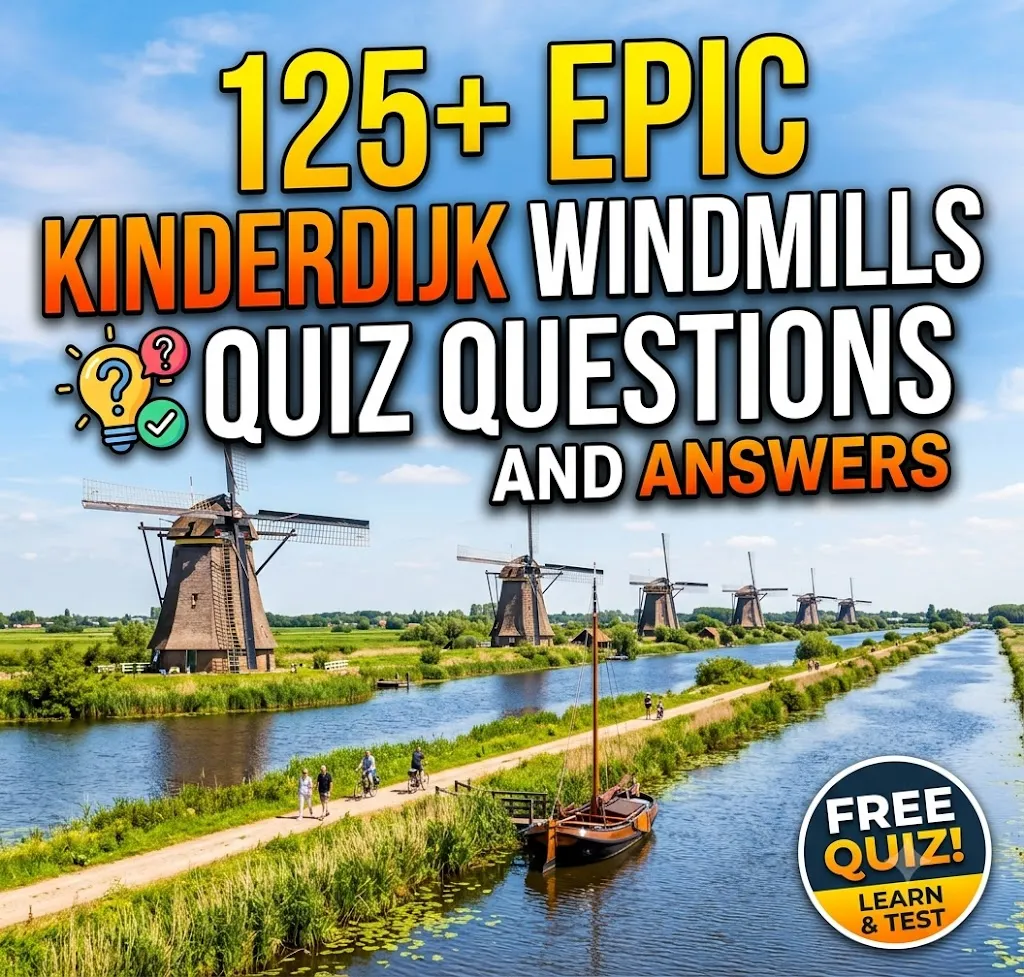
Ready to test your knowledge on one of the most famous UNESCO World Heritage sites in the Netherlands? The historic Kinderdijk Windmills are a true marvel of Dutch engineering and history.
Whether you’re prepping for trivia night, a school project, or just testing your own travel trivia, our Kinderdijk Windmills quiz questions and answers will see if you’re a true expert or if you’ll get blown away by the competition.
Let’s see how many you can get right! 👇
Kinderdijk Windmills Quiz Questions and Answers for Adults
1. In which Dutch province is the UNESCO World Heritage site of Kinderdijk located?
A) North Holland
B) South Holland
C) Utrecht
D) Zeeland
Answer: B) South Holland
2. In what year were the windmills of Kinderdijk officially designated as a UNESCO World Heritage site?
A) 1987
B) 1997
C) 2007
D) 2017
Answer: B) 1997
3. What major historical flood in 1421 heavily impacted the region and led to the strict water management systems at Kinderdijk?
A) The St. Elizabeth Flood
B) The St. Felix Flood
C) The All Saints Flood
D) The North Sea Flood
Answer: A) The St. Elizabeth Flood
4. What does the Dutch name “Kinderdijk” literally translate to in English?
A) King’s Dyke
B) Children’s Dyke
C) Cattle Dyke
D) Church Dyke
Answer: B) Children’s Dyke
5. According to a famous local folktale, what was found floating unharmed after the 1421 flood that inspired the name Kinderdijk?
A) A wooden chest filled with gold coins
B) A cradle containing a crying baby and a cat keeping it balanced
C) A crown belonging to a lost prince
D) A sacred church bell
Answer: B) A cradle containing a crying baby and a cat keeping it balanced
6. Around which century were the first simple water-pumping windmills constructed in the Alblasserwaard region?
A) 11th century
B) 13th century
C) 15th century
D) 18th century
Answer: C) 15th century
7. How many historic windmills are still preserved at the Kinderdijk site today?
A) 12
B) 15
C) 19
D) 24
Answer: C) 19
8. What is the primary historical purpose of the Kinderdijk windmills?
A) Crushing grain into flour for baking
B) Sawing logs into timber for shipbuilding
C) Pumping excess water out of the low-lying polders
D) Pressing olives and seeds into oil
Answer: C) Pumping excess water out of the low-lying polders
9. Which two rivers converge near Kinderdijk, making the area highly vulnerable to flooding?
A) Rhine and Meuse
B) Lek and Noord
C) Amstel and IJssel
D) Scheldt and Vecht
Answer: B) Lek and Noord
10. What is the name of the low-lying regional polder district that the Kinderdijk windmills were built to drain?
A) Beemster
B) Alblasserwaard
C) Flevoland
D) Schermer
Answer: B) Alblasserwaard
11. Who originally granted the Alblasserwaard region the right to form a water board to manage local water levels in the 13th century?
A) Count Floris V
B) King William I
C) Emperor Charles V
D) Napoleon Bonaparte
Answer: A) Count Floris V
12. Why did the land in the Alblasserwaard polder begin sinking lower and lower starting in the Middle Ages?
A) Tectonic plate movement
B) Severe volcanic ash buildup
C) The drying and compaction of peat soil due to artificial drainage
D) Heavy mining for coal
Answer: C) The drying and compaction of peat soil due to artificial drainage
13. Into which major body of water do the Kinderdijk systems ultimately discharge their managed water?
A) The IJsselmeer
B) The Wadden Sea
C) The River Lek
D) The Zuiderzee
Answer: C) The River Lek
14. What historic administrative bodies were responsible for maintaining the dykes, canals, and windmills at Kinderdijk?
A) Guilds
B) Water Boards (Waterschappen)
C) Hanseatic Leagues
D) Provincial Estates
Answer: B) Water Boards (Waterschappen)
15. Which century saw the construction of the specific 19 stone and thatched windmills that stand at Kinderdijk today?
A) 16th century
B) 17th century
C) 18th century
D) 19th century
Answer: C) 18th century (specifically between 1738 and 1740)
16. What event during World War II briefly brought the Kinderdijk windmills back into critical, full-scale operational service?
A) A major fuel and electricity shortage across the Netherlands
B) The bombing of all local modern bridges
C) A massive earthquake in South Holland
D) A direct request from Nazi forces to grind grain
Answer: A) A major fuel and electricity shortage across the Netherlands
17. What type of terrain makes up the vast majority of the landscape surrounding the Kinderdijk windmills?
A) Heathland
B) Low-lying reclaimed polder land
C) Dense pine forests
D) Natural sand dunes
Answer: B) Low-lying reclaimed polder land
18. Why are there two distinct rows of windmills facing each other at Kinderdijk?
A) They were built by rival engineering companies trying to outdo each other
B) One side drained the Overwaard district and the other drained the Nederwaard district
C) One row pumped fresh drinking water while the other pumped wastewater
D) The second row was built solely as a spare back-up in case of fire
Answer: B) One side drained the Overwaard district and the other drained the Nederwaard district
19. What alternative legend exists for the name Kinderdijk involving a family dwelling on the dyke?
A) A family with nineteen children lived in the tallest windmill
B) It was built entirely by child labor during a great labor strike
C) A poor family’s cottage on the dyke stayed dry because it was built on higher ground
D) The builder of the first mill was named Jan de Kinder
Answer: C) A poor family’s cottage on the dyke stayed dry because it was built on higher ground
20. Which prominent historical Dutch engineer is famous for revolutionary hydraulic designs that influenced later Kinderdijk polder systems?
A) Cornelis Lely
B) Jan Leeghwater
C) Hendrik Lorentz
D) Christiaan Huygens
Answer: B) Jan Leeghwater
Recommended: 125+ Fun Wimbledon Quiz Questions and Answers
Easy Kinderdijk Windmills Quiz Questions and Answers
21. What happened to the water management at Kinderdijk in the year 1950?
A) All the windmills were permanently demolished
B) The first diesel-powered pumping station completely took over daily operations
C) The canals were paved over to build a modern highway
D) The site was purchased by an American museum group
Answer: B) The first diesel-powered pumping station completely took over daily operations
22. What was the main reason the 19 windmills were kept in pristine, working condition after modern pumps took over?
A) To keep electricity costs down for local farmers
B) Out of deep cultural respect, national heritage preservation, and wartime backup security
C) Because the modern pumps fail every winter during freezes
D) They were required by law to keep operating to generate tourist revenue
Answer: B) Out of deep cultural respect, national heritage preservation, and wartime backup security
23. What international convention protects the Kinderdijk site from urban development and destruction?
A) The Geneva Convention
B) The UNESCO World Heritage Convention
C) The Kyoto Protocol
D) The Treaty of Utrecht
Answer: B) UNESCO World Heritage Convention
24. What type of fuel did the early mechanical pumping stations at Kinderdijk use when they first replaced windmill reliance in the 19th century?
A) Peat
B) Coal-fired steam engines
C) Crude oil
D) Natural gas
Answer: B) Coal-fired steam engines
25. Which Dutch monarch has famously visited Kinderdijk to celebrate its status as a crowning jewel of Dutch water management?
A) King Willem-Alexander
B) Queen Wilhelmina
C) King Louis Bonaparte
D) King Willem II
Answer: A) King Willem-Alexander
26. What architectural shape is characteristic of the eight windmills belonging to the Nederwaard district?
A) Round, brick structures
B) Octagonal, wooden smock mills
C) Square, stone towers
D) Hexagonal, metal frames
Answer: A) Round, brick structures
27. What material is used to clad the exterior walls of the eight octagonal windmills in the Overwaard district?
A) Red clay bricks
B) Corrugated iron sheets
C) Thatch made of local reeds
D) Polished slate shingles
Answer: C) Thatch made of local reeds
28. What classification of windmill style are the Overwaard mills, characterized by their stationary octagonal bodies and rotating caps?
A) Post mills
B) Smock mills
C) Tower mills
D) Palette mills
Answer: B) Smock mills
29. What type of windmill is the single “De Blokker” mill located slightly outside the two main rows?
A) Hollow post mill (Wipmolen)
B) Smock mill
C) Brick tower mill
D) Stage mill
Answer: A) Hollow post mill (Wipmolen)
30. Why is a hollow post mill (Wipmolen) like “De Blokker” structurally unique compared to the tower mills?
A) The entire body of the mill can rotate to face the wind, not just the cap
B) It has no sails and functions entirely using hidden water currents
C) It is built completely underground with only the sails sticking out
D) It features a stone base with a fully cast-iron cap
Answer: A) The entire body of the mill can rotate to face the wind, not just the cap
31. What color are the sails of the Kinderdijk windmills traditionally when they are stripped of their canvas covers?
A) Solid white
B) Deep black or dark brown wood
C) Painted bright blue and red
D) Dark green metal
Answer: B) Deep black or dark brown wood
32. What structural function does the massive wooden beam system at the back of a Kinderdijk mill cap serve?
A) It balances the weight of the water wheel inside
B) It is used by the miller to turn the cap so the sails face directly into the wind
C) It acts as a chimney to let out smoke from the kitchen fireplace
D) It keeps birds from nesting on the roof
Answer: B) It is used by the miller to turn the cap so the sails face directly into the wind
33. What is the term for the large external wheel at the rear of the mill cap that the miller spins to rotate the cap?
A) The tail wheel
B) The brake wheel
C) The tail-pole wheel (Winch wheel/Kruirad)
D) The scoop wheel
Answer: C) The tail-pole wheel (Winch wheel/Kruirad)
34. What specific type of foundation do the heavy brick windmills of Kinderdijk rely on to prevent sinking into the soft mud?
A) Solid concrete blocks
B) Massive wooden piles driven deep into the underground sand layer
C) Floating steel pontoons
D) Natural granite bedrock outcrops
Answer: B) Massive wooden piles driven deep into the underground sand layer
35. How many sails does a standard Kinderdijk windmill have?
A) Three
B) Four
C) Five
D) Six
Answer: B) Four
36. What material was historically used to build the main internal drive gears of the 18th-century windmills?
A) Cast iron
B) Hardwoods like oak, elm, or hornbeam
C) Forged copper
D) Volcanic stone
Answer: B) Hardwoods like oak, elm, or hornbeam
37. What is the purpose of the long wooden poles that extend diagonally across the face of each sail frame?
A) To provide structural support and hold the canvas sail cloths in place
B) To scare off migrating birds
C) To slice through thick winter ice blocks
D) To act as lightning rods during summer storms
Answer: A) To provide structural support and hold the canvas sail cloths in place
38. What specific color scheme is traditionally painted on the decorative breastboards and caps of the Nederwaard windmills?
A) Orange, white, and blue
B) Red, white, and green
C) Yellow and black
D) Purple and grey
Answer: B) Red, white, and green
39. What is the name of the top-most rotating section of a smock or tower windmill that holds the sails and axle?
A) The crown
B) The bonnet
C) The cap
D) The helm
Answer: C) The cap
40. Why are the brick tower windmills of the Nederwaard tapered slightly inward as they get taller?
A) To save money on building materials
B) To lower the center of gravity and provide superior aerodynamic wind flow
C) Because the builders made mathematical measuring errors
D) To prevent rainwater from hitting the windows
Answer: B) To lower the center of gravity and provide superior aerodynamic wind flow
Recommended: 101+ Fun Grand Slam Legends Quiz Questions With Answers
Funny Kinderdijk Windmills Quiz Questions and Answers
41. What feature does “De Blokker” mill possess that sets its base apart from the other 18 mills?
A) Its base is surrounded by a protective moat filled with fish
B) It sits on a high pyramidal wooden base painted black
C) Its base is integrated directly into a functioning modern church
D) It is built inside a concrete lock gate system
Answer: B) It sits on a high pyramidal wooden base painted black
42. How do millers prevent the wooden teeth of the internal gears from wearing out due to friction?
A) By pouring buckets of water over them constantly
B) By lubricating them with animal fat, beeswax, or specialized grease
C) By wrapping them in thick leather strips
D) By running them at very slow speeds only
Answer: B) By lubricating them with animal fat, beeswax, or specialized grease
43. What are the thatched roofs and walls of the Overwaard smock mills made from?
A) Dried wheat straw from local farms
B) Reeds harvested directly from the surrounding marshy polder waters
C) Woven hemp fibers imported from Asia
D) Imported coconut coir
Answer: B) Reeds harvested directly from the surrounding marshy polder waters
44. What does a miller do to the sails when the wind is very weak?
A) Trims them shorter using a saw
B) Unrolls canvas sailcloths completely over the wooden lattice frames to catch more air
C) Removes the wooden frames completely
D) Pours oil on the canvas to make it heavy
Answer: B) Unrolls canvas sailcloths completely over the wooden lattice frames to catch more air
45. What is the main structural hazard that can destroy a windmill’s wooden cap during a severe gale?
A) The wood drying out too fast
B) The wind catching the sails from behind, causing the mill to run backward out of control
C) Heavy moss growth unbalancing the beams
D) Termites eating the rotating bearings
Answer: B) The wind catching the sails from behind, causing the mill to run backward out of control
46. What are the small windows on the sides of the windmill bodies primarily used for by the miller?
A) Checking the water levels in the lower canals
B) Watching the weather, cloud patterns, and nearby windmills for signals
C) Fishing directly from the living room
D) Letting out heat from the baking ovens
Answer: B) Watching the weather, cloud patterns, and nearby windmills for signals
47. What is the name of the long main axle that connects the rotating sails outside to the large brake wheel inside the cap?
A) The wind shaft (bovenas)
B) The kingpin
C) The drive shaft
D) The spindle
Answer: A) The wind shaft (bovenas)
48. What unique advantage do the brick tower mills of Nederwaard have over traditional all-wooden structures?
A) They are completely immune to fire from lightning strikes
B) They are much more durable against rot caused by the damp, humid marsh air
C) They can be disassembled and moved to a new location in a single day
D) They do not require a foundation
Answer: B) They are much more durable against rot caused by the damp, humid marsh air
49. How many of the 19 historic windmills are currently open to the public as fully dedicated museum interiors?
A) 2
B) 8
C) 14
D) All 19
Answer: A) 2 (Museum Windmill Nederwaard and Museum Windmill Blokker)
50. What architectural design feature allows the thatch on the Overwaard mills to last for decades without rotting?
A) It is coated in a chemical plastic sealant
B) The steep slope of the octagonal walls ensures rainwater drains off instantly
C) The thatch is mixed with copper wires to kill mold
D) It is kept completely indoors during the winter months
Answer: B) The steep slope of the octagonal walls ensures rainwater drains off instantly
51. What specific device inside or alongside the Kinderdijk windmills physically moves the water upward?
A) An Archimedes’ screw
B) A large external scoop wheel (scheprad)
C) A modern centrifugal turbine
D) A system of leather buckets on a rope
Answer: B) A large external scoop wheel (scheprad)
52. How much water can a single standard Kinderdijk windmill scoop wheel lift per minute under optimal wind conditions?
A) Around 5,000 liters
B) Around 20,000 to 40,000 liters
C) Over 500,000 liters
D) Exactly 1,000 gallons
Answer: B) Around 20,000 to 40,000 liters
53. What is the maximum vertical height that a single traditional Dutch scoop wheel can efficiently lift water?
A) 1.5 to 2 meters
B) 5 to 6 meters
C) 10 meters
D) 15 meters
Answer: A) 1.5 to 2 meters
54. Because a single mill can only lift water a short distance, how did Kinderdijk solve the problem of moving water to much higher levels?
A) By using massive canvas pipes powered by hand pumps
B) By arranging windmills in a multi-stage series or “gang” (molengang) to lift water in steps
C) By heating the water into steam so it rose naturally
D) By building underground siphons powered by horses
Answer: B) By arranging windmills in a molengang to lift water in steps
55. What is the name of the artificial storage basins or canals located between the polders and the river where water is temporarily held?
A) Deltas
B) Boezems (storage basins)
C) Fjords
D) Aqueducts
Answer: B) Boezems (storage basins)
56. What mechanical system is used to stop a windmill’s spinning sails when the wind becomes dangerously high?
A) A mechanical gear clutch
B) A catch-rope tied to the ground
C) A wooden brake band (vang) clamped tightly around the internal brake wheel
D) A bucket of water thrown onto the main axle
Answer: C) A wooden brake band (vang) clamped tightly around the internal brake wheel
57. What component converts the horizontal rotation of the wind shaft into the vertical rotation needed to drive the lower machinery?
A) The crankshaft
B) The wallower and pit wheel (bevel gears)
C) The piston rod
D) The eccentric cam
Answer: B) The wallower and pit wheel (bevel gears)
58. What naturally occurring force must millers constantly calculate to ensure the wooden sails do not spin too fast and catch fire from friction?
A) Atmospheric pressure
B) Velocity and force of the wind gusts
C) Humidity levels of the canal water
D) Tidal pull of the North Sea
Answer: B) Velocity and force of the wind gusts
59. What modern facility works alongside the Kinderdijk windmills today to keep the Alblasserwaard polder dry?
A) The J.U. Smit Pumping Station
B) The Afsluitdijk Barrier
C) The Maeslantkering Storm Surge Barrier
D) The Delta Works Command Center
Answer: A) The J.U. Smit Pumping Station
60. What type of power source does the primary modern pumping station at Kinderdijk use today?
A) Diesel fuel
B) Coal power
C) Electricity
D) Wind turbines
Answer: C) Electricity
Recommended: Serve & Smile — 400+ Funny Tennis Captions
Best Kinderdijk Windmills Quiz Questions and Answers
61. What are the low-lying fields called that have been artificially reclaimed from the water and are protected by the Kinderdijk dykes?
A) Fjords
B) Polders
C) Highlands
D) Shallows
Answer: B) Polders
62. What structural risk occurs if the water levels in the Kinderdijk canals are allowed to drop too low during a severe drought?
A) The clay and peat dykes can dry out, crack, and catastrophically collapse
B) The windmills will spin backward automatically
C) The wooden sails will rot from lack of humidity
D) The river fish will turn into land animals
Answer: A) The clay and peat dykes can dry out, crack, and catastrophically collapse
63. What mechanism prevents river water from rushing backward into the low-lying polders when the river level rises higher than the storage canals?
A) High-pressure air curtains
B) Automatic one-way sluice gates (clack valves/sluices)
C) Massive sandbags changed daily
D) Giant wooden plugs driven by mallets
Answer: B) Automatic one-way sluice gates
64. What is the purpose of the long vertical wooden beam called the “upright shaft” (koningsspil) inside the mill?
A) It acts as the central support beam for the master bedroom
B) It transfers rotational energy from the high cap down to the scoop wheel at the base
C) It is used as a ladder to climb to the roof
D) It measures the height of the floodwaters
Answer: B) It transfers rotational energy from the high cap down to the scoop wheel at the base
65. What minimum wind speed is generally required to get a heavy Kinderdijk windmill’s internal scoop wheel functioning efficiently?
A) 2 knots
B) 12 knots (Force 3 to 4 on the Beaufort scale)
C) 40 knots
D) 60 knots
Answer: B) 12 knots (Force 3 to 4 on the Beaufort scale)
66. What material replaced the traditional wooden scoop wheels in several Kinderdijk mills during 19th-century upgrades?
A) Cast iron and steel
B) Solid aluminum
C) Reinforced concrete
D) Hardened vulcanized rubber
Answer: A) Cast iron and steel
67. What dynamic system is used to secure the canvas sails onto the wooden lattices quickly during a sudden storm?
A) Heavy iron chains
B) Sail strings and sail rings tied manually by the miller on the outdoor gallery
C) Automated hydraulic remote controls
D) Industrial velcro strips
Answer: B) Sail strings and sail rings tied manually by the miller on the outdoor gallery
68. What specific direction must the sails always face to catch the maximum energy from the wind?
A) Perpendicular to the direction of the oncoming wind
B) Directly into the teeth of the oncoming wind
C) Parallel to the ground below
D) Away from the river Lek
Answer: B) Directly into the teeth of the oncoming wind
69. What is the function of the “gudgeon” in windmill engineering?
A) It is the iron pin at the end of a wooden shaft that rotates inside a bearing block
B) It is the cloth used to clean the windows
C) It is the channel that carries grain into a hopper
D) It is the bell that rings when water rises too high
Answer: A) It is the iron pin at the end of a wooden shaft that rotates inside a bearing block
70. What is the name of the upper storage basin canal system at Kinderdijk?
A) High Boezem (Hoge Boezem)
B) Low Boezem (Lage Boezem)
C) Lek Storage Canal
D) Alblas Catchment
Answer: A) High Boezem (Hoge Boezem)
71. Why do millers carefully watch for “tail-wind” gusts?
A) Because wind hitting the back of the sails can snap the blades forward off the cap structure
B) Because it makes the kitchen chimney smoke reverse into the house
C) Because it causes the water wheel to run completely dry
D) Because it signals that the fish are biting
Answer: A) Because wind hitting the back of the sails can snap the blades forward off the cap structure
72. How does the modern electric pumping station at Kinderdijk know when to turn on automatically?
A) Local residents call a hotline
B) Automated electronic sensors monitor the water levels in the polder canals around the clock
C) It turns on at exactly 8:00 AM every single day regardless of weather
D) It operates only during a full moon when tides are high
Answer: B) Automated electronic sensors monitor the water levels in the polder canals around the clock
73. What traditional task must a miller perform before leaving the mill cap alone during high winds?
A) Lock the internal gears with a steel chain
B) Set the wooden brake (vang) tightly and tie down the tail rope
C) Remove all four sails from the frames completely
D) Flood the lower floor with water to balance the weight
Answer: B) Set the wooden brake (vang) tightly and tie down the tail rope
74. What engineering term describes the angle of the sail blades relative to the wind, which changes along the length of the sail?
A) The drift
B) The twist or weather angle
C) The cant
D) The sweep pitch
Answer: B) The twist or weather angle
75. What structural part prevents the rotating cap of the Nederwaard brick mills from falling off the top of the tower?
A) A system of heavy iron counterweights hanging down the center
B) A circular wooden track lined with metal rollers or blocks called a curb (kruivloer)
C) Massive steel bolts welded to the stone walls
D) A layer of highly adhesive tar paste
Answer: B) A circular wooden track lined with metal rollers or blocks called a curb (kruivloer)
76. Historically, where did the traditional millers of Kinderdijk and their families live?
A) In small row houses built along the main dyke road
B) Inside the cramped lower floors of the working windmills themselves
C) In a communal barracks building near the river lock
D) In floating houseboats anchored in the main storage canal
Answer: B) Inside the cramped lower floors of the working windmills themselves
77. How many children did a typical historical Kinderdijk miller family often raise inside a single windmill?
A) None, children were strictly forbidden from living inside mills due to safety laws
B) One or two at most
C) Large families of ten to over a dozen children were common
D) Exactly four, one for each sail of the mill
Answer: C) Large families of ten to over a dozen children were common
78. What is the cozy built-in wall alcove called where the miller family slept to maximize space and stay warm?
A) A loft bed
B) A box bed (Bedstee)
C) A hammock berth
D) A trundle drawer
Answer: B) A box bed (Bedstee)
79. How did millers traditionally communicate messages across long distances to other mills across the polder?
A) By blowing large brass foghorns
B) By setting the windmill sails into specific stationary positions (sail signals)
C) By releasing carrier pigeons from the small upper windows
D) By hanging colored flags from the gallery railing
Answer: B) By setting the windmill sails into specific stationary positions (sail signals)
Hard Kinderdijk Windmills Quiz Questions and Answers
80. What did it mean when a miller stopped the sails in a perfect “+” cross position, known as the “short rest” position?
A) The mill was broken and needed immediate mechanical help
B) The mill was closed for a very brief period but would start up again soon
C) A baby had just been born inside the windmill
D) The water levels were at an all-time high emergency level
Answer: B) The mill was closed for a very brief period but would start up again soon
81. What sail position was used to signify a long period of inactivity, such as when there was no wind predicted for days?
A) The short rest position
B) The diagonal “X” position (long rest)
C) The leaning left position
D) The upside-down position
Answer: B) The diagonal “X” position (long rest)
82. How did a miller position the sails to share a message of joy or celebration, like a wedding, with the surrounding countryside?
A) By stopping the top sail just before it reached the highest vertical point (coming-to-rest/joy signal)
B) By painting the canvas sails bright pink or gold
C) By spinning the sails as fast as possible without a brake on
D) By removing two of the four sails completely
Answer: A) By stopping the top sail just before it reached the highest vertical point
83. What sail signal was used to communicate mourning, sadness, or the passing of a family member?
A) Stopping the top sail just after it passed the highest vertical peak (going-past/mourning signal)
B) Wrapping the sails in heavy black woolen blankets
C) Stopping the sails in an asymmetrical broken shape
D) Pointing all sails directly toward the church steeple
Answer: A) Stopping the top sail just after it passed the highest vertical peak
84. What was the primary source of daily food for historical families living at Kinderdijk?
A) Crops grown in the small gardens on the dykes, fish from the canals, and local livestock
B) Rations delivered by boat from the city of Amsterdam every morning
C) Exclusively wild birds hunted from the marsh reeds
D) Wheat flour processed directly inside their own drainage mills
Answer: A) Crops grown in the small gardens on the dykes, fish from the canals, and local livestock
85. Why was living inside a Kinderdijk drainage windmill exceptionally damp and cold during the winter months?
A) The walls were made of ice blocks
B) The ground floor sat directly over or next to the rushing polder water canal
C) Open fires were completely outlawed inside due to the extreme risk of sparks burning the thatch
D) The windows had no glass coverings until the 20th century
Answer: B) The ground floor sat directly over or next to the rushing polder water canal
86. What qualification is mandatory for anyone wanting to operate a historic windmill at Kinderdijk today?
A) A university degree in civil hydraulic engineering
B) A national certified miller’s license (Gilde van Vrijwillige Molenaars)
C) Ten years of experience driving modern commercial marine boats
D) A direct family lineage tracing back to the 18th-century millers
Answer: B) A national certified miller’s license
87. What chore did the miller’s children frequently perform to assist with the family income?
A) Catching eels and fish in the polder ditches to sell at local town markets
B) Polishing the iron gears with sand sheets
C) Climbing the outside of the rotating sails to clear away stuck leaves
D) Weaving clothing from the swamp reed fibers
Answer: A) Catching eels and fish in the polder ditches to sell at local town markets
88. What unique danger did small children face while playing outside around an operational windmill?
A) Falling into the fast-moving open water channels or being struck by the low-sweeping sails
B) Being attacked by wild mountain wolves
C) Getting lost in underground drainage tunnels
D) Toxic fumes coming out of the stone chimneys
Answer: A) Falling into the fast-moving open water channels or being struck by the low-sweeping sails
89. What did millers traditionally wear on their feet to keep dry while walking through the muddy, wet polder landscape?
A) Leather riding boots
B) Traditional Dutch wooden shoes (clogs/klompen)
C) Woven straw sandals
D) Canvas sneakers
Answer: B) Traditional Dutch wooden shoes (clogs/klompen)
90. How did millers ensure their windmills did not suffer catastrophic damage during lightning storms?
A) They stayed awake all night to manually spin the sails away from thunderclouds
B) They poured water over the thatch walls every hour
C) They grounded the structures using early metal rod conductors connected to the canal water
D) They covered the entire cap in thick wet canvas tarps
Answer: C) They grounded the structures using early metal rod conductors connected to the canal water
91. What is a modern-day miller at Kinderdijk expected to do when a sudden major shift in wind direction occurs?
A) Turn on the electric auxiliary motor inside
B) Immediately go outside to wind or “krui” the mill cap so the sails face the correct way
C) Call the national emergency services for assistance
D) Drop the sails to the lowest setting and wait for dawn
Answer: B) Immediately go outside to wind or “krui” the mill cap so the sails face the correct way
92. Why did historical millers need to be highly skilled carpenters?
A) Because they built the furniture for the local town hall
B) They were responsible for maintaining and repairing the intricate wooden gear teeth and sails themselves
C) Because they supplemented their income by building wooden canal boats
D) To build extra rooms outside the mills for their large families
Answer: B) They were responsible for maintaining and repairing the intricate wooden gear teeth and sails themselves
93. What does it mean when a modern Kinderdijk miller proudly displays a blue pennant flag from the windmill’s tail pole?
A) The miller is away on vacation
B) The windmill is fully operational, open to visitors, or actively turning today
C) The canal water levels have reached a dangerous low
D) A political election is occurring in the province
Answer: B) The windmill is fully operational, open to visitors, or actively turning today
94. What domestic item was often positioned near the warm stove inside the mill to dry out quickly?
A) Woven fishing nets
B) The canvas sailcloths used on stormy days
C) Wooden shoes damp from the polder marsh mud
D) All of the above
Answer: D) All of the above
95. How did millers ensure their families had clean drinking water while living surrounded by stagnant polder marsh water?
A) They filtered canal water through barrels filled with sand and charcoal
B) They collected pure rainwater running off the steep sloped caps into large cisterns
C) They drank exclusively fermented goat’s milk
D) They imported bottled spring water from Germany via trade ships
Answer: B) They collected pure rainwater running off the steep sloped caps into large cisterns
96. Approximately how many tourists from all over the world visit Kinderdijk each year?
A) Fewer than 10,000
B) Around 50,000
C) Over 600,000 to a million visitors
D) Exactly five million
Answer: C) Over 600,000 to a million visitors
97. What popular eco-friendly transportation method is the most common way for tourists to travel along the paths between the Kinderdijk windmills?
A) Motorized golf carts
B) Bicycles
C) Horse-drawn carriages
D) Electric segways
Answer: B) Bicycles
98. During which special annual week in September are all 19 Kinderdijk windmills beautifully illuminated by floodlights at night?
A) Tulip Week
B) King’s Day Festival
C) Illumination Week (Verlichtingsweek)
D) Heritage Polder Days
Answer: C) Illumination Week (Verlichtingsweek)
99. What type of boat tour allows visitors to cruise down the central canals to photograph both sides of the rows of windmills?
A) High-speed jet boats
B) Hopper or cruiser tour boats (The Wisper and Djieuwke)
C) Traditional Venetian gondolas
D) Authentic steam-powered tugboats
Answer: B) Hopper or cruiser tour boats
Creative Kinderdijk Windmills Quiz Questions and Answers
100. What is the name of the modern, interactive visitor center located at the entrance of the Kinderdijk site?
A) The Lely Pavilion
B) The Kinderdijk World Heritage Visitor Center
C) The Alblasserwaard Water Museum
D) The National Windmill Center
Answer: B) The Kinderdijk World Heritage Visitor Center
101. In which Dutch city can you board a fast waterbus or ferry that takes you directly across the water to Kinderdijk?
A) Amsterdam
B) Rotterdam (or Dordrecht)
C) Utrecht
D) Groningen
Answer: B) Rotterdam (or Dordrecht)
102. What seasonal winter activity occasionally transforms Kinderdijk into a picture-perfect postcard scene enjoyed by locals?
A) Downhill skiing down the dyke slopes
B) Ice skating on the completely frozen solid polder canals alongside the mills
C) Snowcastle building competitions on the water defense structures
D) Ice fishing through holes drilled in the river Lek
Answer: B) Ice skating on the completely frozen solid polder canals alongside the mills
103. What major challenge does Kinderdijk face today due to its extreme worldwide popularity?
A) A lack of wind causing the mills to decay
B) Balancing large tourist crowds with environmental conservation and the privacy of the millers who still live there
C) Running out of water in the surrounding river basins
D) The canals sinking below sea level too fast for the modern electric pumps
Answer: B) Balancing large tourist crowds with environmental conservation and the privacy of the millers who still live there
104. What type of vegetation grows heavily along the banks of the Kinderdijk canals, providing vital nesting habitats for rare water birds?
A) Thick fields of purple heather
B) Tall marsh reeds and cattails
C) Mangrove trees
D) Wild willow groves
Answer: B) Tall marsh reeds and cattails
105. Which famous international artists and painters traveled to the region around Kinderdijk in the 18th and 19th centuries to paint the iconic landscape?
A) The Dutch Masters and Hague School landscape painters
B) Italian Renaissance fresco painters
C) French Cubist artists
D) American Pop artists
Answer: A) The Dutch Masters and Hague School landscape painters
106. What does the preservation of Kinderdijk symbolize on a global scale regarding humanity’s relationship with nature?
A) The ultimate victory of industrial urbanization over wild forests
B) Centuries of master engineering teamwork to survive and live safely below sea level
C) The rapid abandonment of manual farming techniques
D) The transition from water transport to rail transport
Answer: B) Centuries of master engineering teamwork to survive and live safely below sea level
107. What is the name of the secondary museum location inside Kinderdijk that features a multi-screen cinema film about the site’s history?
A) The Wisboom Pumping Station (Wisboomgemaal)
B) The Overwaard Depot
C) The Nederwaard Shed
D) The Blokker Barn
Answer: A) The Wisboom Pumping Station (Wisboomgemaal)
108. What object can visitors see inside the historic Wisboom Pumping Station that showcases 19th-century technological transitions?
A) A fully intact massive steam-driven iron paddle wheel framework
B) A fleet of early electric cars
C) A wooden model of a Spanish galleon ship
D) A collection of ancient stone farming tools
Answer: A) A fully intact massive steam-driven iron paddle wheel framework
109. What animal is commonly spotted grazing on the grassy banks and dykes between the windmills to maintain the lawn levels naturally?
A) Wild mountain goats
B) Domestic sheep and cows
C) Reindeer
D) Water buffalo
Answer: B) Domestic sheep and cows
110. What color are the traditional wooden entry doors of most Nederwaard museum windmills?
A) Neon yellow
B) Deep forest green or dark red
C) Polished silver chrome
D) Bright orange
Answer: B) Deep forest green or dark red
111. Which global entity coordinates with Kinderdijk to monitor the site’s environmental health and structural authenticity?
A) Interpol
B) ICOMOS (International Council on Monuments and Sites) / UNESCO
C) The World Bank
D) The Olympic Committee
Answer: B) ICOMOS / UNESCO
112. What can tourists purchase at the Kinderdijk souvenir shops that pays tribute to the historic folktale of the site’s name?
A) Toy cats inside tiny miniature wicker cradles
B) Metal scale models of modern electric water pumps
C) Bags of grain grown inside the polders
D) Traditional fisherman harpoons
Answer: A) Toy cats inside tiny miniature wicker cradles
113. What architectural structure spans the canals at various intervals to allow visitors to cross from the bike paths to the windmills?
A) Massive concrete drawbridges
B) Traditional wooden footbridges and lifting arches
C) Underground stone pedestrian tunnels
D) Hanging rope bridges
Answer: B) Traditional wooden footbridges and lifting arches
114. What rule must visitors strictly follow out of respect for the local community when visiting Kinderdijk?
A) They must speak fluent Dutch while on the paths
B) They must not enter or photograph the private yards of the windmills where millers currently live
C) They must wear traditional wooden shoes to walk on the dykes
D) They are not allowed to bring any cameras onto the site
Answer: B) They must not enter or photograph the private yards of the windmills where millers currently live
115. What type of souvenir food item, cooked fresh on hot irons, is a favorite for tourists traveling through the South Holland windmill regions?
A) Stroopwafels (syrup waffle cookies)
B) Salted cod skins
C) Pickled herring rolls
D) Dark rye polder bread
Answer: A) Stroopwafels (syrup waffle cookies)
116. How do the Kinderdijk windmills contribute to modern green energy initiatives during special promotional events?
A) They generate electricity for the national power grid using hidden internal alternators
B) They educate thousands of international visitors daily on the history, power, and efficiency of clean wind energy
C) They pump clean drinking water to neighboring countries
D) They are used to charge electric tour buses parked nearby
Answer: B) They educate thousands of international visitors daily on the history, power, and efficiency of clean wind energy
117. What is the name of the local stream that flows directly past the polder channels before joining the main river networks?
A) The Amstel
B) The Alblas
C) The Rotte
D) The Vecht
Answer: B) The Alblas
118. What geological deposit makes up the thick layers of soil beneath the Alblasserwaard, requiring constant drainage to keep it dry?
A) Solid volcanic basalt
B) Peat, clay, and soft river silt
C) White chalk formations
D) Coarse desert sand
Answer: B) Peat, clay, and soft river silt
119. What unique angle can aviation passengers occasionally see when flying into Amsterdam’s Schiphol Airport on a clear day?
A) The perfect geometric alignment of the two rows of Kinderdijk windmills from the air
B) The underground pipes glowing in the dark
C) The sails spell out words to passing planes
D) The windmills floating on the open sea
Answer: A) The perfect geometric alignment of the two rows of Kinderdijk windmills from the air
120. What structural update was added to the polder paths in recent decades to handle the influx of global travelers without damaging the delicate ecosystem?
A) A network of multi-level concrete parking garages
B) Dedicated, separated pedestrian boardwalks and bicycle lanes running parallel to the canals
C) An underground subway rail system
D) A series of overhead cable cars suspended from the mill caps
Answer: B) Dedicated, separated pedestrian boardwalks and bicycle lanes running parallel to the canals
121. What type of bird is the official mascot of the Kinderdijk region due to its frequent appearance in the local wetlands?
A) The Golden Eagle
B) The Purple Heron (or Stork)
C) The Atlantic Puffin
D) The Wild Mallard Duck
Answer: B) The Purple Heron (or Stork)
122. What classic Dutch landscape element is deliberately kept free of modern power lines and skyscrapers around Kinderdijk to protect its historic integrity?
A) The wide open, unobstructed historic Dutch horizon and sky (low horizon)
B) The surrounding mountain views
C) The ancient oak forests
D) The deep rocky canyons
Answer: A) The wide open, unobstructed historic Dutch horizon and sky (low horizon)
123. What happens to the ticket fees collected from tourists entering the Kinderdijk museum zones?
A) They are sent entirely to foreign investment firms
B) They directly fund the continuous, expensive structural maintenance and restoration of the 19 historic windmills
C) They are used to build new modern residential neighborhoods in the polder
D) They are used to purchase new diesel engines for trade ships
Answer: B) They directly fund the continuous, expensive structural maintenance and restoration of the 19 historic windmills
124. During what time of day do professional photographers flock to Kinderdijk to capture the iconic reflections of the windmills in the perfectly still canal waters?
A) Exactly at noon when the sun is highest
B) Sunrise and sunset during the “golden hours”
C) In total darkness during a new moon
D) Only during heavy mid-day downpours
Answer: B) Sunrise and sunset during the “golden hours”
125. What is the main message of the educational exhibits inside the Museum Windmill Nederwaard?
A) A demonstration on how to build high-speed modern racing boats
B) A realistic look into how an 18th-century family balanced hard physical labor with daily life inside a working water pump
C) A step-by-step guide to farming commercial tulip bulbs
D) A history of the Dutch royal family’s military uniform designs
Answer: B) A realistic look into how an 18th-century family balanced hard physical labor with daily life inside a working water pump
Final Thoughts
Whether you aced this Kinderdijk windmills quiz or learned a few surprising new facts along the way, there is no denying that this UNESCO World Heritage site is a marvel of human ingenuity.
For centuries, these iconic Dutch windmills have stood as a powerful testament to the Netherlands’ historic battle against water, showcasing how clever engineering can shape a landscape. Taking a windmills of Kinderdijk trivia challenge is a fantastic way to prepare for a future trip to the province of South Holland, or simply to appreciate Dutch culture and history from afar.
You May Also Like:
135+ Fun Bing Festive Traditions Quiz Questions and Answers
131+ Ultimate Muhammad Ali Quiz Questions and Answers
126+ Delicious Burgers Quiz Questions and Answers
123+ Fun The Golden Gate Bridge Trivia Questions and Answers
118+ Fun Cyclades Trivia Questions and Answers