
Meditation has become one of the most popular wellness practices for reducing stress, improving focus, and creating a sense of inner peace. Rooted in ancient traditions, it is now embraced by people of all ages around the world.
If you’re curious about its history, techniques, and surprising facts, these meditation trivia questions and answers will make learning both fun and informative.
Whether you’re a mindfulness enthusiast, a teacher, or simply looking for an engaging activity, this collection will help you test your knowledge while discovering interesting insights about meditation.
Meditation Trivia Questions And Answers In English
1. What is meditation?
A) A type of exercise only
B) A practice of focusing the mind and calming the body
C) A sleeping technique
D) A music style
Answer: B) A practice of focusing the mind and calming the body
2. What is one common reason people meditate?
A) To become louder
B) To reduce stress
C) To avoid sleep
D) To get tired faster
Answer: B) To reduce stress
3. Which part of the body is often used as a focus in meditation?
A) Hands
B) Eyes
C) Breath
D) Feet
Answer: C) Breath
4. What is mindfulness?
A) Ignoring all thoughts
B) Paying attention to the present moment
C) Talking quietly
D) Reading a book
Answer: B) Paying attention to the present moment
5. Which of these can help create a peaceful meditation space?
A) Loud music
B) Bright flashing lights
C) A quiet place
D) A busy street
Answer: C) A quiet place
6. What should you do if thoughts come up during meditation?
A) Fight them hard
B) Notice them and gently return to your focus
C) Stop immediately
D) Shout at them
Answer: B) Notice them and gently return to your focus
7. How long can a beginner meditate at first?
A) 1 to 5 minutes
B) 3 hours
C) 2 days
D) 10 hours
Answer: A) 1 to 5 minutes
8. What is a meditation posture usually like?
A) Slouching with no support
B) Comfortable and steady
C) Running
D) Sleeping on the floor
Answer: B) Comfortable and steady
9. Which feeling is meditation often meant to increase?
A) Anger
B) Calmness
C) Confusion
D) Fear
Answer: B) Calmness
10. What is a mantra?
A) A kind of food
B) A repeated word or phrase used in meditation
C) A type of dance
D) A breathing machine
Answer: B) A repeated word or phrase used in meditation
11. Which of these is a benefit of regular meditation?
A) Better focus
B) Less patience
C) More noise
D) Poorer sleep
Answer: A) Better focus
12. What should your breathing be like during meditation?
A) Forced and rushed
B) Natural and relaxed
C) Held tightly
D) Very loud
Answer: B) Natural and relaxed
13. What is guided meditation?
A) Meditation with instructions from a teacher or recording
B) Meditation while driving
C) Meditation with no focus
D) Meditation only at night
Answer: A) Meditation with instructions from a teacher or recording
14. What is one emotion people often try to observe during meditation?
A) Hunger
B) Thoughts and feelings
C) Weather
D) TV shows
Answer: B) Thoughts and feelings
15. Which of these is a good meditation goal for beginners?
A) Perfect silence every time
B) Practicing regularly
C) Never getting distracted
D) Meditating only once a year
Answer: B) Practicing regularly
16. What can meditation help improve?
A) Attention and self-awareness
B) TV volume
C) Shoe size
D) Car speed
Answer: A) Attention and self-awareness
17. Which of these is often used in meditation to stay present?
A) Counting breaths
B) Eating snacks
C) Watching movies
D) Talking loudly
Answer: A) Counting breaths
18. What should you do if you feel restless while meditating?
A) Give up forever
B) Adjust your posture and continue gently
C) Start running
D) Turn on a game
Answer: B) Adjust your posture and continue gently
19. What is one mental effect meditation can have over time?
A) More distraction
B) Greater clarity
C) Less sleep always
D) More forgetfulness
Answer: B) Greater clarity
20. What is the best way to begin meditation?
A) Expect perfection
B) Start small and be consistent
C) Meditate only when angry
D) Avoid practice
Answer: B) Start small and be consistent
Related : 121+ French Pastry Quiz Questions and Answers
Funny Meditation Trivia Questions And Answers
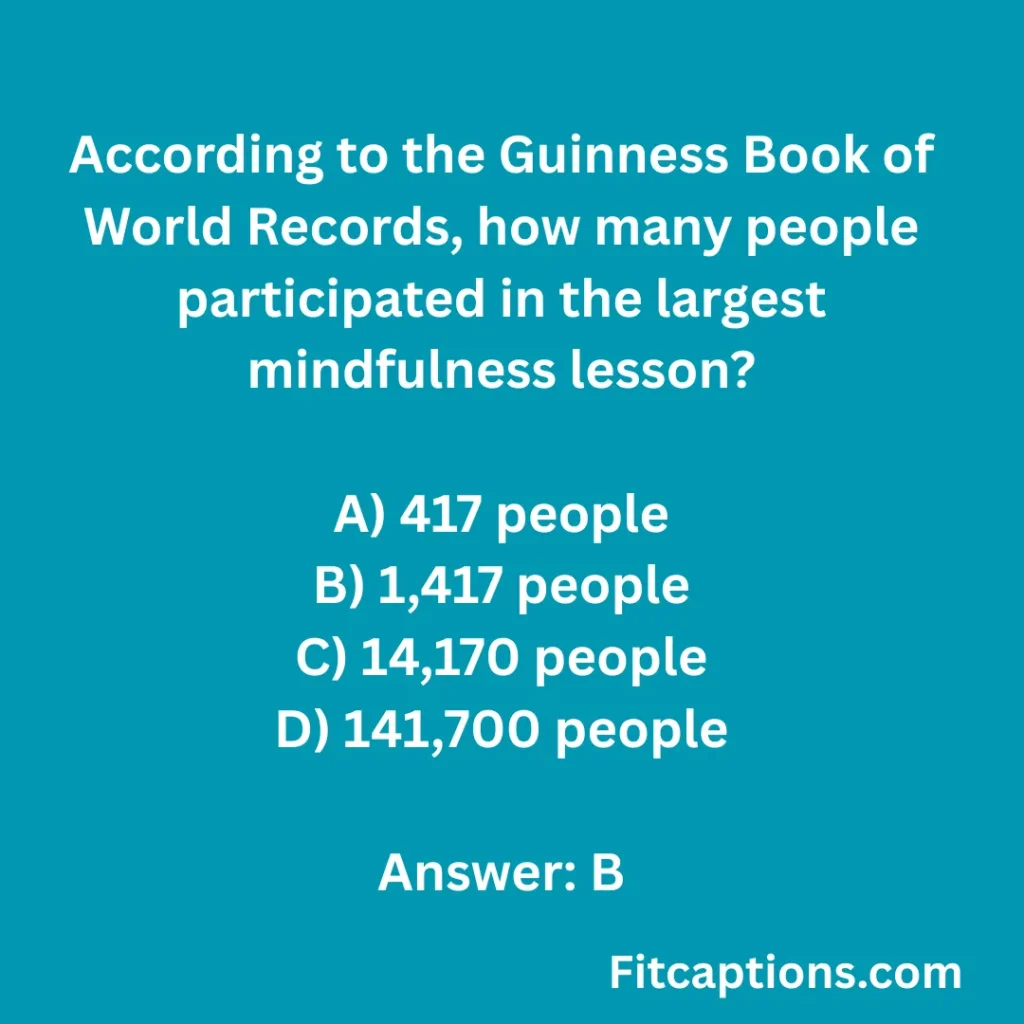
1. According to the Guinness Book of World Records, how many people participated in the largest mindfulness lesson?
A) 417 people
B) 1,417 people
C) 14,170 people
D) 141,700 people
Answer: B
2. When is the earliest recorded practice of meditation believed to have originated?
A) Around 500 BCE
B) Around 1500 BCE
C) Around 5000 BCE
D) Around 1500 CE
Answer: B
3. Which famous Apple co-founder was known for his deep interest in meditation and Zen Buddhism?
A) Steve Wozniak
B) Tim Cook
C) Steve Jobs
D) Jony Ive
Answer: C
4. Vipassana, one of the most ancient forms of meditation, originated in which country?
A) China
B) Japan
C) India
D) Thailand
Answer: C
5. Which country has the highest percentage of its population practicing meditation, at around 79%?
A) United States
B) India
C) China
D) Pakistan
Answer: B
6. The English word “meditation” is derived from which Latin verb?
A) Meditari
B) Medius
C) Medicus
D) Memor
Answer: A
7. Mindfulness as a meditation practice originated in which religious tradition?
A) Hinduism
B) Buddhism
C) Jainism
D) Taoism
Answer: B
8. The earliest written records of meditation (dhyana) are found in which ancient Hindu texts?
A) The Upanishads
B) The Puranas
C) The Vedas
D) The Ramayana
Answer: C
9. On average, how long does it take for a meditation practice to begin changing your brain?
A) 1 day
B) 1 week
C) 8 weeks
D) 6 months
Answer: C
10. According to a 2025 study, meditating can reduce pain intensity by approximately what percentage?
A) 10%
B) 33%
C) 50%
D) 75%
Answer: B
11. What is the Sanskrit word for mindfulness, from which the Eastern concept originates?
A) Dhyana
B) Samadhi
C) Smriti
D) Karma
Answer: C
12. Which ancient Jewish mystical tradition involves meditation practices?
A) Kabbalah
B) Hasidism
C) Talmud
D) Zohar
Answer: A
13. Approximately what percentage of adults in the United States have tried meditation at least once?
A) 14%
B) 34%
C) 54%
D) 74%
Answer: C
14. The goal of Anapanasati meditation in Buddhism is mindfulness of what?
A) Breathing
B) Eating
C) Walking
D) Body sensations
Answer: A
15. Since 2018, the global percentage of people who meditate has increased from 29% to what percentage in 2025?
A) 25%
B) 35%
C) 45%
D) 55%
Answer: B
16. According to a 2024 study, which of the following is true about altered states of consciousness induced by meditation?
A) They are always negative
B) They are always positive
C) They are mostly positive but can sometimes be linked to suffering
D) They only occur in experienced meditators
Answer: C
17. The earliest documented evidence of meditation, showing people in seated postures with half-closed eyes, dates back to approximately what time?
A) 500 to 1,000 BCE
B) 1,500 to 2,000 BCE
C) 3,500 to 5,000 BCE
D) 5,000 to 7,000 BCE
Answer: C
18. According to a 2025 survey, approximately what proportion of Australian adults have meditated in the past year?
A) One-fifth
B) One-quarter
C) One-third
D) One-half
Answer: C
19. What is the primary objective of Focused Attention meditation?
A) To think about nothing
B) To concentrate on a specific object, like the breath
C) To recall past memories
D) To solve complex problems
Answer: B
20. According to a 2025 survey, what percentage of both frequent smokers and drinkers report meditating often?
A) 12%
B) 22%
C) 32%
D) 42%
Answer: B
Related : 128+ Superhero Quiz Questions and Answers
Short Meditation Trivia Questions And Answers
1. What do people often say happens when you meditate too long?
A) You float away
B) You fall asleep
C) You turn invisible
D) You become a guru instantly
Answer: B) You fall asleep
2. What’s the classic meditation pose called?
A) Pretzel pose
B) Lotus pose
C) Pizza pose
D) Couch potato pose
Answer: B) Lotus pose
3. What sound is often used in meditation?
A) Moo
B) Om
C) Boom
D) Zoom
Answer: B) Om
4. What’s the funniest thing beginners say during meditation?
A) “Is it over yet?”
B) “I’m hungry.”
C) “My leg is asleep.”
D) All of the above
Answer: D) All of the above
5. What’s the main goal of meditation?
A) Inner peace
B) Winning arguments
C) Growing taller
D) Becoming a superhero
Answer: A) Inner peace
6. What do people joke about meditation apps?
A) They make you nap faster
B) They whisper too much
C) They sound like robots
D) All of the above
Answer: D) All of the above
7. What’s the funniest place people try to meditate?
A) In traffic
B) At the gym
C) In a noisy café
D) All of the above
Answer: D) All of the above
8. What happens if you meditate with pets around?
A) They join you
B) They lick your face
C) They sit on your lap
D) All of the above
Answer: D) All of the above
9. What’s the nickname for someone who meditates daily?
A) Zen master
B) Chill champion
C) Nap ninja
D) Calm commander
Answer: A) Zen master
10. What’s the funniest thing to imagine during meditation?
A) Dancing llamas
B) Flying donuts
C) Singing cats
D) All of the above
Answer: D) All of the above
11. What’s the common beginner mistake in meditation?
A) Thinking too much
B) Snoring loudly
C) Checking phone
D) All of the above
Answer: D) All of the above
12. What’s the funniest meditation mantra?
A) “I want pizza.”
B) “Don’t fall asleep.”
C) “Stay calm, stay cool.”
D) All of the above
Answer: D) All of the above
13. What’s the funniest meditation accessory?
A) Giant cushion
B) Scented donut candle
C) Headphones shaped like ears
D) All of the above
Answer: A) Giant cushion
14. What’s the funniest meditation advice?
A) “Don’t think about not thinking.”
B) “Breathe like a dragon.”
C) “Sit like a potato.”
D) “Float like a balloon.”
Answer: A) “Don’t think about not thinking.”
15. What’s the funniest meditation challenge?
A) Meditate while laughing
B) Meditate while eating
C) Meditate while dancing
D) Meditate while sneezing
Answer: A) Meditate while laughing
16. What’s the funniest meditation soundtrack?
A) Whale songs
B) Cat meows
C) Pizza sizzling
D) All of the above
Answer: D) All of the above
17. What’s the funniest meditation teacher nickname?
A) Guru Giggles
B) Master Nap
C) Captain Calm
D) Professor Peace
Answer: A) Guru Giggles
18. What’s the funniest meditation outcome?
A) You dream of snacks
B) You forget your worries
C) You forget your shoes
D) All of the above
Answer: D) All of the above
19. What’s the funniest meditation position?
A) Upside‑down lotus
B) Couch slouch
C) Bed sprawl
D) All of the above
Answer: D) All of the above
20. What’s the funniest meditation motto?
A) “Keep calm and nap on.”
B) “Om is where the heart is.”
C) “Breathe in pizza, breathe out stress.”
D) All of the above
Answer: D) All of the above
Best Meditation Trivia Questions And Answers
1. What is the approximate origin of the earliest written records of meditation?
A) Around 500 BCE
B) Around 1500 BCE in the Vedas of ancient India
C) Around 1000 CE in Europe
D) Around 3000 BCE in Egypt
Answer: B
2. In which ancient tradition do the earliest documented mentions of meditation (dhyana) primarily appear?
A) Ancient Greek philosophy
B) Hinduism / Vedic traditions
C) Mayan civilization
D) Norse mythology
Answer: B
3. What does the word “meditation” derive from in Latin?
A) “Meditatum,” meaning to ponder or think over
B) “Meditari,” meaning to exercise
C) “Meditus,” meaning peaceful
D) “Medicus,” meaning healer
Answer: A
4. Which of these is one of the most popular modern meditation techniques focused on present-moment awareness?
A) Transcendental Meditation
B) Mindfulness meditation
C) Mantra chanting only
D) Dream analysis
Answer: B
5. Roughly how many people worldwide practice meditation?
A) 10–50 million
B) 200–500 million
C) Over 1 billion
D) Less than 5 million
Answer: B
6. Which country has shown very high per capita interest in meditation based on trends?
A) India
B) United States
C) Australia
D) Japan
Answer: C
7. What is the primary focus of “Metta” or Loving-Kindness meditation?
A) Focusing only on breath
B) Cultivating goodwill and compassion toward oneself and others
C) Visualizing future success
D) Analyzing past traumas
Answer: B
8. Vipassana meditation is also known as:
A) Insight meditation
B) Walking meditation
C) Sleep meditation
D) Group chanting
Answer: A
9. Which ancient figure is credited with spreading meditation practices through Buddhism around 600–500 BCE?
A) Confucius
B) Siddhartha Gautama (the Buddha)
C) Lao Tzu
D) Patanjali
Answer: B
10. What is a common benefit of regular meditation supported by scientific studies?
A) It has no effect on the body
B) Reduced stress and improved immune function
C) Increased heart rate
D) Decreased focus
Answer: B
11. Zen meditation (Zazen) primarily comes from which tradition?
A) Hindu
B) Buddhist (Japanese)
C) Christian contemplative
D) Sufi
Answer: B
12. What is the largest recorded group meditation event mentioned in records?
A) Over 33,000 participants led by Deepak Chopra in 2014
B) 500 people in ancient India
C) 1,000 in a modern app event
D) 100 monks in Tibet
Answer: A
13. Mindfulness-Based Stress Reduction (MBSR) was developed by:
A) Jon Kabat-Zinn
B) The Dalai Lama
C) Oprah Winfrey
D) Deepak Chopra
Answer: A
14. Which of these is NOT a common type of meditation?
A) Focused attention (e.g., on breath)
B) Open monitoring (mindfulness)
C) Loving-kindness
D) Extreme physical exercise
Answer: D
15. Meditation has been shown to potentially help with which of the following?
A) Only spiritual enlightenment
B) Anxiety, depression, and blood pressure
C) Only improving memory
D) Nothing measurable
Answer: B
16. The Yoga Sutras of Patanjali, which outline meditation practices, were compiled around:
A) 400–100 BCE
B) 2000 CE
C) 1000 BCE
D) 500 CE
Answer: A
17. What is a key element of Transcendental Meditation (TM)?
A) Use of a personal mantra
B) Only group sessions
C) Physical postures only
D) Fasting
Answer: A
18. Which city is often cited as having high per capita interest in meditation?
A) New York
B) Melbourne, Australia
C) Tokyo
D) Mumbai
Answer: B
19. Body scan meditation primarily involves:
A) Focusing attention sequentially on different parts of the body
B) Chanting loudly
C) Walking in circles
D) Staring at a candle for hours
Answer: A
20. One notable meditation fact involves:
A) The largest simultaneous online meditation lesson with thousands of participants
B) The longest single meditation session of 1 hour
C) Meditation in space
D) Meditation while skydiving
Answer: A
Easy Meditation Trivia Questions And Answers
1. What is meditation mainly used for?
A) Making noise
B) Calming the mind
C) Running faster
D) Painting pictures
Answer: B) Calming the mind
2. Which part of the body is often used as a meditation focus?
A) Breath
B) Hair
C) Hands
D) Shoulders
Answer: A) Breath
3. What is a good place for meditation?
A) A noisy road
B) A quiet room
C) A crowded mall
D) A football field
Answer: B) A quiet room
4. What should you do if your mind starts to wander?
A) Panic
B) Stop forever
C) Bring it back gently
D) Start shouting
Answer: C) Bring it back gently
5. How long can a beginner meditate?
A) A few minutes
B) A whole day
C) One month
D) Ten seconds only
Answer: A) A few minutes
6. What does meditation often help reduce?
A) Stress
B) Height
C) Hair growth
D) Shoes size
Answer: A) Stress
7. What should your breathing be like during meditation?
A) Fast and tense
B) Natural and relaxed
C) Very loud
D) Held tightly
Answer: B) Natural and relaxed
8. What is mindfulness?
A) Sleeping deeply
B) Paying attention to now
C) Forgetting everything
D) Talking nonstop
Answer: B) Paying attention to now
9. What kind of feeling does meditation usually bring?
A) Calmness
B) Anger
C) Confusion
D) Noise
Answer: A) Calmness
10. Do you need special tools to meditate?
A) Yes, many tools
B) No, you do not
C) Only a phone
D) Only a book
Answer: B) No, you do not
11. What is a mantra?
A) A type of food
B) A repeated word or phrase
C) A dance move
D) A machine
Answer: B) A repeated word or phrase
12. What is guided meditation?
A) Meditation with instructions
B) Meditation while driving
C) Meditation in water
D) Meditation with music only
Answer: A) Meditation with instructions
13. Which of these is a benefit of meditation?
A) Better focus
B) More stress
C) Less sleep
D) More anger
Answer: A) Better focus
14. Can children meditate?
A) No
B) Yes
C) Only at night
D) Only with headphones
Answer: B) Yes
15. How should you sit while meditating?
A) Comfortably
B) Uncomfortably
C) Upside down
D) Running
Answer: A) Comfortably
16. What is one thing meditation can improve over time?
A) Self-awareness
B) Shoe size
C) Voice volume
D) Car speed
Answer: A) Self-awareness
17. What should you do with thoughts during meditation?
A) Fight them
B) Observe them and let them pass
C) Shout at them
D) Write them all down immediately
Answer: B) Observe them and let them pass
18. Is meditation only for adults?
A) Yes
B) No
C) Only for athletes
D) Only for teachers
Answer: B) No
19. What is one simple meditation technique?
A) Counting breaths
B) Playing games
C) Watching TV
D) Cooking food
Answer: A) Counting breaths
20. What is the best way to start meditating?
A) Start small and practice regularly
B) Wait until perfect
C) Meditate only once
D) Stop if distracted
Answer: A) Start small and practice regularly
Meditation Trivia Questions And Answers One Liners
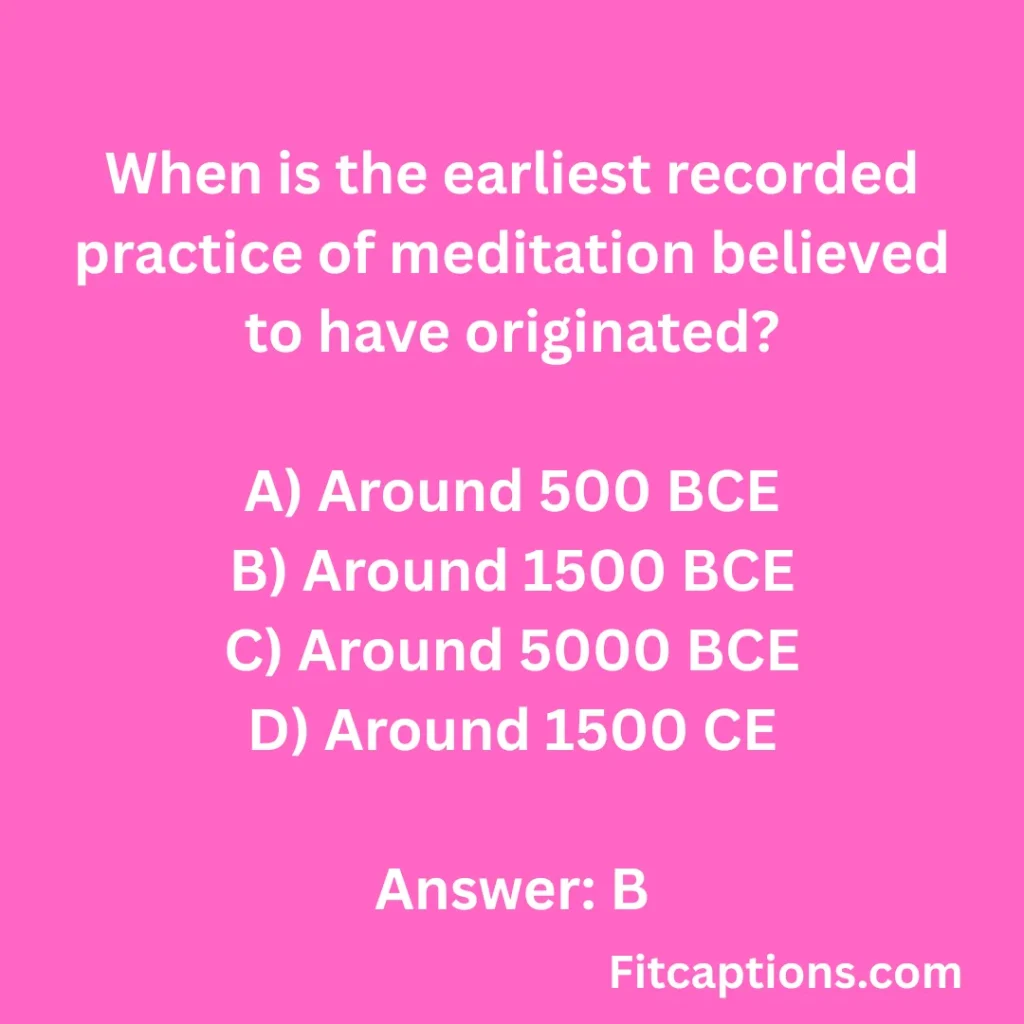
1. When is the earliest recorded practice of meditation believed to have originated?
A) Around 500 BCE
B) Around 1500 BCE
C) Around 5000 BCE
D) Around 1500 CE
Answer: B
2. The earliest written records of meditation (dhyana) are found in which ancient Hindu texts?
A) The Upanishads
B) The Puranas
C) The Vedas
D) The Ramayana
Answer: C
3. Which famous Apple co-founder was known for his deep interest in meditation and Zen Buddhism?
A) Steve Wozniak
B) Tim Cook
C) Steve Jobs
D) Jony Ive
Answer: C
4. Vipassana, one of the most ancient forms of meditation, originated in which country?
A) China
B) Japan
C) India
D) Thailand
Answer: C
5. Which country has the highest percentage of its population practicing meditation, at around 79%?
A) United States
B) India
C) China
D) Pakistan
Answer: B
6. The English word “meditation” is derived from which Latin verb?
A) Meditari
B) Medius
C) Medicus
D) Memor
Answer: A
7. Mindfulness as a meditation practice originated in which religious tradition?
A) Hinduism
B) Buddhism
C) Jainism
D) Taoism
Answer: B
8. On average, how long does it take for a meditation practice to begin changing your brain?
A) 1 day
B) 1 week
C) 8 weeks
D) 6 months
Answer: C
9. According to a 2025 study, meditating can reduce pain intensity by approximately what percentage?
A) 10%
B) 33%
C) 50%
D) 75%
Answer: B
10. What is the Sanskrit word for mindfulness, from which the Eastern concept originates?
A) Dhyana
B) Samadhi
C) Smriti
D) Karma
Answer: C
11. Which ancient Jewish mystical tradition involves meditation practices?
A) Kabbalah
B) Hasidism
C) Talmud
D) Zohar
Answer: A
12. Approximately what percentage of adults in the United States have tried meditation at least once?
A) 14%
B) 34%
C) 54%
D) 74%
Answer: C
13. The goal of Anapanasati meditation in Buddhism is mindfulness of what?
A) Breathing
B) Eating
C) Walking
D) Body sensations
Answer: A
14. Since 2018, the global percentage of people who meditate has increased from 29% to what percentage in 2025?
A) 25%
B) 35%
C) 45%
D) 55%
Answer: B
15. According to a 2024 study, altered states of consciousness induced by meditation are mostly positive but can sometimes be linked to what?
A) Happiness
B) Suffering
C) Confusion
D) Fatigue
Answer: B
16. The earliest documented evidence of meditation, showing people in seated postures with half-closed eyes, dates back to approximately what time?
A) 500 to 1,000 BCE
B) 1,500 to 2,000 BCE
C) 3,500 to 5,000 BCE
D) 5,000 to 7,000 BCE
Answer: C
17. According to a 2025 survey, approximately what proportion of Australian adults have meditated in the past year?
A) One-fifth
B) One-quarter
C) One-third
D) One-half
Answer: C
18. What is the primary objective of Focused Attention meditation?
A) To think about nothing
B) To concentrate on a specific object, like the breath
C) To recall past memories
D) To solve complex problems
Answer: B
19. According to a 2025 survey, what percentage of both frequent smokers and drinkers report meditating often?
A) 12%
B) 22%
C) 32%
D) 42%
Answer: B
20. What is the primary difference between mindfulness and meditation?
A) Mindfulness is a structured practice; meditation is being present
B) Mindfulness is present-moment awareness; meditation is a structured practice to train it
C) They are exactly the same thing
D) Mindfulness requires a teacher; meditation does not
Answer: B
FAQS
What is a fun fact about meditation?
A fun fact about meditation is that just a few minutes of meditation can help reduce stress and improve focus. Studies have shown that regular meditation may even change certain parts of the brain associated with attention, emotional regulation, and memory.
Another interesting fact is that meditation has been practiced for thousands of years, with roots in ancient cultures across Asia, yet it remains popular today for improving mental well-being.
What are the 7 types of meditation?
Here are seven common types of meditation:
- Mindfulness Meditation
Focuses on observing thoughts, feelings, and sensations without judgment. - Loving-Kindness Meditation (Metta)
Encourages compassion and positive feelings toward yourself and others. - Guided Meditation
Involves following the instructions of a teacher, recording, or app. - Transcendental Meditation
Uses a repeated mantra to help the mind settle into a state of deep relaxation. - Spiritual Meditation
Focuses on spiritual growth, reflection, or connection with a higher power. - Focused Meditation
Concentrates attention on a single object, sound, breath, or sensation. - Movement Meditation
Combines mindfulness with physical movement, such as yoga, tai chi, or walking meditation.
What are some mindfulness questions?
Mindfulness questions can help you become more aware of your thoughts, emotions, and surroundings.
Self-Reflection Questions
- What am I feeling right now?
- What thoughts are occupying my mind?
- What am I grateful for today?
- How is my body feeling at this moment?
- What do I need most right now?
Present-Moment Awareness Questions
- What can I see around me?
- What sounds can I hear?
- What scents do I notice?
- Am I fully focused on what I’m doing?
- What is happening right now that I might usually overlook?
Stress and Well-Being Questions
- What is causing me stress today?
- Can I let go of something I cannot control?
- How can I show myself kindness today?
- What positive thing happened today?
- What would help me feel more balanced?
These mindfulness questions are excellent for journaling, meditation sessions, classroom activities, or personal growth exercises. 🌱✨
Final Thoughts
Exploring the world of meditation can be both educational and inspiring. These meditation trivia questions and answers offer an enjoyable way to learn about the origins, benefits, and practices associated with mindfulness and meditation.
Whether you use them for a quiz night, classroom activity, or personal growth, they can help deepen your understanding of this powerful practice. Keep learning, stay mindful, and share these trivia questions with others to spread awareness about the positive impact meditation can have on everyday life.
You May Also Like:
128+ The Godfather Trivia Questions and Answers
135+ Best Bangkok Quiz Questions and Answers
124+ Inspiring Women’s History Quiz Questions and Answers
137+ Fun Ariana Grande Trivia Questions and Answers