
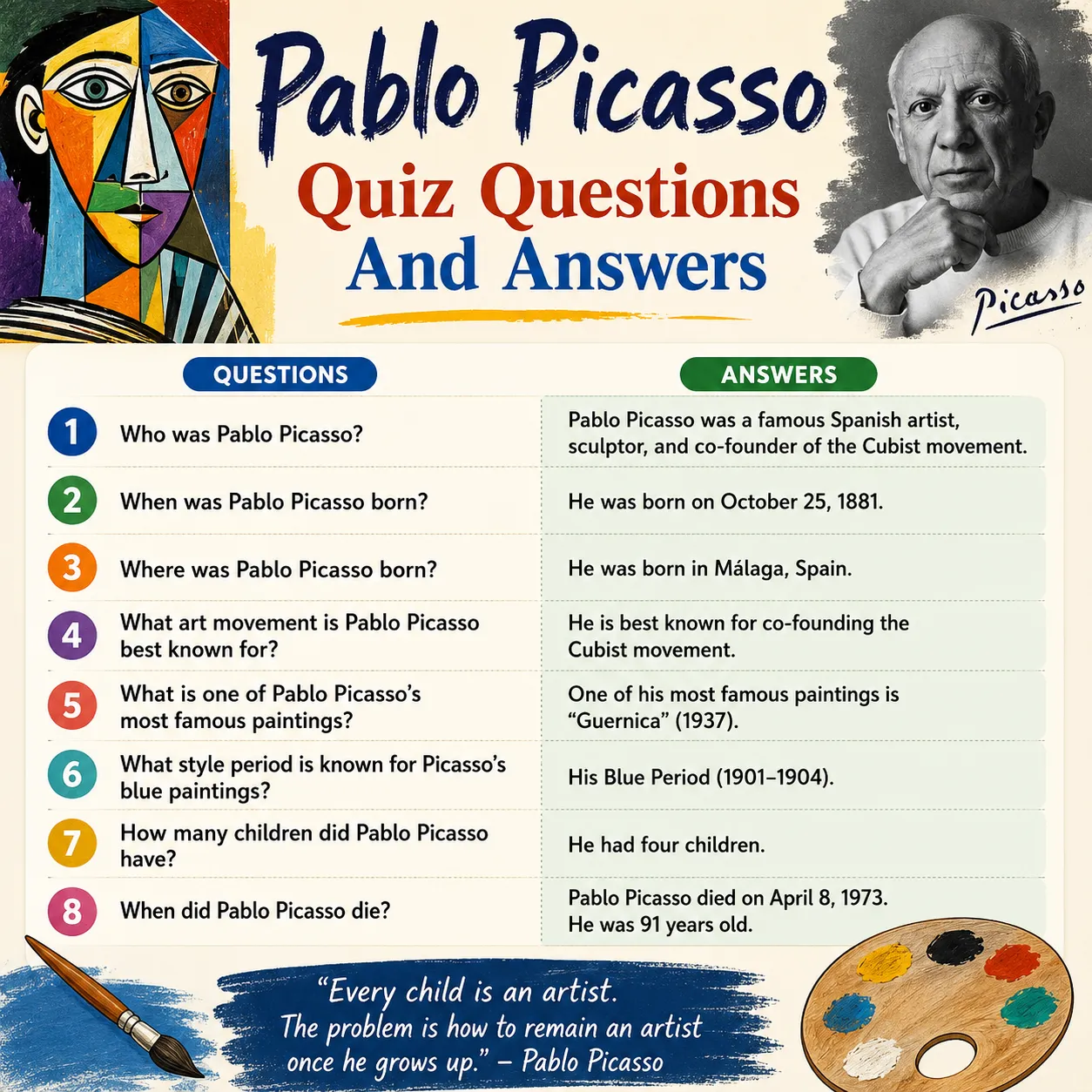
Pablo Picasso is one of the most influential artists in history. Famous for co-founding Cubism, creating thousands of works of art, and constantly reinventing his style, Picasso transformed modern art forever.
Whether you’re an art student, teacher, museum enthusiast, or simply curious about one of the world’s greatest painters, these Pablo Picasso Quiz Questions and Answers are a fun way to test your knowledge.
This collection features 126 carefully selected trivia questions covering Picasso’s life, paintings, artistic periods, Cubism, sculptures, interesting facts, and lasting legacy. The quiz includes easy, medium, hard, true or false, multiple-choice, and fun trivia suitable for all ages.
Let’s see if you have what it takes to become a Picasso expert!
Who Was Pablo Picasso?
Pablo Picasso (1881–1973) was a Spanish painter, sculptor, printmaker, ceramicist, and stage designer. He is widely regarded as one of the greatest and most influential artists of the 20th century.
Born in Málaga, Spain, Picasso showed extraordinary artistic talent from a young age. Throughout his long career, he created more than 20,000 works of art, including paintings, drawings, sculptures, ceramics, and prints.
Picasso is best known for helping develop Cubism, a revolutionary art movement that changed the way artists represented people and objects.
Pablo Picasso Quiz Questions And Answers In English
1. What was Pablo Picasso’s full name?
A. Pablo Ruiz Picasso
B. Pablo Diego Picasso
C. Pablo José Ruiz
D. Pablo Juan Picasso
Answer: A. Pablo Ruiz Picasso
2. What country was Pablo Picasso from?
A. France
B. Spain
C. Italy
D. Portugal
Answer: B. Spain
3. In which city was Picasso born?
A. Madrid
B. Barcelona
C. Málaga
D. Seville
Answer: C. Málaga
4. When was Picasso born?
A. 1871
B. 1881
C. 1891
D. 1901
Answer: B. 1881
5. What was Picasso’s profession?
A. Painter and sculptor
B. Singer and actor
C. Athlete and coach
D. Writer and lawyer
Answer: A. Painter and sculptor
6. Which art movement did Picasso help create?
A. Romanticism
B. Cubism
C. Impressionism
D. Realism
Answer: B. Cubism
7. Who worked with Picasso to develop Cubism?
A. Vincent van Gogh
B. Georges Braque
C. Claude Monet
D. Salvador Dalí
Answer: B. Georges Braque
8. What is one of Picasso’s most famous paintings?
A. Guernica
B. The Starry Night
C. Mona Lisa
D. The Scream
Answer: A. Guernica
9. What year did Picasso paint Guernica?
A. 1907
B. 1917
C. 1937
D. 1947
Answer: C. 1937
10. What is the name of Picasso’s famous painting that introduced Cubism?
A. The Blue Room
B. Les Demoiselles d’Avignon
C. The Old Guitarist
D. Girl before a Mirror
Answer: B. Les Demoiselles d’Avignon
11. What style did Picasso create during his Blue Period?
A. Dark and blue-toned paintings
B. Bright landscapes
C. Comic strips
D. Abstract sculpture only
Answer: A. Dark and blue-toned paintings
12. What period followed Picasso’s Blue Period?
A. Gold Period
B. Rose Period
C. Silver Period
D. Green Period
Answer: B. Rose Period
13. What did Picasso also work on besides painting?
A. Sculpture and ceramics
B. Racing and boxing
C. Acting and dancing
D. Cooking and farming
Answer: A. Sculpture and ceramics
14. Where did Picasso move in 1904?
A. London
B. Paris
C. Berlin
D. Rome
Answer: B. Paris
15. What was Picasso’s father’s job?
A. Art teacher
B. Doctor
C. Sailor
D. Engineer
Answer: A. Art teacher
16. What was Picasso’s mother’s surname?
A. Lopez
B. Garcia
C. Ruiz
D. Torres
Answer: A. Lopez
17. What famous museum in Paris is dedicated to Picasso’s work?
A. Louvre Museum
B. Picasso Museum
C. Orsay Museum
D. Rodin Museum
Answer: B. Picasso Museum
18. What year did Picasso die?
A. 1963
B. 1973
C. 1983
D. 1993
Answer: B. 1973
19. What kind of artist was Picasso?
A. Spanish-born French artist
B. American poet
C. German composer
D. Italian architect
Answer: A. Spanish-born French artist
20. Why is Picasso famous today?
A. He changed modern art with bold new styles
B. He wrote many novels
C. He invented photography
D. He designed airplanes
Answer: A. He changed modern art with bold new styles
Related : 101+ J.K. Rowling Quiz Questions And Answers
Funny Pablo Picasso Quiz Questions And Answers
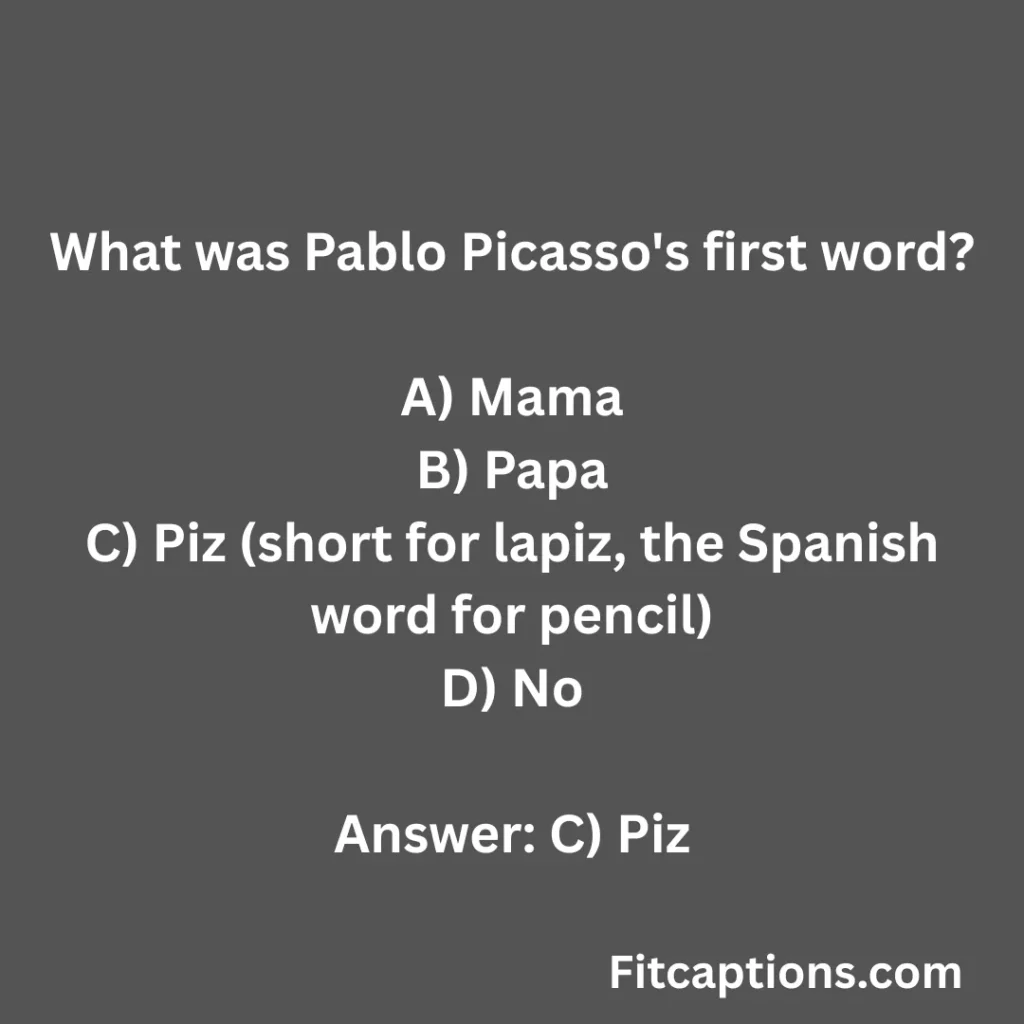
1. What was Pablo Picasso’s first word?
A) Mama
B) Papa
C) Piz (short for lapiz, the Spanish word for pencil)
D) No
Answer: C) Piz
2. What did Picasso’s uncle, a doctor, do to save him after he was mistakenly declared stillborn at birth?
A) Gave him mouth-to-mouth
B) Blew cigar smoke in his face
C) Spanked him
D) Dunked him in cold water
Answer: B) Blew cigar smoke in his face
3. How did Picasso prefer to sign his works in his later career?
A) Ruiz Blasco (his father’s name)
B) P.R-Picasso
C) Diego Ruiz
D) Picasso (his mother’s maiden name)
Answer: D) Picasso (his mother’s maiden name)
4. Which unusual item did Picasso carry around with him, loaded with blanks?
A) A camera
B) A letter opener
C) A sword
D) A revolver
Answer: D) A revolver
5. On whom did Picasso reportedly use his revolver?
A) Art critics who gave him bad reviews
B) Admirers who asked about the meaning of his paintings
C) People who tried to steal his work
D) His art dealers
Answer: B) Admirers who asked about the meaning of his paintings
6. How tall was Pablo Picasso?
A) 5 feet 4 inches
B) 5 feet 10 inches
C) 6 feet 2 inches
D) 4 feet 11 inches
Answer: A) 5 feet 4 inches
7. What was a requirement for Picasso’s mistresses?
A) They had to be artists themselves
B) They had to be taller than him
C) They had to be shorter than him
D) They had to be from France
Answer: C) They had to be shorter than him
8. What was the name of Picasso’s pet monkey?
A) Monina
B) Coco
C) Fifi
D) Guernica
Answer: A) Monina
9. What did Picasso’s pet monkey famously take from his hands?
A) His paintbrushes
B) His cigarettes
C) His wallet
D) His hat
Answer: B) His cigarettes
10. What did Picasso claim was “his one and only master”?
A) His father
B) Paul Cézanne
C) Georges Braque
D) Vincent van Gogh
Answer: B) Paul Cézanne
11. At what age did Picasso’s father quit painting because he felt his son had surpassed him?
A) 9
B) 11
C) 13
D) 15
Answer: C) 13
12. Which painting was Picasso suspected of stealing in 1911?
A) The Scream
B) Starry Night
C) The Mona Lisa
D) The Last Supper
Answer: C) The Mona Lisa
13. Why did Picasso’s “Blue Period” begin?
A) He ran out of other colors
B) He was inspired by the ocean
C) The suicide of his friend Carlos Casagemas
D) A commission from a wealthy collector
Answer: C) The suicide of his friend Carlos Casagemas
14. In what unusual way did Picasso sometimes pay his bills?
A) With IOUs
B) With drawings
C) With post-dated checks
D) With his pet monkey
Answer: B) With drawings
15. What did Picasso have to do to keep warm in his early days in Montmartre?
A) Wear all his clothes at once
B) Burn some of his own paintings
C) Move to a warmer city
D) Share a bed with friends
Answer: B) Burn some of his own paintings
16. What did Picasso do in school when he was thrown into detention?
A) He slept
B) He read books
C) He drew incessantly
D) He planned his escape
Answer: C) He drew incessantly
17. Besides painting, which of these did Picasso also do?
A) He was a poet and playwright
B) He was a musician
C) He was a professional boxer
D) He was a chef
Answer: A) He was a poet and playwright
18. What replaced the harlequin as a common motif in Picasso’s work during the 1930s?
A) The dove
B) The bull/minotaur
C) The horse
D) The guitar
Answer: B) The bull/minotaur
19. What did Picasso’s friends reportedly do with his hair and nail clippings?
A) They sold them
B) They kept them as souvenirs
C) Nothing; he burned them
D) He kept them out of fear someone would use them for a curse
Answer: D) He kept them out of fear someone would use them for a curse
20. What did Picasso do when he was a student to protest against authority?
A) He didn’t show up to class
B) He painted over his schoolwork
C) He brought a pigeon from his father’s pigeon cote to class
D) He talked back to the teachers
Answer: C) He brought a pigeon from his father’s pigeon cote to class
Related: 135+ Women Authors Quiz Questions And Answers
Easy Pablo Picasso Quiz Questions And Answers
1. Pablo Picasso was born in… A) France B) Spain C) Italy D) Portugal Answer: B) Spain
2. Picasso was famous as a… A) Musician B) Painter C) Chef D) Athlete Answer: B) Painter
3. Picasso co‑founded which art movement? A) Impressionism B) Cubism C) Surrealism D) Realism Answer: B) Cubism
4. Picasso’s famous anti‑war painting is… A) Guernica B) Mona Lisa C) The Scream D) Starry Night Answer: A) Guernica
5. Picasso spent most of his adult life in… A) Spain B) France C) Italy D) Germany Answer: B) France
6. Picasso’s “Blue Period” paintings were mostly… A) Happy B) Sad C) Funny D) Bright Answer: B) Sad
7. Picasso’s “Rose Period” paintings were mostly… A) Dark B) Cheerful C) Scary D) Abstract Answer: B) Cheerful
8. Picasso’s father was a… A) Doctor B) Artist C) Farmer D) Teacher Answer: B) Artist
9. Picasso’s full name is famously… A) Very long B) Very short C) Just “Pablo Picasso” D) Unknown Answer: A) Very long
10. Picasso painted in how many styles? A) One B) Many C) Two D) None Answer: B) Many
11. Picasso’s art often showed… A) Realistic faces B) Abstract shapes C) Landscapes only D) Animals only Answer: B) Abstract shapes
12. Picasso was also known for making… A) Ceramics B) Jewelry C) Cars D) Buildings Answer: A) Ceramics
13. Picasso’s famous painting “Les Demoiselles d’Avignon” was created in… A) 1907 B) 1920 C) 1935 D) 1950 Answer: A) 1907
14. Picasso’s art often broke… A) Rules of perspective B) Rules of cooking C) Rules of music D) Rules of sports Answer: A) Rules of perspective
15. Picasso lived to the age of… A) 50 B) 91 C) 70 D) 60 Answer: B) 91
16. Picasso’s famous dove drawing became a symbol of… A) Peace B) War C) Love D) Freedom Answer: A) Peace
17. Picasso’s first exhibition was held when he was… A) 13 B) 20 C) 25 D) 30 Answer: A) 13
18. Picasso’s art is displayed in museums… A) Only in Spain B) All over the world C) Only in France D) Only in Italy Answer: B) All over the world
19. Picasso’s style often included… A) Broken shapes B) Bright colors C) Strange faces D) All of the above Answer: D) All of the above
20. Picasso’s nationality was… A) French B) Spanish C) Italian D) German Answer: B) Spanish
Best Pablo Picasso Quiz Questions And Answers
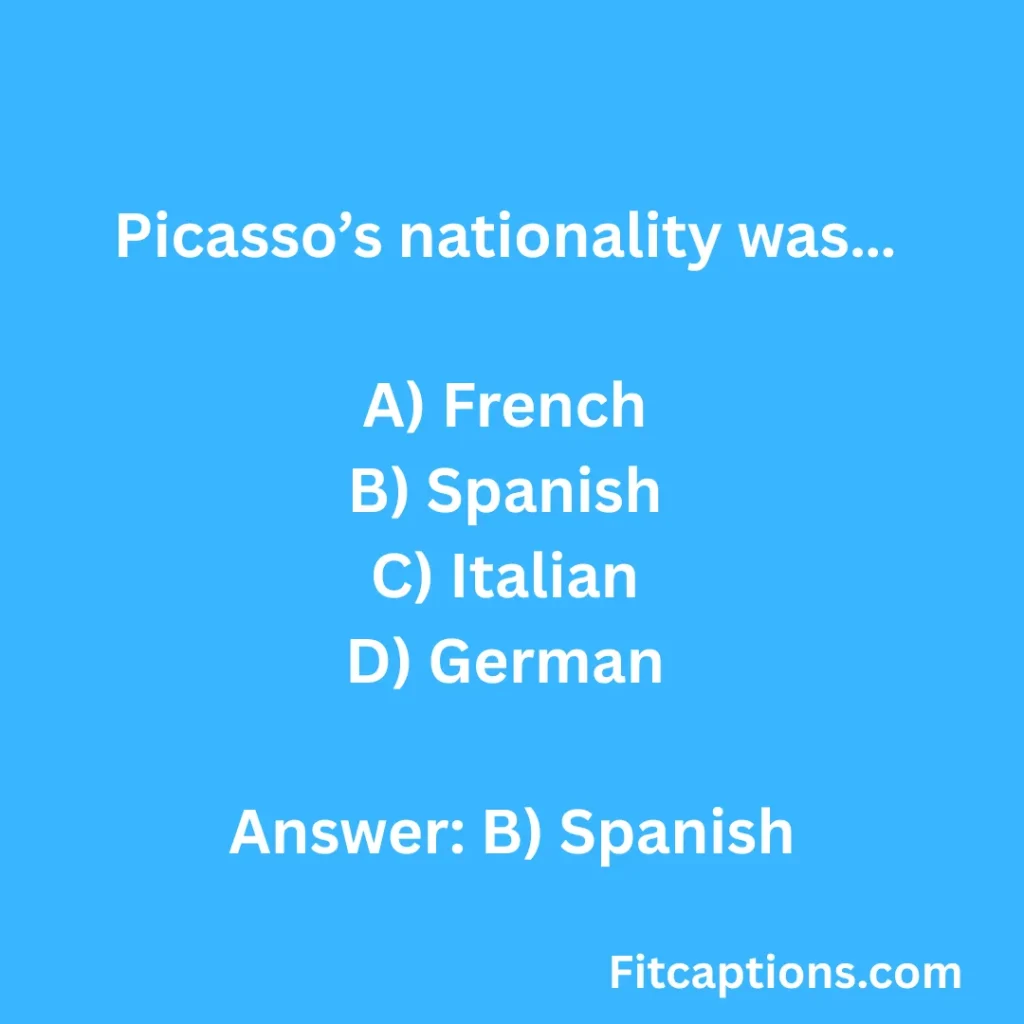
1. What is Pablo Picasso’s nationality?
A) Spanish
B) French
C) Italian
D) Portuguese
Answer: A) Spanish
2. In which art movement is Pablo Picasso considered a pioneer?
A) Impressionism
B) Cubism
C) Surrealism
D) Realism
Answer: B) Cubism
3. What was Picasso’s full name?
A) Pablo Diego José Francisco de Paula Juan Nepomuceno María de los Remedios Cipriano de la Santísima Trinidad Ruiz y Picasso
B) Pablo Ruiz Picasso
C) Pablo Diego Picasso
D) Francisco Picasso
Answer: A) Pablo Diego José Francisco de Paula Juan Nepomuceno María de los Remedios Cipriano de la Santísima Trinidad Ruiz y Picasso
4. Which famous painting did Picasso create in response to the bombing of Guernica?
A) Les Demoiselles d’Avignon
B) Guernica
C) The Weeping Woman
D) The Old Guitarist
Answer: B) Guernica
5. In which period of Picasso’s career did he use mostly blue tones?
A) Rose Period
B) Blue Period
C) Cubist Period
D) African Period
Answer: B) Blue Period
6. How many artworks did Picasso create in his lifetime?
A) Around 2,000
B) Over 50,000
C) 10,000
D) 500
Answer: B) Over 50,000
7. What was Picasso’s first word as a child?
A) Mama
B) Piz (short for lápiz, meaning pencil)
C) Papa
D) Paint
Answer: B) Piz (short for lápiz, meaning pencil)
8. Which famous artist was Picasso’s close friend and rival?
A) Salvador Dalí
B) Henri Matisse
C) Vincent van Gogh
D) Claude Monet
Answer: B) Henri Matisse
9. Picasso joined the Communist Party in:
A) 1944
B) 1936
C) 1950
D) 1960
Answer: A) 1944
10. What style did Picasso help invent along with Georges Braque?
A) Cubism
B) Fauvism
C) Expressionism
D) Abstract Expressionism
Answer: A) Cubism
11. Picasso’s most expensive painting sold at auction is:
A) Les Femmes d’Alger
B) Guernica
C) The Old Guitarist
D) Boy with a Pipe
Answer: A) Les Femmes d’Alger
12. In which city did Picasso spend most of his adult life?
A) Madrid
B) Paris
C) Barcelona
D) New York
Answer: B) Paris
13. Picasso had how many children?
A) 2
B) 4
C) 6
D) 8
Answer: B) 4
14. What period of Picasso’s work is known for warm colors and circus themes?
A) Blue Period
B) Rose Period
C) Analytic Cubism
D) Synthetic Cubism
Answer: B) Rose Period
15. Picasso died in which year?
A) 1973
B) 1960
C) 1980
D) 1955
Answer: A) 1973
16. Which museum in Paris has the largest collection of Picasso’s works?
A) Louvre
B) Musée Picasso
C) Centre Pompidou
D) Orsay Museum
Answer: B) Musée Picasso
17. Picasso’s famous sculpture “Bull’s Head” is made from:
A) Bronze
B) Bicycle parts
C) Marble
D) Wood
Answer: B) Bicycle parts
18. What was Picasso’s favorite subject to paint?
A) Landscapes
B) Women
C) Still life
D) Animals
Answer: B) Women
19. Picasso was known for changing his artistic style:
A) Never
B) Multiple times throughout his career
C) Only once
D) Every year
Answer: B) Multiple times throughout his career
20. Pablo Picasso is widely regarded as:
A) One of the greatest artists of the 20th century
B) The father of modern art
C) A genius
D) All of the above
Answer: D) All of the above
Pablo Picasso Quiz Questions And Answers For Adults
1. Which art movement is Picasso most closely associated with?
A. Cubism
B. Baroque
C. Rococo
D. Minimalism
Answer: A. Cubism
2. What was the name of Picasso’s longer, darker early artistic phase?
A. Blue Period
B. Green Period
C. Gold Period
D. Silver Period
Answer: A. Blue Period
3. What theme often dominated Picasso’s Blue Period works?
A. Wealth and celebration
B. Poverty and melancholy
C. Mythology and kings
D. Rural farming life
Answer: B. Poverty and melancholy
4. Which period followed the Blue Period and featured warmer colors?
A. Rose Period
B. Iron Period
C. White Period
D. Stone Period
Answer: A. Rose Period
5. Which symbol or character appears often in Picasso’s Rose Period?
A. Harlequins
B. Cowboys
C. Mermaids
D. Astronauts
Answer: A. Harlequins
6. What is the title of Picasso’s anti-war masterpiece from 1937?
A. Guernica
B. The Persistence of Memory
C. The Kiss
D. The Garden of Earthly Delights
Answer: A. Guernica
7. Why did Picasso paint Guernica?
A. To celebrate a royal event
B. To respond to the bombing of a Spanish town
C. To decorate a cathedral
D. To illustrate a poem
Answer: B. To respond to the bombing of a Spanish town
8. Which city did Picasso settle in permanently in 1904?
A. Paris
B. Madrid
C. Rome
D. Vienna
Answer: A. Paris
9. Which fellow artist is credited with developing Cubism alongside Picasso?
A. Georges Braque
B. Henri Matisse
C. Salvador Dalí
D. Joan Miró
Answer: A. Georges Braque
10. What medium did Picasso use beyond painting?
A. Ceramics
B. Ballet
C. Film editing
D. Architecture only
Answer: A. Ceramics
11. Which subject appears frequently in Picasso’s work across many periods?
A. The human figure
B. Space travel
C. Industrial machinery
D. Underwater scenes
Answer: A. The human figure
12. What is the name of Picasso’s long multi-part self-identity and family name?
A. Pablo Diego José Francisco de Paula Juan Nepomuceno Crispín Crispiniano María de los Remedios Cipriano de la Santísima Trinidad Ruiz y Picasso
B. Pablo Luis Antonio Picasso
C. Pablo José María Ruiz
D. Pablo Fernando Picasso
Answer: A. Pablo Diego José Francisco de Paula Juan Nepomuceno Crispín Crispiniano María de los Remedios Cipriano de la Santísima Trinidad Ruiz y Picasso
13. What was unusual about Picasso’s artistic productivity?
A. He worked very slowly
B. He produced an enormous number of works
C. He only painted landscapes
D. He stopped after age 30
Answer: B. He produced an enormous number of works
14. What type of art did Picasso help invent with constructed sculpture?
A. Assemblage-style sculpture
B. Digital art
C. Graffiti art
D. Neon art
Answer: A. Assemblage-style sculpture
15. Which style is known for fragmented forms and multiple viewpoints?
A. Cubism
B. Impressionism
C. Neoclassicism
D. Surrealism
Answer: A. Cubism
16. Which museum in Paris is dedicated to Picasso’s work?
A. Musée Picasso
B. Musée d’Orsay
C. Louvre Museum
D. Centre Pompidou
Answer: A. Musée Picasso
17. What year did Picasso die?
A. 1963
B. 1973
C. 1983
D. 1993
Answer: B. 1973
18. What kind of artist was Picasso besides being a painter?
A. Printmaker, sculptor, ceramicist, and stage designer
B. Singer and dancer only
C. Poet and novelist only
D. Film director only
Answer: A. Printmaker, sculptor, ceramicist, and stage designer
19. Which of these is a well-known early Picasso work from his Cubist breakthrough?
A. Les Demoiselles d’Avignon
B. The Night Watch
C. American Gothic
D. The Birth of Venus
Answer: A. Les Demoiselles d’Avignon
20. What makes Picasso one of the most important artists of the 20th century?
A. His influence on modern art and innovative styles
B. His work in sculpture only
C. His role in politics only
D. His landscape paintings only
Answer: A. His influence on modern art and innovative styles
Pablo Picasso Quiz Questions And Answers For Kids
1. Pablo Picasso’s very first word wasn’t “mama” or “dada.” What did he say?
A) “Piz” — short for the Spanish word for pencil
B) “Arte” — the Spanish word for art
C) “Sí” — the Spanish word for yes
D) “Papa” — the Spanish word for dad
Answer: A) “Piz” — short for the Spanish word for pencil
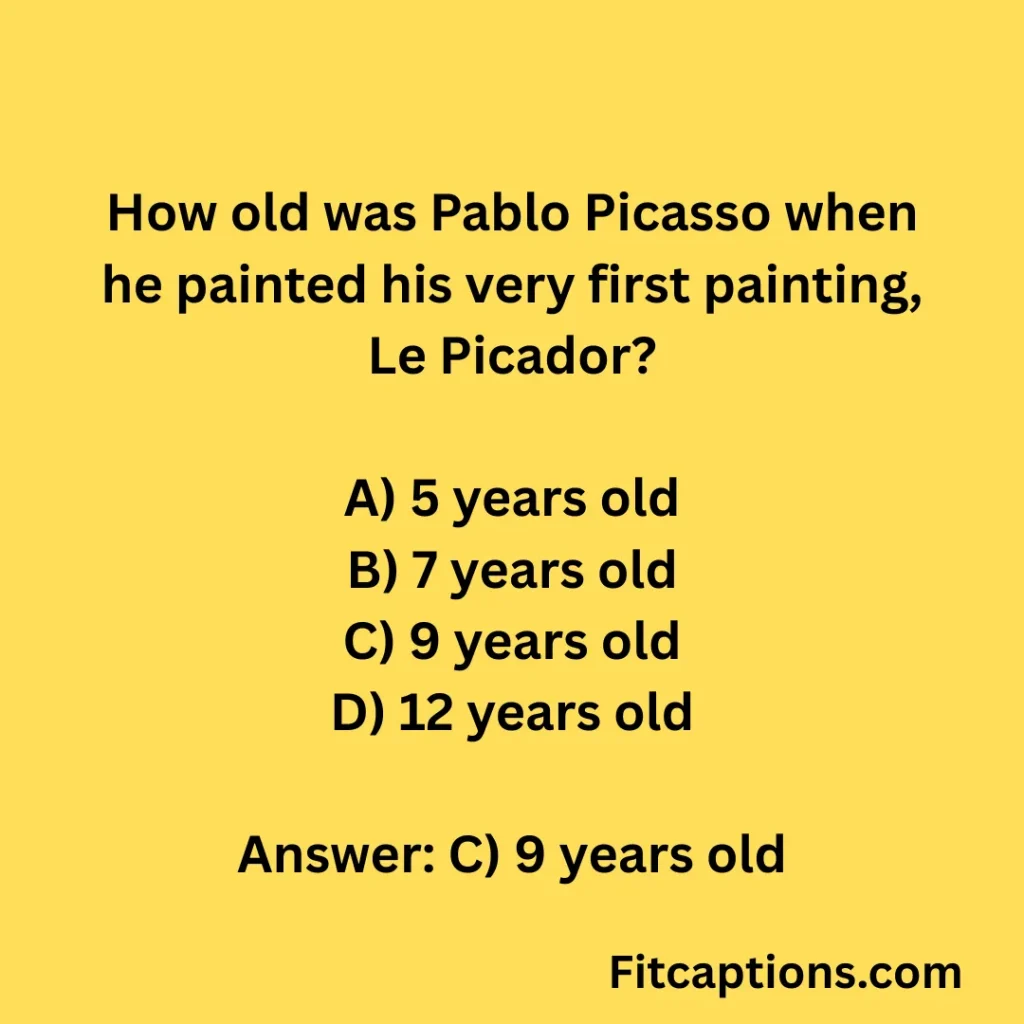
2. How old was Pablo Picasso when he painted his very first painting, Le Picador?
A) 5 years old
B) 7 years old
C) 9 years old
D) 12 years old
Answer: C) 9 years old
3. What did Picasso’s first painting, Le Picador, actually show?
A) A beautiful landscape
B) A bullfighter
C) A bowl of fruit
D) His family
Answer: B) A bullfighter
4. Which famous art movement did Pablo Picasso help create?
A) Impressionism
B) Cubism
C) Surrealism
D) Pop Art
Answer: B) Cubism
5. In which country was Pablo Picasso born?
A) France
B) Italy
C) Spain
D) Portugal
Answer: C) Spain
6. Picasso’s full name is incredibly long! How many names did he have?
A) 12
B) 17
C) 23
D) 25
Answer: C) 23
7. What was his father’s job that helped Picasso become an artist?
A) He was a baker
B) He was an art teacher
C) He was a famous painter
D) He was a scientist
Answer: B) He was an art teacher
8. At what age did Picasso have his very first art exhibition?
A) 9 years old
B) 11 years old
C) 13 years old
D) 15 years old
Answer: C) 13 years old
9. After Picasso had his first exhibition, what did his father do?
A) He opened an art school
B) He gave up art because he thought his son was better
C) He became Picasso’s manager
D) He moved the family to Paris
Answer: B) He gave up art because he thought his son was better
10. In 1904, where did Picasso move to become part of the “cutting-edge” art scene?
A) London, England
B) Rome, Italy
C) Paris, France
D) New York, USA
Answer: C) Paris, France
11. In school, Picasso would bring a pigeon to class. Why did he do that?
A) To use it as a model for his drawings
B) To protest against authority and boring lessons
C) To sell it for art supplies
D) To enter it in a pet show
Answer: B) To protest against authority and boring lessons
12. How many paintings did Picasso create during his lifetime?
A) 500
B) 1,000
C) 1,800
D) 5,000
Answer: C) 1,800
13. What other creative things did Picasso do besides painting?
A) He only painted
B) He wrote poetry and designed ballet sets
C) He was a famous musician
D) He wrote novels
Answer: B) He wrote poetry and designed ballet sets
14. What was the name of Picasso’s pet monkey?
A) Guernica
B) Coco
C) Monina
D) Pablo
Answer: C) Monina
15. What did Picasso’s pet monkey famously take from his hands?
A) His paintbrushes
B) His cigarettes
C) His wallet
D) His hat
Answer: B) His cigarettes
16. Which of these is a TRUE fact about how Picasso made his art?
A) He only used traditional paint
B) He sometimes used sand, plaster, and newspaper
C) He never used a paintbrush
D) He only painted in black and white
Answer: B) He sometimes used sand, plaster, and newspaper
17. What is the name of Picasso’s most famous anti-war painting?
A) The Scream
B) Starry Night
C) Guernica
D) Mona Lisa
Answer: C) Guernica
18. In his later years, what did Picasso become superstitious about?
A) The number 13
B) Black cats
C) Death (he refused to make a will because of it)
D) Broken mirrors
Answer: C) Death (he refused to make a will because of it)
19. At what age did Pablo Picasso die?
A) 61 years old
B) 71 years old
C) 81 years old
D) 91 years old
Answer: D) 91 years old
20. Why did Picasso’s midwife think he was stillborn when he was born?
A) He was a very weak and sickly baby
B) He didn’t cry
C) He was born in a different country
D) He was born blue
Answer: A) He was a very weak and sickly baby
Interesting Pablo Picasso Facts
- Pablo Picasso was born on October 25, 1881, in Málaga, Spain.
- He showed remarkable artistic talent from an early age, encouraged by his father, an art teacher.
- Picasso created more than 20,000 works during his lifetime.
- He co-founded Cubism, one of the most influential art movements in history.
- His masterpiece Guernica is regarded as one of the greatest anti-war paintings ever created.
- Picasso worked in painting, sculpture, printmaking, ceramics, stage design, and collage.
- He spent much of his adult life in France.
- Picasso remained artistically active well into his nineties.
- His artworks are displayed in major museums around the world.
- His influence continues to inspire artists, designers, and art students today.
Pablo Picasso Quiz FAQs
Who was Pablo Picasso?
Pablo Picasso was a Spanish artist widely regarded as one of the greatest painters of the 20th century. He co-founded Cubism and created thousands of influential works across many artistic disciplines.
How many questions are included in this quiz?
This article features 75 Pablo Picasso Quiz Questions and Answers, including easy, medium, hard, true or false, multiple-choice, and fun trivia.
What is Pablo Picasso most famous for?
Picasso is best known for co-founding Cubism and creating masterpieces such as Guernica and Les Demoiselles d’Avignon.
What age group is this quiz suitable for?
The quiz is suitable for kids, students, teachers, homeschoolers, museum visitors, art enthusiasts, and trivia lovers of all ages.
Can I use these questions for classroom activities?
Yes! These questions are ideal for art history lessons, classroom quizzes, museum education programs, homeschool activities, and trivia competitions.
Final Thoughts
We hope you enjoyed exploring these Pablo Picasso quiz questions and answers and discovered new facts about one of the greatest artists of all time. Whether you scored high or learned something new along the way, this quiz is a fun and informative way to appreciate Picasso’s extraordinary contributions to modern art.
Be sure to share this quiz with friends, family, or classmates, and explore more art trivia to continue expanding your knowledge of famous painters, iconic masterpieces, and art history.
You May Like:
124+ Easy & Challenging BTS Quiz Questions And Answers
125+ Best Elderly Trivia Questions and Answers
127+ Fun Beijing Quiz Questions and Answers