
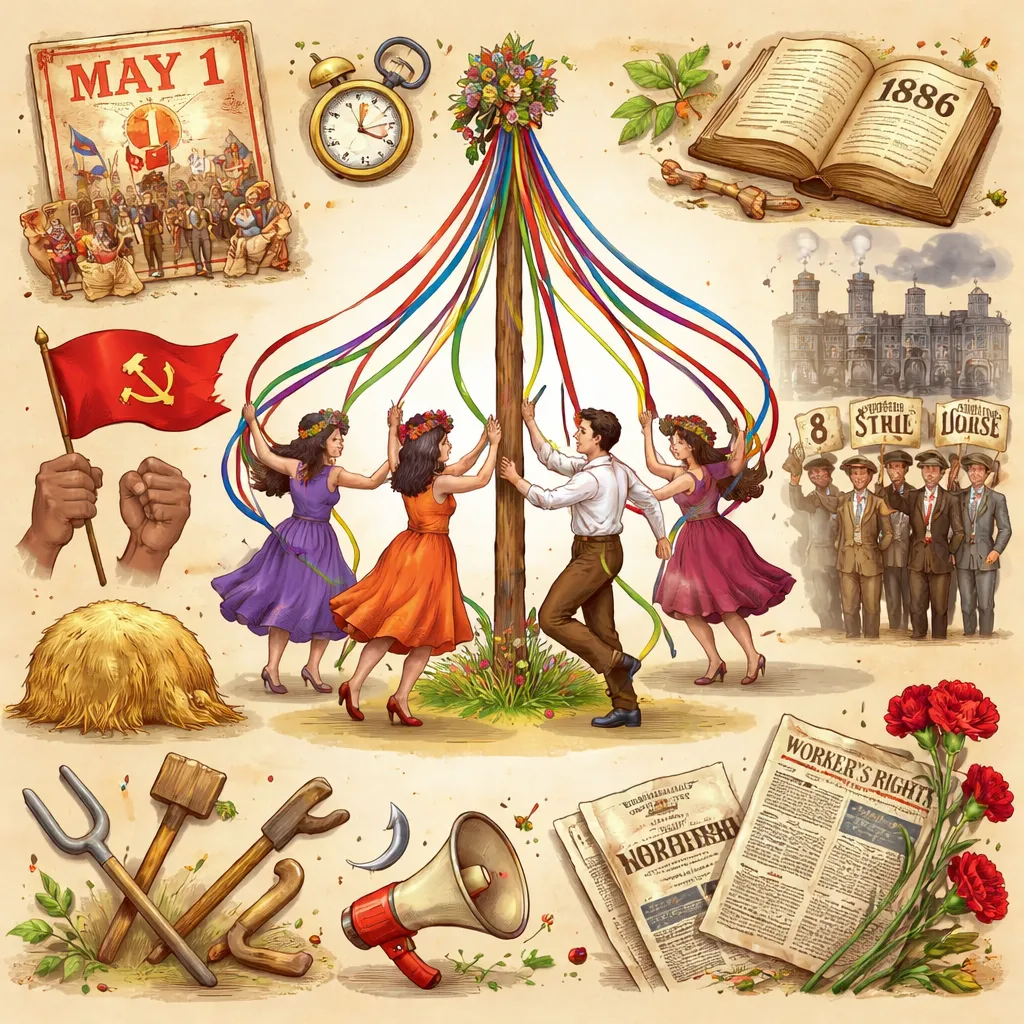
Observed every year on May 1st, May Day is a globally recognized occasion with deep historical roots and meaningful traditions.
Often referred to as International Workers’ Day, it represents both the celebration of labor rights and the welcoming of spring in many cultures.
Over time, this day has come to symbolize unity, resilience, and the ongoing pursuit of social and economic justice.
The origins of May Day can be traced back to ancient seasonal festivals that marked the transition into warmer months with music, dancing, and community gatherings. Its modern significance, however, emerged during the industrial era when workers began advocating for fair treatment, safer conditions, and reasonable working hours. Key events in the late 1800s, particularly labor protests in the United States, helped establish May 1st as a powerful day of recognition for workers’ contributions and struggles.
In the present day, May Day is celebrated across the world through marches, rallies, and cultural events. It stands as both a tribute to past achievements in labor rights and a call to continue striving for equality and dignity in the workplace. This blend of historical depth and modern relevance makes May Day an important and widely observed global event.
May Day History Facts In English
1. May 1st, or May Day, has roots in ancient European spring festivals that celebrated the arrival of summer and fertility.
2. In pre‑Christian Europe, May Day was linked to festivals like Celtic Beltane and Roman Floralia, which honored nature and growth.
3. Early May Day celebrations included dancing around the maypole, gathering flowers, and lighting bonfires to mark the start of summer.
4. In the 16th century, some religious leaders tried to ban May Day customs, fearing they were too linked to older pagan traditions.
5. In England, May Day was revived in the 12th century as a popular spring festival with pageants and dancing.
6. Over time, many May Day customs were Christianized or turned into local village festivals, keeping the day as a folk‑holiday.
7. In the 19th century, May 1st became associated with the labor movement and the fight for workers’ rights.
8. On May 1, 1886, tens of thousands of workers in the United States went on strike to demand an eight‑hour workday, starting in Chicago.
9. The violent Haymarket Square incident in Chicago a few days later followed a May Day‑related labor rally and became a key moment in labor history.
10. In 1889, an international labor meeting chose May 1st as International Workers’ Day to honor the struggle for the eight‑hour day.
11. Since then, in many countries May 1st has been celebrated as Labor Day or International Workers’ Day.
12. In some European countries, May 1st is a public holiday with parades, speeches, and demonstrations focused on workers’ rights.
13. In the United States and Canada, May 1st is often marked by labor rallies and protests, though their main Labor Day holiday is in September.
14. In socialist and communist countries, May 1st became a major state‑organized holiday with military parades and political speeches.
15. Alongside its political meaning, May Day has kept folk traditions such as maypole dances, crowning a “May Queen,” and flower‑gathering customs.
16. In some cultures, May 1st is also linked to the coming of spring and the blessing of fields and animals for the farming year.
17. The split between “May Day” as a spring festival and “International Workers’ Day” shows how the date carries both cultural and political meanings.
18. In modern times, May 1st is often used to promote social justice, fair wages, and better working conditions worldwide.
19. Many countries combine May Day celebrations with local traditions, mixing marches, speeches, music, and community festivals.
20. Today, May 1st stands as a global reminder of both ancient spring‑time customs and the ongoing fight for workers’ dignity and rights.
Related : 121+ Random Fun Facts about May
May Day History Facts Short
1. May Day traces back to the ancient Roman festival Floralia, honoring Flora, the goddess of flowers.
2. The Celts celebrated Beltane on May 1st, marking the beginning of summer with bonfires and dancing.
3. In medieval Europe, May Day was a time for villagers to gather flowers, dance around a maypole, and welcome spring.
4. The maypole tradition originated from Germanic pagan tree worship and was later adopted across Europe.
5. In 1886, May 1st was chosen by labor unions in the U.S. to demand an eight-hour workday.
6. The Haymarket affair in Chicago on May 4, 1886, became a pivotal event that linked May Day to workers’ rights.
7. In 1889, the International Socialist Congress declared May 1st as International Workers’ Day.
8. May Day became a public holiday in many countries, including France, Germany, Russia, and China.
9. In the Soviet Union, May Day parades displayed military might and honored the working class.
10. The United States and Canada celebrate Labor Day in September instead of May 1st due to post-Haymarket tensions.
11. In 1955, the Catholic Church designated May 1st as the Feast of St. Joseph the Worker to offer a Christian alternative.
12. In England, traditional May Day includes Morris dancing, where dancers wear bells and wave handkerchiefs.
13. In Scotland, Beltane fire festivals on April 30th often continue into the early hours of May Day.
14. In Hawaii, May Day is called “Lei Day,” marked by wearing and giving flower leis since 1927.
15. In France, it’s customary to give lily of the valley flowers to loved ones on May 1st.
16. In Germany, Walpurgisnacht on April 30th blends into May Day with bonfires and spring celebrations.
17. In Finland, May Day (Vappu) is a carnival-style festival with student parades, picnics, and sparkling wine.
18. In Sweden, May Day is both a spring celebration and a political event with socialist rallies.
19. Under the Nazi regime, May Day was declared a national holiday in 1933, but unions were banned the next day.
20. Today, May Day remains a global holiday celebrating both the arrival of spring and the achievements of workers.
May Day History Facts One Liners
1. May Day, celebrated on May 1st, originated as an ancient festival marking the arrival of spring in the Northern Hemisphere.
2. The modern May Day as International Workers’ Day began after the 1886 Haymarket Affair in Chicago.
3. On May 1, 1886, thousands of American workers went on strike demanding an eight-hour workday.
4. The Haymarket Riot in Chicago led to the establishment of May 1 as a global day honoring workers’ rights.
5. In 1889, the Second International declared May 1 as International Workers’ Day in Paris.
6. May Day became an official public holiday in many countries after the Russian Revolution of 1917.
7. The Soviet Union made May Day one of its most important state holidays with massive military parades.
8. May 1 is also known as International Labour Day in over 80 countries around the world.
9. Ancient Romans celebrated May 1 with the festival of Floralia, honoring the goddess of flowers.
10. In medieval England, May Day involved dancing around the maypole and crowning a May Queen.
11. The first May Day celebration in the United States was organized by labor unions in 1890.
12. May Day has both pagan roots and strong socialist and labor movement connections.
13. In many European countries, May 1 is still marked with large parades and workers’ rallies.
14. The red flag became a symbol of May Day due to its association with the labor and socialist movements.
15. In 1955, the Catholic Church established May 1 as the feast day of Saint Joseph the Worker.
16. May Day was a major propaganda tool during the Cold War for both Eastern and Western blocs.
17. In China, May 1 is celebrated as Labour Day with a week-long public holiday until 2008.
18. Australia celebrates Labour Day on different dates in each state, not necessarily on May 1.
19. The United States and Canada observe Labor Day in September instead of May 1 to distance from socialist origins.
20. Today, May Day continues to symbolize both the beauty of spring and the fight for workers’ rights worldwide.
Related : 101+ Memorial Day Trivia Questions And Answers
May Day History Facts Reddit
1. May Day is celebrated every year on May 1st.
2. The tradition dates back to ancient spring festivals in Europe.
3. Romans honored the goddess Flora with a festival called Floralia.
4. The Celtic festival Beltane marked the start of summer with bonfires.
5. Dancing around the Maypole became a popular medieval tradition.
6. Puritans in 17th‑century Massachusetts banned maypoles, calling them pagan.
7. In England, parades often featured a figure called Jack‑in‑the‑Green, covered in leaves.
8. May Day later became linked to workers’ rights and labor movements.
9. The Haymarket Affair in Chicago in 1886 was a turning point for labor activism.
10. Strikes for the eight‑hour workday were central to May Day’s labor history.
11. In 1889, the Paris Congress declared May 1st International Workers’ Day.
12. Australian stonemasons won the first eight‑hour workday in 1856, inspiring others worldwide.
13. The U.S. moved its official Labor Day to September in 1894 to avoid May Day’s radical ties.
14. In France, people give Lily of the Valley flowers on May 1st for good luck.
15. Hawaii celebrates May 1st as Lei Day, with flower garlands and music.
16. Finland’s May Day, called Vappu, is marked with balloons, picnics, and student parties.
17. Germany observes Walpurgis Night on April 30–May 1 with bonfires to ward off spirits.
18. In Wales, Calan Mai traditions included hawthorn decorations and fertility rituals.
19. Victorian England crowned May Queens as symbols of spring beauty.
20. Modern May Day often includes parades, protests, and celebrations of social justice.
May Day History Facts For Adults
1. May Day originated from the ancient Roman festival Floralia (April 28 – May 3), celebrating Flora, the goddess of flowers, fertility, and spring.
2. The Celtic festival Beltane, held on May 1st, involved bonfires, feasting, and rituals to protect cattle and encourage growth.
3. In medieval and Tudor England, May Day was a secular celebration featuring maypoles, Morris dancing, and the crowning of a May Queen.
4. The Puritan government banned May Day celebrations in England in 1644, calling them “heathenish” and “lewd.”
5. May Day’s transformation into a labor holiday began in the United States with the fight for an eight‑hour workday.
6. On May 1, 1886, over 300,000 workers across the U.S. went on strike demanding an eight‑hour day. Chicago was the epicenter.
7. The Haymarket affair (May 4, 1886) in Chicago – a bombing during a labor rally – led to the deaths of police and civilians.
8. In 1889, the International Socialist Congress in Paris declared May 1st as International Workers’ Day to honor the Haymarket martyrs.
9. The United States and Canada do not celebrate May 1st as a labor holiday; instead, they observe Labor Day in September to distance themselves from the Haymarket legacy.
10. International Workers’ Day became a major public holiday in the Soviet Union, Eastern Bloc countries, and many socialist nations, often marked by military parades.
11. In Nazi Germany, May 1st was declared a national holiday in 1933, but trade unions were crushed the very next day, May 2nd.
12. In 1955, Pope Pius XII established the Feast of St. Joseph the Worker on May 1st to provide a Catholic alternative to communist‑inspired May Day.
13. May Day is a public holiday in more than 80 countries, including France, Germany, Italy, Spain, China, Russia, Brazil, and India.
14. In France, May 1st is known as “La Fête du Travail” (Labor Day), and it is the only day when the sale of lily‑of‑the‑valley (muguet) is tax‑free.
15. In Germany, May 1st (“Tag der Arbeit”) has two faces: peaceful labor rallies and, in many cities, the raucous “Tanz in den Mai” (dance into May) on the night of April 30.
16. In Finland and Sweden, May Day (“Vappu” / “Valborg”) is a carnival‑like student festival featuring champagne, cider, and the wearing of white student caps.
17. In Japan, May 1st is not a public holiday, but it coincides with “Golden Week,” which includes several national holidays, making it one of the year’s busiest travel periods.
18. In the Philippines, May 1st is known as “Araw ng Manggagawa” (Workers’ Day), and it is marked by protests and union marches for better wages and working conditions.
19. Under the Soviet system, May Day parades were enormous state‑controlled displays of military might and the “friendship of peoples,” often featuring portraits of Lenin and Stalin.
20. Today, May Day remains a complex symbol: in Western Europe, it blends spring pagan traditions with labor activism; in the U.S., it is almost entirely forgotten as a workers’ holiday.
May Day History Facts For Kids
1. May Day is a special day that comes every year on May 1st and celebrates the start of spring.
2. Long ago, people in Europe celebrated May 1st as a spring festival with dancing, singing, and bonfires.
3. In some countries, May Day is still celebrated with games, flowers, and fun in the parks.
4. One famous May Day tradition is the maypole, a tall pole with colorful ribbons that children dance around.
5. In many villages, people used to crown a “May Queen” to celebrate spring and beauty.
6. Kids in some places used to leave “May baskets” with flowers or sweets on their neighbors’ doors.
7. In the 1800s, May 1st became linked to workers’ rights as a day to remember the fight for fair pay and safe jobs.
8. In 1886, workers in Chicago went on strike on May 1st to ask for an eight‑hour workday.
9. A few days later, a protest in Chicago called the Haymarket riot became an important moment in labor history.
10. In 1889, leaders from different countries chose May 1st as International Workers’ Day to honor working people everywhere.
11. Today, many countries celebrate May 1st as a holiday for workers, with marches and speeches.
12. In some places, May 1st is also linked to religious celebrations, like honoring Saint Joseph the Worker.
13. May Day shows that one date can have two meanings: a fun spring festival and a serious day for workers’ rights.
14. In England, May Day celebrations often include dancing, music, and crowning a May Queen in the village.
15. Morris dancing—where people wear bells and colorful clothes—is a traditional dance done on May Day in England.
16. Farmers in the past liked May 1st because planting was mostly done and they could take a break to celebrate.
17. Around the world, children may dance, weave ribbons around a maypole, or pick flowers on May Day.
18. In some countries, May 1st is a public holiday, which means kids get a day off school and families can go out together.
19. May Day reminds us to be kind to workers, protect the environment, and enjoy the beauty of spring.
20. Today, May 1st is a fun and meaningful day that mixes old spring traditions with modern celebrations of workers and community.
Final Thoughts
In conclusion, May Day stands as a powerful reminder of both cultural traditions and the enduring struggle for workers’ rights. Its journey from ancient spring celebrations to a global symbol of labor unity reflects how deeply it is woven into human history. While much progress has been made over the years, the message of fairness, dignity, and equality in the workplace remains just as relevant today. By honoring May Day, people around the world continue to recognize past sacrifices while encouraging a more just and balanced future for all.