

Celebrated by millions of Muslims worldwide, this special festival is filled with meaningful traditions, generosity, and joyful family gatherings.
From delicious meals to charitable giving, there’s much more to this occasion than many people realize.
In this article, we’ll uncover some interesting and surprising Eid Al Adha fun facts, including its history, unique customs, and fascinating traditions observed across different countries.
Whether you’re celebrating or simply curious, these fun facts will give you a deeper understanding of one of the most important festivals in Islam.
Eid Al Adha Fun Facts In English
1. Eid al‑Adha means “Festival of Sacrifice,” celebrating Prophet Ibrahim’s great faith and obedience to God.
2. It takes place on the 10th day of Dhu al‑Hijjah, the twelfth month of the Islamic lunar calendar.
3. The holiday falls at the end of the Hajj pilgrimage to Makkah, so it is often called the “Hajj Festival.”
4. Eid al‑Adha usually lasts for three to four days, giving families more time for prayer, food, and visiting.
5. It is one of the two main Eids in Islam, the other being Eid al‑Fitr at the end of Ramadan.
6. Many Muslims who can afford it sacrifice an animal such as a sheep, goat, cow, or camel, following the story of Prophet Ibrahim.
7. The meat from the sacrifice is traditionally divided into three parts: one for the family, one for friends, and one for the poor.
8. This practice teaches sharing, gratitude, and caring for the less fortunate on such a blessed day.
9. Eid al‑Adha is called “Qurbani Eid” in many parts of South Asia, where “Qurbani” means “sacrifice.”
10. The date of Eid al‑Adha changes each year on the Gregorian calendar because it follows the moon’s cycle.
11. Muslims greet each other on this day by saying “Eid Mubarak,” which means “Blessed Eid” or “Happy Eid.”
12. Many people wear new or special clothes, especially bright colors, to mark the festive occasion.
13. Families often attend a special Eid prayer (Salat al‑Eid) in mosques or open prayer grounds before the celebrations begin.
14. The story behind Eid al‑Adha teaches that God stopped Prophet Ibrahim from sacrificing his son and instead provided a ram as a sacrifice.
15. Animals are slaughtered according to specific Islamic rules (halal), ensuring kindness and respect during the sacrifice.
16. On Eid al‑Adha, communities may also give extra charity to make sure everyone can join the celebration.
17. It is very common to cook large, shared meals with dishes like biryani, kebabs, and sweets on this day.
18. Many families visit relatives, exchange gifts, and send food packages to neighbors and the poor during Eid days.
19. Children often enjoy Eid cards, new clothes, small gifts, and sometimes “Eidi” (money or treats) from elders.
20. Eid al‑Adha reminds Muslims worldwide that faith, obedience, and sacrifice go hand‑in‑hand with kindness, sharing, and gratitude.
Short Eid Al Adha Fun Facts
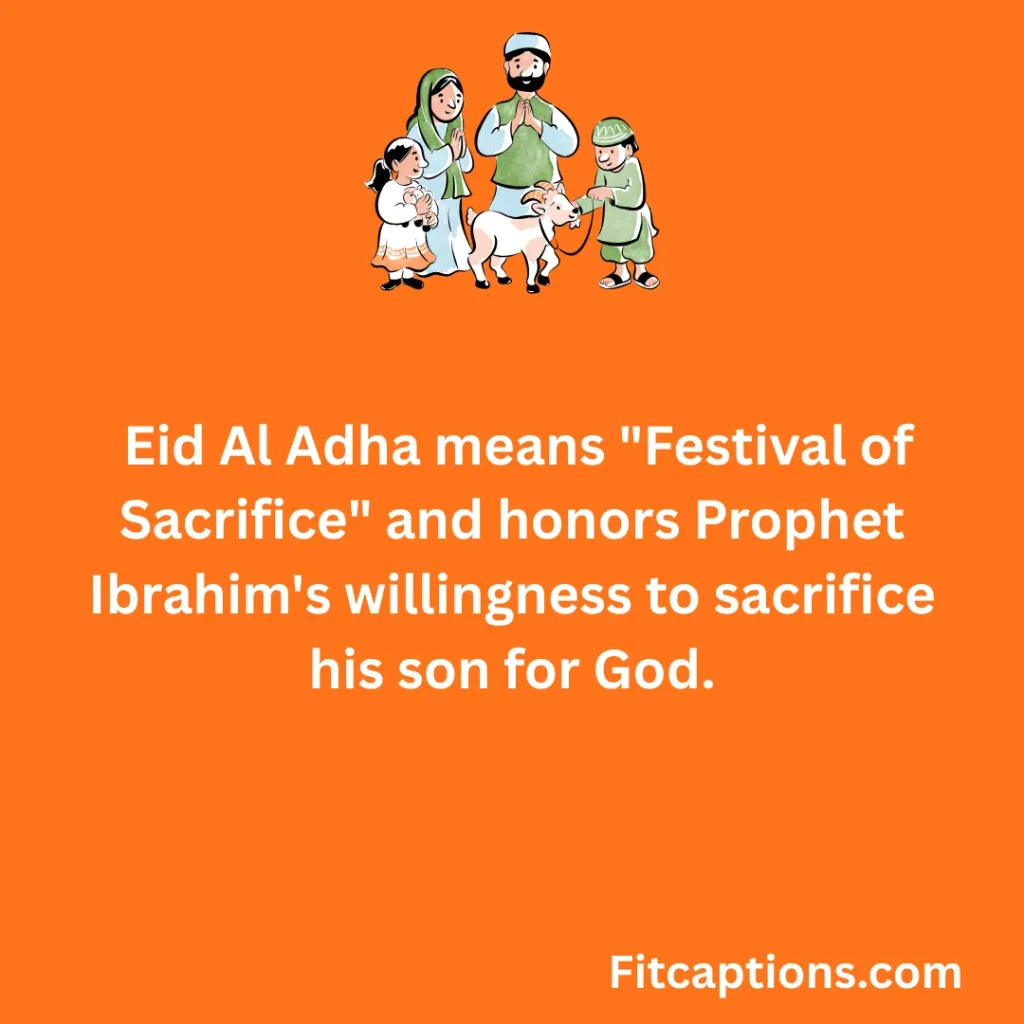
1. Eid Al Adha means “Festival of Sacrifice” and honors Prophet Ibrahim’s willingness to sacrifice his son for God.
2. It falls on the 10th day of Dhul Hijjah, the final month of the Islamic lunar calendar.
3. The holiday lasts four days, making it one of the longest Islamic celebrations.
4. Muslims who can afford it sacrifice a sheep, goat, cow, or camel, then distribute the meat in three equal parts: family, friends, and the poor.
5. The meat from the sacrifice is often called “Qurbani meat,” and sharing it is a mandatory act of charity.
6. Eid Al Adha coincides with the Hajj pilgrimage – millions of pilgrims in Mecca celebrate it at the same time as Muslims worldwide.
7. The takbir (chanting “Allahu Akbar”) is recited loudly from the morning of Eid until the last day of the festival.
8. Some countries roast an entire camel for large communal feasts – it’s the ultimate sharing meal.
9. Children often receive new clothes, money (Eidi), and gifts, similar to Eid Al Fitr.
10. In Turkey, Eid Al Adha is called “Kurban Bayramı,” and families visit neighbors to exchange sweets and meat dishes.
11. The sacrifice commemorates that God replaced Ibrahim’s son with a ram, so Muslims honor animals as a gift from God.
12. In South Asia, many families decorate their sacrificial animals with flowers and henna before the ritual.
13. The first day of Eid Al Adha begins with a special prayer (Salat al-Eid) performed in congregation, often in large open grounds.
14. It is forbidden to fast on the first day of Eid Al Adha – feasting is the rule.
15. Some communities organize large barbecues or picnics in parks to cook and share the Qurbani meat together.
16. The date of Eid Al Adha moves back about 11 days each year because the Islamic calendar is lunar.
17. In Indonesia, the holiday is called “Idul Adha” and it’s common to see hundreds of cows and goats sacrificed in a single village.
18. The skin of the sacrificed animal is often donated to tanneries, with proceeds going to charity.
19. Eid Al Adha is a public holiday in almost all Muslim-majority countries, lasting 2 to 4 days.
20. The festival encourages unity across social classes – the rich and poor eat the same meat, often side by side.
Related : 104+ Eid Mubarak Wishes in Arabic
Eid Al Adha Fun Facts For Students
1. Eid Al Adha is also called the “Festival of Sacrifice” and is one of the biggest celebrations in Islam.
2. It remembers the story of Prophet Ibrahim (Abraham) who was ready to sacrifice his son for God.
3. A big sheep, goat, cow, or camel is sacrificed during Eid Al Adha to remember Prophet Ibrahim’s obedience.
4. The meat from the sacrificed animal is shared in three parts: for family, friends, and people in need.
5. Eid Al Adha happens every year on the 10th day of the Islamic month called Dhul-Hijjah.
6. It usually comes right after the Hajj pilgrimage to Makkah, which millions of Muslims try to do once in their lifetime.
7. Kids often get new clothes, gifts, money (called Eidi), and lots of sweets during Eid Al Adha!
8. Families wake up early, take a shower, wear their best clothes, and go to the mosque for special Eid prayers.
9. The celebration can last for 3 to 4 days, filled with visiting family and eating delicious food.
10. One of the favorite Eid foods is kebabs, biryani, and sweet treats like sheer khurma and baklava.
11. Muslims say “Eid Mubarak!” to each other, which means “Have a blessed Eid!”
12. During Eid Al Adha, people are encouraged to be extra kind, share with others, and help the poor.
13. In some countries, kids decorate their homes with lights, balloons, and colorful Eid banners.
14. Camels are very important in the Eid story — they are one of the animals that can be sacrificed.
15. Eid Al Adha teaches us to be brave, obedient, and generous just like Prophet Ibrahim.
16. The word “Adha” means “sacrifice” — so Eid Al Adha literally means “Festival of Sacrifice.”
17. Many children enjoy making handmade Eid cards for their parents, grandparents, and friends.
18. In some places, big Eid fairs are held with games, rides, and fun activities for kids.
19. Families often cook huge meals together and invite neighbors to celebrate with them.
20. Eid Al Adha reminds us that giving to others and being thankful to God brings the greatest happiness.
Related : 129+ Funny Eid Jokes
Eid Al Adha Fun Facts For Kids

1. Eid al‑Adha is also called the “Festival of Sacrifice.”
2. It is the second major Islamic holiday after Eid al‑Fitr.
3. The festival honors Prophet Ibrahim’s test of faith.
4. Allah replaced Ibrahim’s son with a ram to be sacrificed.
5. Eid al‑Adha begins on the 10th day of Dhul‑Hijjah.
6. The date changes every year in the Gregorian calendar.
7. It marks the end of the annual Hajj pilgrimage.
8. Millions of Muslims worldwide celebrate Eid al‑Adha.
9. The Eid prayer is performed in large congregations.
10. Muslims wear their best clothes for the occasion.
11. Families often share festive meals together.
12. Meat from the sacrifice is divided into three parts.
13. One part is kept, one shared with relatives, and one given to the poor.
14. In South Asia, it is often called “Bakra Eid.”
15. In some cultures, goats, cows, or camels are sacrificed.
16. Eid al‑Adha teaches lessons of faith and obedience.
17. The story is found in the Quran, Surah As‑Saffat.
18. Pilgrims in Mecca perform the stoning of the devil ritual.
19. Eid al‑Adha has been celebrated since the 7th century.
20. It reminds Muslims that true sacrifice is devotion to God.
Eid Al Adha Fun Facts For Adults
1. Eid al‑Adha, also called the “Festival of Sacrifice,” is one of the two main Eids in the Islamic calendar and holds deep spiritual meaning for millions of Muslims worldwide.
2. It falls on the 10th day of Dhu al‑Hijjah, the last month of the Islamic lunar calendar, marking the climax of the Hajj pilgrimage.
3. The holiday typically lasts three to four days, giving families time for prayer, family visits, and sharing food with others.
4. Eid al‑Adha commemorates Prophet Ibrahim’s willingness to obey God’s command by preparing to sacrifice his son, a story shared (with variations) in the Qur’an, Bible, and Torah.
5. In the Qur’an, God replaces Ibrahim’s son with a ram at the last moment, a moment symbolized by the ritual animal sacrifice during Eid.
6. Families who can afford it often sacrifice a sheep, goat, cow, or camel, carried out according to strict Islamic rules to ensure kindness and respect.
7. The meat is traditionally divided into three parts: one for the family, one for friends and relatives, and one for the poor and needy.
8. The day usually begins with a special communal prayer (Salat al‑Eid) held in mosques or large open areas, followed by a short sermon.
9. It is common for Muslims to wear their best or new clothes on Eid, reflecting purity, dignity, and the joy of the occasion.
10. Eid al‑Adha is closely tied to the Hajj, so millions of pilgrims in Makkah experience the festival at the same time as Muslims around the world.
11. The exact Gregorian date of Eid al‑Adha changes every year, as the Islamic calendar is lunar rather than solar, so the holiday can fall in any season.
12. Many Muslims living in non‑Muslim countries arrange for their sacrificial animal or donation to be carried out through local mosques or charities.
13. Charitable giving is a big part of the day, with many families also giving extra cash or food packages to those in need, beyond the Qurbani meat.
14. Different countries have their own names for the festival, such as “Qurbani Eid” in South Asia, “Idul Adha” in Indonesia, and “Kurban Bayramı” in Turkey.
15. In many places, Eid al‑Adha is a public or half‑day holiday, giving adults time off work to pray, visit family, and prepare meals.
16. Modern technology has made it easier for families to share greetings, photos, and live‑streamed prayers, even when they are far apart.
17. The festival bridges ancient religious tradition and modern life, with many people now donating their sacrifice through online platforms so meat reaches distant communities.
18. Eid al‑Adha is a powerful reminder that faith, obedience, and sacrifice go hand‑in‑hand with community, charity, and hospitality.
19. For adults, it is often a time of quiet reflection, remembering the stories of prophets, the blessings in their own lives, and the needs of others.
20. The scent of Qurbani, the sound of communal prayers, and the warmth of shared meals make Eid al‑Adha a very special spiritual and family experience for Muslim adults around the world.
Funny Eid Al Adha Fun Facts

1. The sheep never see it coming – which is probably for the best, because sheep are terrible at keeping secrets.
2. Some goats develop a sixth sense for Eid and start hiding behind the sofa a week in advance.
3. The world’s most nervous animal on Eid morning is definitely the cow – they’ve heard the rumors.
4. In some countries, the sacrificial animal gets a bath, a haircut, and henna tattoos – basically a spa day before the big event.
5. Kids often name the sheep “Dinner” about three hours before dinner – dark humor starts young.
6. After the sacrifice, the family’s freezer looks like a meat museum for the next six months.
7. The “three parts” rule (family, friends, poor) is really just a polite way of saying “you’ll be eating leftovers until next Eid.”
8. Eid Al Adha is the only time of year when giving a cow as a gift is considered completely normal.
9. Some uncles treat the Qurbani knife like a lightsaber – dramatic inspections, practice swings, and a lot of unnecessary commentary.
10. The moment of silence after the sacrifice is actually everyone mentally calculating how many kebabs they can make.
11. Children’s favorite part of Eid? Not the sacrifice – it’s the new clothes and the mountain of sweets they hide before anyone notices.
12. In some households, the sheep gets a farewell pep talk that sounds suspiciously like a recipe.
13. The family cat suddenly becomes very interested in the kitchen on Eid morning – suspiciously interested.
14. Burnt Qurbani meat is a Eid tradition in some families – not because it’s good, but because uncle insisted on manning the grill.
15. The most repeated phrase on Eid afternoon is “No, don’t give me more meat – I’m still chewing last year’s.”
16. Some dads treat the Eid prayer like a competitive sport – arrive early, secure the front row, then nap through the sermon.
17. The real sacrifice is not the animal – it’s the family’s digestive system after three days of non‑stop meat.
18. Children quickly learn that “Eidi” (money gifts) is the only acceptable form of love – meat doesn’t buy video games.
19. By day four of Eid, neighbors start hiding when they see you coming with another plate of “extra meat.”
20. The ultimate Eid Al Adha joke: “Why did the sheep cross the road? It was the last day of the holiday.”
Final Thoughts
From meaningful traditions to worldwide celebrations, Eid Al Adha fun facts reveal the rich cultural and spiritual importance of this cherished occasion. It is a time of faith, sacrifice, kindness, and togetherness, bringing families and communities closer every year.
Whether through acts of charity, festive meals, or cultural customs, the celebration continues to spread joy across the globe. Hopefully, these fun facts helped you learn something new and inspired a greater appreciation for the beauty and significance of Eid Al Adha.
Read Also:
127+ Heart Touching Eid Mubarak Wishes
128+ Warm Happy Eid Wishes Quotes