
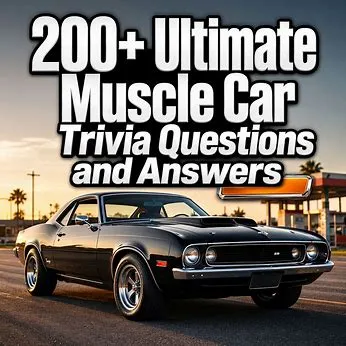
Fuel your passion for classic automobiles with this exciting collection of Muscle Car Trivia Questions and Answers, created for car enthusiasts and speed lovers.
From legendary models and powerful engines to iconic manufacturers, racing history, and automotive milestones, this trivia set explores the fascinating world of muscle cars.
Whether you’re a lifelong gearhead, a classic car admirer, or simply curious about these powerful machines, these questions offer a fun and engaging way to test your knowledge and discover amazing facts about automotive history.
What Is a Muscle Car?
A muscle car is a high-performance automobile typically featuring a powerful engine, rear-wheel drive, and a sporty design. These vehicles became especially popular in the United States during the 1960s and early 1970s.
Muscle cars were built to deliver impressive acceleration and performance while remaining affordable enough for everyday drivers.
Some famous muscle car characteristics include:
- Powerful V8 engines
- High horsepower ratings
- Aggressive styling
- Strong acceleration
- Racing-inspired performance
- Affordable performance compared to exotic sports cars
Classic muscle cars remain highly valuable today because of their history, rarity, and emotional connection with automotive enthusiasts.
History of Muscle Cars
The muscle car era began during the 1960s when American automobile manufacturers started creating affordable performance vehicles for younger drivers.
One of the earliest examples was the Pontiac GTO, introduced in 1964. It combined a midsize body with a powerful V8 engine and helped create the formula that defined the muscle car category.
Other manufacturers quickly joined the competition:
- Ford Motor Company introduced the Mustang.
- Chevrolet produced the Camaro and Chevelle.
- Chevelle.
- Dodge created powerful models like the Charger and Challenger.
- Plymouth developed famous cars like the Road Runner and Barracuda.
- During the late 1960s, manufacturers competed to create faster and more powerful vehicles.
- This period became known as the golden age of muscle cars.
Muscle Car Trivia Questions and Answers
1. What is generally considered the first muscle car?
A) Ford Mustang
B) Pontiac GTO
C) Chevrolet Camaro
D) Dodge Charger
Correct Answer: B) Pontiac GTO
Explanation: The Pontiac GTO, introduced in 1964, is widely recognized as the first true muscle car because it combined a powerful engine with a midsize body.
2. Which company produced the Mustang?
A) Chevrolet
B) Ford
C) Dodge
D) Pontiac
Correct Answer: B) Ford
Explanation: Ford introduced the Mustang in 1964, creating the popular pony car category.
3. What does the term “muscle car” usually describe?
A) Small economy cars
B) Luxury vehicles
C) High-performance American cars with powerful engines
D) Racing motorcycles
Correct Answer: C) High-performance American cars with powerful engines
Explanation: Muscle cars are known for large engines, strong acceleration, and performance-focused designs.
4. Which engine is famous in the Chevrolet Camaro Z/28?
A) 302 V8
B) 4-cylinder turbo
C) V6 diesel
D) Inline-six
Correct Answer: A) 302 V8
Explanation: The 302 cubic-inch V8 was a legendary engine option in classic Camaro Z/28 models.
5. Which car is known as “The King of the Streets” among classic muscle cars?
A) Pontiac GTO
B) Dodge Challenger
C) Chevrolet Chevelle SS
D) Ford Pinto
Correct Answer: A) Pontiac GTO
Explanation: The GTO gained a reputation for combining style and serious performance.
6. What type of engine is most associated with classic muscle cars?
A) Electric motor
B) V8 engine
C) Small diesel engine
D) Two-cylinder engine
Correct Answer: B) V8 engine
Explanation: Powerful V8 engines became a defining feature of many American muscle cars.
7. Which company made the Charger Daytona?
A) Ford
B) Dodge
C) Chevrolet
D) Buick
Correct Answer: B) Dodge
Explanation: The Dodge Charger Daytona was a famous high-performance car built for speed and NASCAR competition.
8. What does “SS” stand for on many Chevrolet performance models?
A) Super Sport
B) Speed System
C) Street Special
D) Sport Sedan
Correct Answer: A) Super Sport
Explanation: Chevrolet uses SS to identify many of its performance-oriented vehicles.
9. Which muscle car featured the famous HEMI engine?
A) Dodge Challenger
B) Ford Fairlane
C) Pontiac Firebird
D) Chevrolet Nova
Correct Answer: A) Dodge Challenger
Explanation: Dodge Challengers have been known for powerful HEMI V8 engines throughout their history.
10. Which car was driven by Steve McQueen in the movie Bullitt?
A) Dodge Charger
B) Ford Mustang GT
C) Chevrolet Camaro
D) Pontiac Firebird
Correct Answer: B) Ford Mustang GT
Explanation: The 1968 Ford Mustang GT became legendary after appearing in the famous Bullitt chase scene.
11. What year was the Ford Mustang first introduced?
A) 1955
B) 1960
C) 1964
D) 1970
Correct Answer: C) 1964
Explanation: Ford launched the Mustang at the 1964 New York World’s Fair.
12. Which car is part of Chevrolet’s famous “pony car” lineup?
A) Camaro
B) Impala
C) Malibu
D) Caprice
Correct Answer: A) Camaro
Explanation: The Chevrolet Camaro was introduced in 1966 as a competitor to the Ford Mustang.
13. What does “426 HEMI” refer to?
A) A transmission type
B) A powerful V8 engine
C) A paint color
D) A racing tire
Correct Answer: B) A powerful V8 engine
Explanation: The 426 HEMI was one of Chrysler’s most famous high-performance engines.
14. Which Pontiac model became famous as a muscle car?
A) GTO
B) Sunbird
C) Aztek
D) Fiero
Correct Answer: A) GTO
Explanation: The Pontiac GTO became one of the most iconic muscle cars of the 1960s.
15. What does horsepower measure?
A) Fuel cost
B) Engine power output
C) Vehicle weight
D) Tire size
Correct Answer: B) Engine power output
Explanation: Horsepower measures the rate at which an engine can perform work.
16. Which muscle car was produced by Plymouth?
A) Road Runner
B) Mustang
C) Camaro
D) Corvette
Correct Answer: A) Road Runner
Explanation: The Plymouth Road Runner was a popular affordable muscle car introduced in 1968.
17. Which company created the Barracuda muscle car?
A) Plymouth
B) Ford
C) Buick
D) Pontiac
Correct Answer: A) Plymouth
Explanation: The Plymouth Barracuda became one of the earliest pony cars and later a muscle car icon.
18. What is a “big block” engine?
A) A small fuel-saving engine
B) A larger displacement engine design
C) An electric motor
D) A racing computer system
Correct Answer: B) A larger displacement engine design
Explanation: Big-block engines are larger and often produce significant power and torque.
19. Which Chevrolet model is famous for the SS 454 version?
A) Chevelle
B) Corvette
C) Nova
D) Cruze
Correct Answer: A) Chevelle
Explanation: The Chevrolet Chevelle SS 454 is one of the most respected classic muscle cars.
20. Why are classic muscle cars still popular today?
A) They are extremely small
B) They represent power, style, and automotive history
C) They use no fuel
D) They are only used for racing
Correct Answer: B) They represent power, style, and automotive history
Explanation: Muscle cars remain popular because of their performance, designs, and cultural impact.
Recommended:267+ Geography Trivia Questions and Answers
Muscle Car Trivia Questions and Answers for Adults
1. Which car is known as the “Mopar” muscle car icon?
A) Dodge Challenger
B) Ford Mustang
C) Chevrolet Corvette
D) Pontiac Firebird
Correct Answer: A) Dodge Challenger
Explanation: The Dodge Challenger became one of Mopar’s most famous muscle cars, especially with powerful HEMI engines.
2. What does the “R/T” badge on Dodge vehicles mean?
A) Road Touring
B) Racing Technology
C) Road and Track
D) Rapid Transport
Correct Answer: C) Road and Track
Explanation: Dodge uses the R/T designation for performance-oriented models.
3. Which engine was famous in the Shelby GT500 Mustang?
A) V6 EcoBoost
B) 428 Cobra Jet V8
C) Inline-four
D) Flat-six
Correct Answer: B) 428 Cobra Jet V8
Explanation: The 428 Cobra Jet was a legendary high-performance engine used in classic Shelby Mustangs.
4. Which company produced the Firebird muscle car?
A) Pontiac
B) Chevrolet
C) Buick
D) Oldsmobile
Correct Answer: A) Pontiac
Explanation: Pontiac introduced the Firebird in 1967 as a competitor to the Chevrolet Camaro.
5. What was the nickname of the 1970 Chevelle SS 454?
A) Blue Thunder
B) King Cobra
C) LS6 Beast
D) Street Rocket
Correct Answer: C) LS6 Beast
Explanation: The Chevelle SS 454 LS6 became famous for its incredible horsepower and performance.
6. Which muscle car featured the “Shaker” hood scoop?
A) Dodge Challenger
B) Ford Torino
C) Chevrolet Nova
D) Pontiac Tempest
Correct Answer: A) Dodge Challenger
Explanation: The Shaker hood scoop was mounted directly over the engine and moved with engine vibration.
7. What does “GT” commonly stand for in car names?
A) Grand Touring
B) General Transport
C) Great Tire
D) Gas Technology
Correct Answer: A) Grand Touring
Explanation: GT usually represents a performance model designed for speed and comfort.
8. Which muscle car was nicknamed the “Goat”?
A) Pontiac GTO
B) Ford Mustang
C) Dodge Charger
D) Camaro SS
Correct Answer: A) Pontiac GTO
Explanation: The GTO earned the nickname “Goat,” a popular shortened version of its name.
9. Which engine powered many classic Chevrolet muscle cars?
A) Small-block Chevy V8
B) Electric motor
C) Rotary engine
D) Turbo diesel
Correct Answer: A) Small-block Chevy V8
Explanation: Chevrolet’s small-block V8 became one of the most famous performance engines in automotive history.
10. Which Ford muscle car was known for the Boss 302 engine?
A) Mustang
B) Thunderbird
C) Falcon
D) Crown Victoria
Correct Answer: A) Mustang
Explanation: The Ford Mustang Boss 302 was designed for performance and racing competition.
11. Which car featured the famous “Cobra Jet” engine option?
A) Ford Mustang
B) Chevrolet Camaro
C) Dodge Charger
D) Pontiac GTO
Correct Answer: A) Ford Mustang
Explanation: The 428 Cobra Jet was one of Ford’s most powerful engines during the muscle car era.
12. What type of racing helped increase muscle car popularity?
A) NASCAR and drag racing
B) Boat racing
C) Motorcycle racing
D) Horse racing
Correct Answer: A) NASCAR and drag racing
Explanation: Muscle cars gained fame through their success on tracks and drag strips.
13. Which car is associated with the nickname “Eleanor” from Gone in 60 Seconds?
A) Ford Mustang Shelby GT500
B) Dodge Charger
C) Chevrolet Camaro
D) Pontiac GTO
Correct Answer: A) Ford Mustang Shelby GT500
Explanation: Eleanor is the famous modified Shelby Mustang featured in the movie.
14. Which brand created the Cutlass 442?
A) Oldsmobile
B) Buick
C) Cadillac
D) Mercury
Correct Answer: A) Oldsmobile
Explanation: The Oldsmobile 442 became a respected muscle car with strong performance options.
15. What does “SS” represent on a Camaro?
A) Super Sport
B) Speed Series
C) Street Style
D) Special Sedan
Correct Answer: A) Super Sport
Explanation: Camaro SS models are performance versions with upgraded engines and features.
16. Which classic muscle car was produced by AMC?
A) Javelin
B) Mustang
C) Charger
D) Chevelle
Correct Answer: A) Javelin
Explanation: The AMC Javelin was a stylish performance car introduced in the late 1960s.
17. What is torque important for in a muscle car?
A) Interior design
B) Acceleration and pulling power
C) Paint quality
D) Sound system
Correct Answer: B) Acceleration and pulling power
Explanation: High torque helps muscle cars deliver strong acceleration from a stop.
18. Which Dodge car became famous for the “Hellcat” engine?
A) Challenger
B) Neon
C) Caravan
D) Dart
Correct Answer: A) Challenger
Explanation: The Dodge Challenger Hellcat became known for its supercharged V8 performance.
19. Which muscle car was available with a “Ram Air” engine option?
A) Pontiac GTO
B) Ford Pinto
C) Chevrolet Vega
D) Dodge Omni
Correct Answer: A) Pontiac GTO
Explanation: Pontiac offered Ram Air engines that improved airflow and performance.
20. What made 1960s and 1970s muscle cars unique?
A) Small engines and low power
B) Combination of large engines and affordable performance
C) Luxury-only features
D) Electric technology
Correct Answer: B) Combination of large engines and affordable performance
Explanation: Classic muscle cars became popular because everyday drivers could own powerful performance vehicles.
Recommended:265+ Vegan Trivia Questions and Answers
Easy Muscle Car Trivia Questions and Answers
1. Question: Which 1969 Pontiac muscle car had a “Judge” variant that was essentially a GTO with a cartoonish personality?
Answer: Pontiac GTO
Fun Fact: The Judge came with bold graphics, a Ram Air engine, and a name inspired by a comedy routine—pure fun on wheels!
2. Question: What 1970 Chevrolet muscle car had a 454-cubic-inch LS6 engine that made it the most powerful factory muscle car of its era?
Answer: Chevrolet Chevelle SS
Fun Fact: LS6 Chevelles are so rare and fast, they’re basically drag strip royalty.
3. Question: Which Ford muscle car featured the legendary 427 “Cammer” engine, but was primarily used in NASCAR?
Answer: Ford Fairlane
Fun Fact: The “Cammer” was a racing monster and never fully street-legal—proof that Ford liked to flex its engineering muscles.
4. Question: What muscle car is known as the “sleeper” because it looked like a regular sedan but had a monstrous engine?
Answer: Dodge Dart GTS or Plymouth GTX
Fun Fact: These cars could sneak past unsuspecting competitors at the lights—hello, mid-’60s stealth mode!
5. Question: Which 1969 Dodge muscle car was famous for its “Daytona” variant built for NASCAR speed records?
Answer: Dodge Charger Daytona
Fun Fact: That giant nose cone and rear wing weren’t just for show—they helped the car break speed records on the track.
6. Question: The AMC AMX, introduced in 1968, was notable for being what kind of muscle car?
Answer: A two-seater
Fun Fact: Unlike most muscle cars of the time, it was a compact, sporty coupe with big-block power—a rare combo!
7. Question: What classic Chevrolet muscle car debuted in 1966 as a direct competitor to the Ford Mustang?
Answer: Chevrolet Camaro
Fun Fact: The Camaro even had Z/28 and SS options that made it a drag-strip legend.
8. Question: Which Plymouth muscle car was nicknamed the “Superbird” for its aerodynamic nose cone and NASCAR dominance?
Answer: Plymouth Road Runner
Fun Fact: The Superbird had a 426 HEMI and a wing taller than your kitchen counter. Ridiculous and glorious.
9. Question: Which iconic 1968 Dodge muscle car was featured in a famous chase scene through San Francisco in Bullitt?
Answer: Dodge Charger R/T
Fun Fact: Steve McQueen’s Charger had a 440 Magnum engine—fast enough to make any cop car blush.
10. Question: What feature distinguished a “Shaker Hood” from other hood designs on muscle cars?
Answer: The hood scoop was mounted directly to the engine and protruded through the hood, shaking with engine movement.
Fun Fact: It wasn’t just eye candy—it helped funnel cold air straight into the carburetor.
11. Question: What muscle car’s name references a bird that always outsmarts its predators in cartoons?
Answer: Plymouth Road Runner
Fun Fact: It came with a cartoon horn that said “Beep Beep,” because even cars deserved personality back then.
12. Question: Which 1970 Dodge muscle car came with a “Rallye” dash and optional 426 HEMI engine?
Answer: Dodge Charger
Fun Fact: Between the HEMI and the rallye dash, you were basically driving a cockpit on steroids.
13. Question: The Ford Torino Cobra, produced in the late ’60s, shared its platform with what classic Ford muscle car?
Answer: Ford Fairlane
Fun Fact: Think of it as a Fairlane with a rocket strapped to it—it could scare the pants off most ’70s muscle cars.
14. Question: What 1969 Plymouth muscle car introduced a fiberglass hood with functional air scoops called the “Air Grabber”?
Answer: Plymouth GTX
Fun Fact: Those scoops could open while driving, making your car look alive… and extremely fast.
15. Question: Which 1970s Chevrolet muscle car is famous for its “LS6” 454-cubic-inch engine producing 450 hp?
Answer: Chevrolet Chevelle SS 454
Fun Fact: That much horsepower in a sedan made your Sunday drive feel like a drag race.
16. Question: What AMC muscle car featured the “Go Package,” which included performance upgrades like a heavy-duty suspension and tachometer?
Answer: AMC Javelin
Fun Fact: The Go Package made the Javelin a drag-strip-ready pony car without looking too showy.
17. Question: Which Dodge muscle car had a rare convertible version of the Charger R/T in 1968?
Answer: Dodge Charger Convertible
Fun Fact: Only 1,500 were made—if you see one today, it’s basically automotive royalty.
18. Question: What Pontiac muscle car featured the “Ram Air IV” and “Ram Air III” engine options in 1969?
Answer: Pontiac GTO
Fun Fact: These engines funneled cold air for extra power, making street racing a little more scientific.
19. Question: Which AMC muscle car, often overlooked, starred in the 1969 Trans-Am racing series?
Answer: AMC Javelin
Fun Fact: It actually beat some Mustangs and Camaros—proof that AMC could play with the big boys.
20. Question: Which modern muscle car keeps the retro styling alive while boasting modern 700+ hp supercharged engines?
Answer: Dodge Challenger Hellcat
Fun Fact: It’s a classic-looking beast that can smoke modern sports cars—old-school soul, modern firepower.
Hard Muscle Car Trivia Questions and Answers
1. Question: Which 1964 Ford muscle car kicked off the “pony car” craze and had a starting price under $2,500?
Answer: Ford Mustang
Fun Fact: Its success created a whole generation of competitors—Camaro, Javelin, and Firebird were basically Mustang’s little siblings.
2. Question: What 1970 Plymouth muscle car came with a 426 HEMI and was famously called “the elephant” because of its size and power?
Answer: Plymouth Road Runner
Fun Fact: The Road Runner’s HEMI could outrun most sports cars of the era, proving that muscle beats finesse sometimes.
3. Question: Which muscle car is famous for having a “four-speed stick” option that could literally launch you into another zip code?
Answer: Chevrolet Chevelle SS
Fun Fact: Floor-shifting that beast was like holding lightning in your hands.
4. Question: What was the nickname for the Dodge Challenger’s 426 HEMI engine?
Answer: Elephant
Fun Fact: Big, gray, and dangerous—like a charging elephant on the streets.
5. Question: Which muscle car, produced from 1967 to 1974, was AMC’s answer to the Mustang and Camaro?
Answer: AMC Javelin
Fun Fact: It may not have had the fame, but the Javelin won Trans-Am races and earned street cred fast.
6. Question: Which 1969 Chevrolet muscle car’s model name sounds like a battle cry and means “small fast fighter”?
Answer: Camaro
Fun Fact: It wasn’t just cute—it could crush Mustangs on the drag strip.
7. Question: What 1968 Dodge muscle car had a “R/T” badge and could come with a 440 Magnum or 426 HEMI?
Answer: Dodge Charger
Fun Fact: That engine lineup made it a top contender in street and drag racing alike.
8. Question: What 1969 Ford muscle car could come with a 428 Cobra Jet engine and optional Drag Pack?
Answer: Ford Torino Cobra
Fun Fact: With Drag Pack, you could probably launch a small rocket… or at least make a Mustang sweat.
9. Question: The 1970 Plymouth Superbird had a nose cone and massive rear wing—why?
Answer: Aerodynamics for NASCAR
Fun Fact: It literally looked like a cartoon car built to fly—and it performed like it could.
10. Question: Which 1970 Chevrolet muscle car introduced the “ZL1” 427-cubic-inch engine, making it a rare collector’s dream?
Answer: Chevrolet Camaro ZL1
Fun Fact: Only 69 were built in ’70—talk about exclusive!
11. Question: What muscle car was nicknamed the “pony car killer” because it was bigger, faster, and fiercer than the Mustangs?
Answer: Pontiac GTO Judge
Fun Fact: With its Ram Air engines and aggressive styling, it was basically a Mustang slayer.
12. Question: Which 1967 muscle car was AMC’s sporty compact with optional V8 power and racing pedigree?
Answer: AMC AMX
Fun Fact: The AMX was a two-seater, proving you didn’t need four doors to be a muscle legend.
13. Question: Which Dodge muscle car is famous for a rear wing so tall it almost blocked the driver’s rearview mirror?
Answer: Dodge Charger Daytona
Fun Fact: That wing wasn’t just dramatic—it helped it dominate NASCAR tracks.
14. Question: Which 1968 Pontiac muscle car offered a “Ram Air IV” 428 engine producing 375 hp?
Answer: Pontiac GTO
Fun Fact: Ram Air meant cooler, denser air got into the engine—science making speed!
15. Question: What 1971 Plymouth muscle car had a unique “four-barrel carb” option that made engines roar like a lion?
Answer: Plymouth GTX
Fun Fact: That roar wasn’t for show—it could make traffic scatter in awe (or terror).
16. Question: Which muscle car was nicknamed “the King of the Street” due to its combination of power, price, and availability?
Answer: Chevrolet Chevelle SS 396
Fun Fact: It dominated the ’60s and ’70s streets, showing that size and speed mattered.
17. Question: Which muscle car is famous for the 700+ hp Hellcat version in modern times?
Answer: Dodge Challenger
Fun Fact: It’s retro styling with modern insanity—basically a time machine that smokes everything on the road.
18. Question: Which 1969 Ford muscle car was available with the Boss 429 engine, a NASCAR-inspired monster?
Answer: Ford Mustang Boss 429
Fun Fact: The engine was built to win races, making this Mustang a very serious street competitor.
19. Question: Which classic muscle car featured the “Shaker Hood” that literally shook with the engine?
Answer: Plymouth HEMI ‘Cuda
Fun Fact: Shaker hoods were dramatic, functional, and guaranteed to make pedestrians stare.
20. Question: The Dodge Challenger, Ford Mustang, and Chevrolet Camaro are all part of what car “family”?
Answer: Pony cars / Muscle cars
Fun Fact: Pony cars are the lightweight, stylish siblings; muscle cars are the big, V8-powered beasts—they sometimes overlap, and that’s when magic happens.
Funny Muscle Car Trivia Questions and Answers
1. Question: Which 1970 Dodge muscle car is famous for its racy “Super Bee” logo and killer acceleration?
Answer: Dodge Super Bee
Fun Fact: The “Bee” was buzzing down the drag strip long before most cars knew what horsepower even meant.
2. Question: What 1966 Pontiac model is often credited as the first true muscle car?
Answer: Pontiac GTO
Fun Fact: Car enthusiasts sometimes call it the “original outlaw,” because it broke all the rules for speed and style.
3. Question: Which muscle car had the iconic “Shaker Hood” that made the engine literally jump out at you?
Answer: Plymouth ‘Cuda
Fun Fact: Not only cool, it also helped suck in cold air for more horsepower—form meets fury.
4. Question: What 1969 Ford Mustang was known as the “King of the Street” with its Boss 302 and 429 engines?
Answer: Mustang Boss
Fun Fact: Designed for racing but street-legal—basically a Mustang on steroids.
5. Question: Which Chevrolet muscle car was nicknamed “Chevy’s answer to everything fast and furious”?
Answer: Chevrolet Chevelle SS
Fun Fact: That 454 LS6 engine could make your ears pop and your heart race simultaneously.
6. Question: What 1970 Plymouth muscle car was famous for the “440 + 6-pack” engine combo?
Answer: Plymouth Road Runner
Fun Fact: “6-pack” means triple two-barrel carburetors—basically triple the fun and chaos.
7. Question: Which AMC muscle car had the sporty nickname “Go-Package” for racing enthusiasts?
Answer: AMC Javelin
Fun Fact: It wasn’t as famous as Mustang, but it could definitely hold its own on a drag strip.
8. Question: What 1969 Dodge car had a version called the “Daytona” with an aerodynamic nose cone for NASCAR?
Answer: Dodge Charger
Fun Fact: It looked like a car designed for warp speed, but it actually dominated real-life racing tracks.
9. Question: Which muscle car is famous for the phrase, “From zero to chaos in 5 seconds flat”?
Answer: Chevrolet Camaro Z28
Fun Fact: The Z28 was built for Trans-Am racing, proving that handling could be just as thrilling as straight-line speed.
10. Question: Which 1968 muscle car’s name literally means “fast bird”?
Answer: Pontiac Firebird
Fun Fact: It was born to rival the Mustang and had flaming performance to match its name.
11. Question: Which modern muscle car resurrected the HEMI engine with the infamous Hellcat and Demon versions?
Answer: Dodge Challenger
Fun Fact: It’s retro nostalgia combined with over 700 hp—basically a time-traveling monster.
12. Question: Which 1971 Plymouth muscle car had a super rare “440 6-pack” option that makes collectors drool today?
Answer: Plymouth GTX
Fun Fact: 6-pack engines aren’t just fun—they’re basically a small orchestra of roaring power.
13. Question: Which muscle car has a modern version called the “Redeye” with over 800 horsepower?
Answer: Dodge Challenger
Fun Fact: You might need a seatbelt just to walk past one without feeling intimidated.
14. Question: Which 1969 Ford muscle car came in a “Mach 1” version for serious street dominance?
Answer: Mustang Mach 1
Fun Fact: The Mach 1 looked as fast sitting still as it did tearing up the quarter-mile.
15. Question: What AMC muscle car was a two-seater that went head-to-head with Ford Mustang?
Answer: AMC AMX
Fun Fact: Short, compact, and ruthless—proof you don’t need four doors to intimidate everyone.
16. Question: Which Dodge muscle car was built specifically for NASCAR and had a huge rear wing and pointy nose?
Answer: Dodge Charger Daytona
Fun Fact: That wing could double as a ski slope… or a spoiler for escaping cops in movies.
17. Question: Which 1967 Chevrolet muscle car was nicknamed “Big Block Beast” for its monstrous engine options?
Answer: Chevrolet Camaro SS 396
Fun Fact: Its 396-cubic-inch engine was literally a brick of horsepower under the hood.
18. Question: Which Plymouth muscle car was named after a cartoon character to appeal to younger buyers?
Answer: Plymouth Road Runner
Fun Fact: Warner Bros. gave permission to use the cartoon likeness, and the horn even said “beep beep!”
19. Question: Which muscle car famously appeared in the movie Gone in 60 Seconds as “Eleanor”?
Answer: 1967 Ford Mustang Shelby GT500
Fun Fact: Eleanor’s car chase scenes made hearts race worldwide—and car theft look cinematic.
20. Question: Which Chevrolet muscle car had a variant called the “COPO” that was made strictly for drag racing?
Answer: Chevrolet Camaro
Fun Fact: COPO stands for Central Office Production Order—basically, the code name for a legal cheating machine.
Muscle Car Trivia Questions and Answers for Kids
1. Question: Muscle cars came roaring to life primarily in which decade—the era of vinyl records, bell-bottoms, and badass horsepower?
Answer: C) 1960s
Fun Fact: The ’60s were so cool, they didn’t just bring muscle cars, they brought the whole “vroom-vroom culture” to life!
2. Question: What American automaker is credited with launching the first true muscle car with the 1949 Oldsmobile 88’s powerful V8?
Answer: C) Oldsmobile
Fun Fact: The Oldsmobile 88 was like a low-key hero — powerful yet unpretentious. It paved the road for muscle mayhem.
3. Question: The “pony car” is often confused with muscle cars. What famous model kickstarted the pony car craze?
Answer: B) Ford Mustang
Fun Fact: Mustang’s compact, affordable, and sporty vibe gave muscle cars a little pony power with a twist of style.
4. Question: Which muscle car is famous for its “shaker hood scoop,” making it look like it’s literally breathing fire?
Answer: Pontiac GTO
Fun Fact: The shaker hood was mounted directly on the engine, so when you revved it up, it… well, shook like it had a caffeine overdose!
5. Question: “Eleanor” is a sleek, black mustang made legendary by which blockbuster car movie?
Answer: A) Gone in 60 Seconds
Fun Fact: Eleanor is so iconic she’s basically the star alongside Nicolas Cage — and yes, she’s every gearhead’s dream.
6. Question: This muscle car was famously driven by Steve McQueen in the movie “Bullitt,” cementing its legendary cool factor. What car was it?
Answer: B) 1968 Ford Mustang GT
Fun Fact: The chase scenes made people want to ditch their cars and buy a Mustang — immediate coolness guaranteed.
7. Question: True or False: Muscle cars were originally built to be street-legal but packed with mid-to-large V8 engines for maximum oomph.
Answer: True
Fun Fact: Muscle cars were the perfect mix of daily driver and drag strip warrior—everyday beast mode activated.
8. Question: Which muscle car’s name means “thick and heavy,” honoring a personality known for muscle power?
Answer: C) Pontiac GTO
Fun Fact: “GTO” stands for Gran Turismo Omologato — basically Italian for “big, bad muscle machine.”
9. Question: What muscle car feature was nicknamed “Ram Air” and promised to boost engine power by feeding it cooler, denser air?
Answer: C) Ram Air Intake
Fun Fact: It’s like giving your car a lung full of fresh air to sprint faster — next-level muscle respiration!
10. Question: The Dodge Charger R/T in “The Dukes of Hazzard” was affectionately known by what nickname?
Answer: B) General Lee
Fun Fact: Painted bright orange and sporting a Confederate flag, the Charger was practically a TV celebrity in its own right.
11. Question: Which company built the legendary 426 HEMI engine, a muscle car powerhouse famously known as the “Elephant Engine”?
Answer: Chrysler
Fun Fact: They called it the “Elephant” because it was big, loud, and stomped competitors into the dust.
12. Question: What muscle car model’s name comes from a tiny, fast bird of prey known for its speed and agility?
Answer: B) Plymouth Road Runner
Fun Fact: They even got the cartoon bird’s permission to use the name — talk about branding with attitude!
13. Question: Which muscle car’s famous “Houndstooth” upholstery became a fashionable trend beyond just the engine?
Answer: A) Chevrolet Chevelle SS
Fun Fact: You could say it wasn’t just the horsepower that was stylish — the interior made chauffeurs jealous.
14. Question: What muscle car is associated with the phrase, “Let me introduce myself,” thanks to a memorable line from the movie “Gone in 60 Seconds”?
Answer: Ford Mustang (Eleanor)
Fun Fact: Eleanor doesn’t just make an entrance; she steals the whole scene—and every tire she burns!
15. Question: What color combo was legendary on 1970 Plymouth Hemi Cudas, giving them their instantly recognizable aggressive look?
Answer: B) Bright yellow and black
Fun Fact: These colors screamed “muscle” louder than any engine roar.
16. Question: Which muscle car was nicknamed the “Judge” after a pop culture reference involving a TV comedian?
Answer: Pontiac GTO
Fun Fact: The Judge was named after a catchphrase from the 1960s comedy show “Rowan & Martin’s Laugh-In” — groovy and powerful!
17. Question: Before muscle cars, American V8s were known as…
Answer: A) Big blocks
Fun Fact: Big block engines were so massive they could probably drink coffee and bench press tires.
18. Question: Which muscle car featured a unique “coke bottle” body shape that hugged curves tighter than your vintage leather jacket?
Answer: B) Chevrolet Camaro
Fun Fact: That shape wasn’t just for looks — it made these cars both sexy and aerodynamic.
19. Question: Muscle cars saw their peak popularity before new laws tightened gas mileage and emissions rules. Which decade marked this decline?
Answer: B) 1970s
Fun Fact: Think of it as “muscle car midlife crisis” — when exhaust pipes got quieter and insurance got pricier.
20. Question: What modern muscle car introduced in the 2000s proudly carries the muscle tradition forward with a retro-modern design and brag-worthy horsepower?
Answer: D) All of the above
Fun Fact: Muscle cars never die — they just keep evolving like rock legends with new riffs!
Best Muscle Car Trivia Questions and Answers
1. Question: When people talk about the very first true muscle car, they usually point to this iconic 1964 mid-size Pontiac with a big-engine option. What machine started the craze?
Answer: Pontiac GTO
Fun Fact: The “GTO” stands for “Gran Turismo Omologato,” an Italian term meaning “Grand Touring Homologated.” Sounds fancy, but it just meant “put a huge engine in it!”
2. Question: Ford needed a muscle car to compete with the GTO. What two-door fastback, introduced in 1968, was named after a terrifying predator and became famous in NASCAR?
Answer: Ford Torino Talladega (or Ford Torino Cobra)
Fun Fact: The high-performance Talladega version was specifically built to meet NASCAR’s rules for aerodynamic design. Victory favors the speedy!
3. Question: The classic definition of a muscle car is a mid-sized car with a big engine. Which competitor of the Pontiac GTO was based on the Chevrolet Chevelle platform?
Answer: Chevrolet Chevelle SS (Super Sport)
Fun Fact: The SS 396 was particularly legendary, packing a big-block engine that made grocery runs… unnecessary.
4. Question: What legendary engine size, used in the high-performance versions of the Chrysler Hemi engines, is often called the “Elephant Engine” due to its massive size?
Answer: 426 cubic inches
Fun Fact: That 426 Hemi was so powerful, you practically needed a pilot’s license to drive it.
5. Question: Dodge wanted a more youthful, entry-level muscle car. Which Pony Car rival to the Mustang, built on the compact A-body platform, shares its name with a type of bird?
Answer: Dodge Dart (specifically the Dart GT or GTS)
Fun Fact: The Dart often gets overlooked, but its small size and big engine made it a street-racing sleeper!
6. Question: What specific model of muscle car was the star vehicle in the 1971 cult classic movie, Vanishing Point?
Answer: Dodge Challenger R/T (1970)
Fun Fact: The movie’s hero, Kowalski, had to deliver a white Challenger from Denver to San Francisco in 15 hours. That’s a serious road trip!
7. Question: Plymouth produced this outrageous, winged muscle car in 1970, which was specifically designed for NASCAR’s high-speed ovals. Name the flying machine!
Answer: Plymouth Superbird
Fun Fact: That massive wing was actually necessary to keep the car from taking flight at 200 mph. Practical, in a ridiculous way!
8. Question: Many muscle cars came with a catchy graphics package. The “W-30” performance package was famous on which Oldsmobile model?
Answer: Oldsmobile 442
Fun Fact: The “4-4-2” originally stood for 4-barrel carburetor, 4-speed manual transmission, and dual exhausts—a true performance formula.
9. Question: What did the “Yenko” designation mean when applied to a Chevrolet Camaro or Chevelle in the late ’60s?
Answer: It was a high-performance model modified by Don Yenko’s dealership.
Fun Fact: Yenko basically told Chevrolet, “Give me a base car, and I’ll drop a ridiculous engine in it.” He was a certified legend!
10. Question: Before it was the “Mustang,” Ford considered names like “Cougar” and “Torino.” What year did the iconic Ford Mustang officially debut, kicking off the Pony Car era?
Answer: 1964 (specifically, 1964 1/2 model year)
Fun Fact: The Mustang was technically a “Pony Car” (smaller and more stylish), but it’s often credited for inspiring the muscle car movement.
11. Question: Let’s talk Mopar! Which Plymouth muscle car was famously named after a cartoon character and featured a distinctive “beep-beep” horn?
Answer: Plymouth Road Runner
Fun Fact: They actually had to pay Warner Bros. for the rights to use the character and the Meep-Meep horn sound!
12. Question: What type of powerful induction system, famous in the early ’70s for sticking out of the hood, was often called the “Shaker Hood” because it moved with the engine?
Answer: Ram Air Intake (or Cold Air Induction)
Fun Fact: The Shaker Hood was the perfect visual declaration that you had serious power under the hood.
13. Question: Which famous rock band immortalized a muscle car (the SS 454) in their 1973 hit song, Ridin’ the Storm Out?
Answer: REO Speedwagon
Fun Fact: A Speedwagon is actually a type of old delivery truck, which makes the band’s name a little less cool when you think about it.
14. Question: Which muscle car, often seen as a spiritual successor to the GTO, was introduced by Pontiac in 1967 and featured split grilles and hidden headlamps?
Answer: Pontiac Firebird
Fun Fact: The Firebird was built on the same F-body platform as the Chevy Camaro, making them very close cousins!
15. Question: What was the name of the incredibly rare, high-performance Camaro, built in 1969, featuring an all-aluminum 427 engine designed for drag racing?
Answer: ZL1
Fun Fact: Only 69 of the original ZL1s were ever built, making it one of the most sought-after collector cars today.
16. Question: General Motors implemented a corporate rule in 1970 that largely signaled the end of the muscle car era. What did this rule limit on mid-sized cars?
Answer: Engine Size/Displacement (to 400 cubic inches)
Fun Fact: This rule was lifted for the 1970 model year, which is why 1970 is often considered the peak year for big-block power!
17. Question: The Big Three dominated the muscle car market. Which of the Big Three automakers (Ford, Chrysler, or GM) produced the Plymouth Barracuda?
Answer: Chrysler (under the Plymouth brand)
Fun Fact: The Barracuda was released two weeks before the Ford Mustang, making it the true first Pony Car, even if the Mustang got all the glory.
18. Question: What term is used to describe the maximum engine speed that a manufacturer recommends for a car, typically shown with a red line on the tachometer?
Answer: Redline
Fun Fact: If you push it past the redline, you’re not getting more horsepower; you’re just tempting fate (and an expensive repair bill).
19. Question: This popular muscle car’s name, which often appears on a hood scoop, is sometimes considered an acronym for “All Bow Down” or “America’s Best Drag Race Car.” Which letters are we looking for?
Answer: A/C (American Motors) Javelin AMX
Fun Fact: Actually, the AMX letters technically stood for American Motors eXperimental. Don’t tell the internet that!
20. Question: In the early 2000s, this muscle car was revived as a retro coupe, often recognized by its aggressive, wide-body design. What is this modern classic?
Answer: Dodge Challenger
Fun Fact: Today’s Challenger is so big, it’s closer to the size of a full-size sedan, keeping the muscle car spirit and the parking difficulty alive!
Famous Muscle Car Records and Achievements
Most Powerful Production Muscle Cars
Modern muscle cars have reached incredible horsepower levels thanks to advanced engineering and supercharged engines.
Some high-performance models have exceeded 700 horsepower.
Most Valuable Muscle Cars
Rare muscle cars with special engines, limited production numbers, and racing history can sell for millions of dollars.
Examples include:
- Rare HEMI-powered Mopars
- Limited-edition Shelby models
- Factory racing versions
Fastest Classic Muscle Cars
Classic muscle cars were designed for straight-line speed, especially quarter-mile racing.
Cars equipped with powerful engines became famous for their quick acceleration.
Famous Muscle Car Rivalries
Ford Mustang vs Chevrolet Camaro
The Mustang and Camaro rivalry has lasted for decades.
Both cars represent American performance and have loyal fan communities.
Dodge Challenger vs Ford Mustang
Modern versions continue the tradition of powerful engines and aggressive styling.
Frequently Asked Questions About Muscle Car Trivia
1. What is muscle car trivia?
Muscle car trivia includes questions about classic cars, engines, brands, racing history, and famous models.
2. What is considered the first muscle car?
The Pontiac GTO is often considered one of the first true muscle cars.
3. When did muscle cars become popular?
Muscle cars became popular during the 1960s and early 1970s.
4. What engine is commonly found in muscle cars?
V8 engines are commonly associated with muscle cars.
5. Which brands are famous for muscle cars?
Ford, Chevrolet, Dodge, Pontiac, and Plymouth are famous muscle car brands.
6. Why are muscle cars popular?
Muscle cars are popular because of their power, design, speed, and history.
7. Is the Ford Mustang a muscle car?
The Mustang is a pony car, but many high-performance versions are considered muscle cars.
8. What makes a muscle car valuable?
Rarity, condition, originality, and historical importance increase value.
9. What is the most famous Chevrolet muscle car?
The Chevrolet Camaro and Chevelle are among the most famous models.
10. What is the Dodge Challenger known for?
The Dodge Challenger is known for its powerful engines and classic muscle car styling.
11. Why do muscle cars use V8 engines?
V8 engines provide strong horsepower and impressive performance.
12. What was the golden era of muscle cars?
The late 1960s and early 1970s are considered the golden era of muscle cars.
13. Are modern muscle cars still made?
Yes, modern muscle cars continue to combine performance with advanced technology.
14. Why do people collect classic muscle cars?
Collectors love them for their history, rarity, design, and emotional value.
15. How can I test my muscle car knowledge?
You can test your knowledge with muscle car trivia quizzes covering cars, engines, and racing history.
Final Thoughts
The world of muscle cars represents a perfect blend of power, design, and automotive innovation that continues to inspire enthusiasts around the globe.
These Muscle Car Trivia Questions and Answers offer a fun way to explore legendary vehicles, historic moments, and fascinating details behind some of the most iconic cars ever built.
Whether you’re a dedicated collector or simply love powerful machines, this trivia journey is a great way to celebrate the passion and excitement of muscle car culture.
Read Also :
135+ Ultimate NASCAR Trivia Questions and Answers
250+ Massage Instagram Captions and Quotes
137+ Automotive Trivia Questions and Answers
176+ Chevrolet Trivia Questions and Answers
167+ Cartoon Network Trivia Questions and Answers