
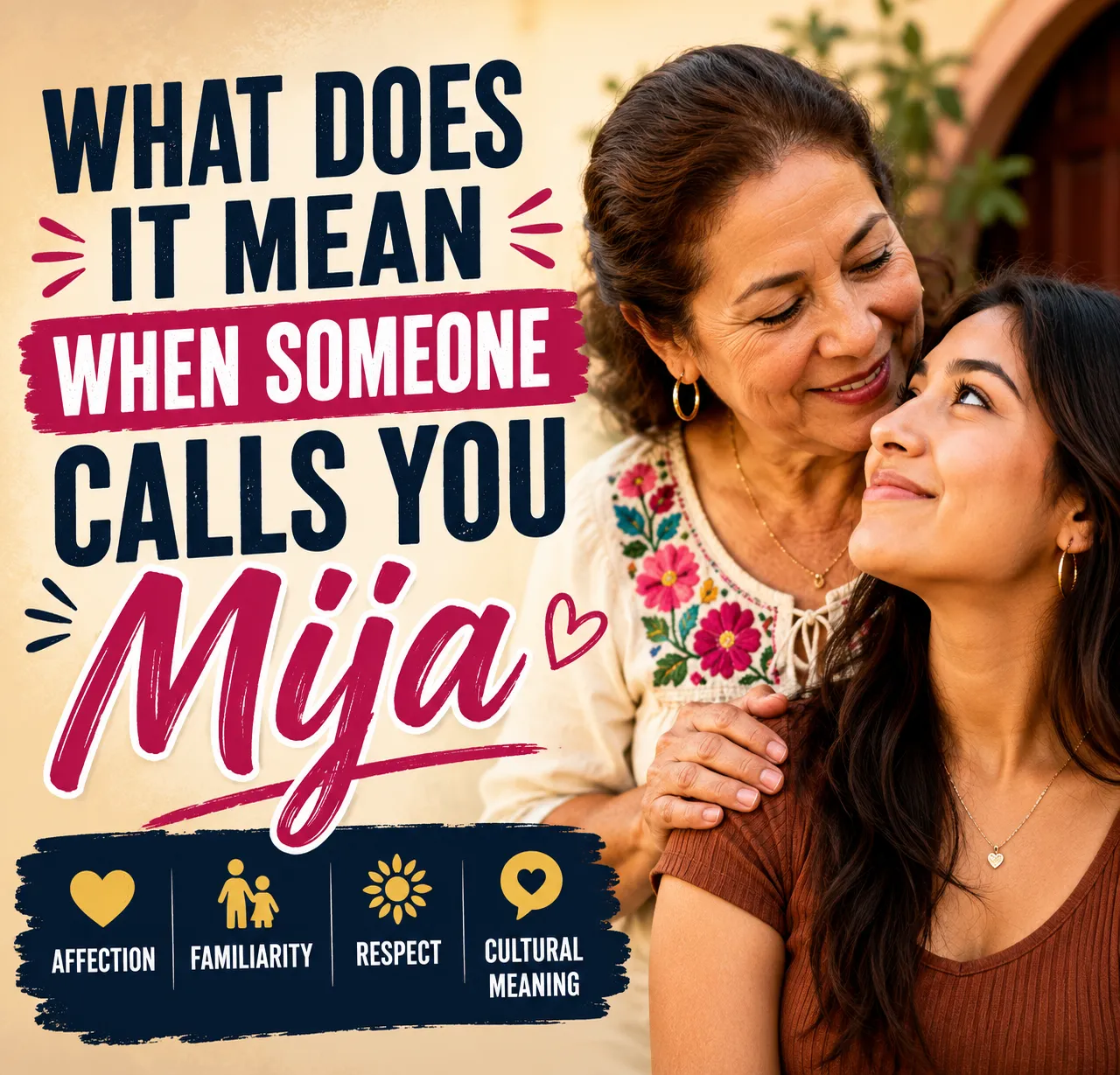
Have you ever had someone call you “mija” and wondered what they meant? Whether you heard it from a family member, friend, coworker, or someone in your community, the word often carries warmth and affection. But depending on who says it and the situation, its meaning can vary slightly.
In this guide, you’ll learn exactly what mija means, where it comes from, how it’s used in Spanish-speaking cultures, and how to respond when someone calls you mija.
What Does “Mija” Mean?
Mija is a Spanish term of endearment that literally comes from combining the words “mi hija,” meaning “my daughter.”
Over time, the phrase “mi hija” became shortened in everyday speech to mija.
Although it literally translates to “my daughter,” it isn’t always used for someone’s actual daughter. Instead, it’s commonly used as a loving nickname for:
- A daughter
- A granddaughter
- A younger female relative
- A close family friend
- A young girl
- Someone the speaker cares about
In English, the closest meanings might be:
- Sweetheart
- Dear
- Honey
- Kiddo
- My dear
- Darling
The exact meaning depends on the relationship and tone of voice.
Pronunciation
Mija is pronounced:
MEE-hah
The “j” in Spanish has an “h” sound.
Origin of the Word “Mija”
The word developed from:
Mi = My
Hija = Daughter
Together:
Mi hija → M’hija → Mija
This shortening is common in conversational Spanish and has been used for generations across many Spanish-speaking countries.
Is “Mija” Always Used for Daughters?
No.
This is one of the biggest misconceptions.
Many people use mija even when the person is not their daughter.
For example:
- A grandmother may call her granddaughter mija.
- An aunt may call her niece mija.
- An older neighbor may call a young woman mija.
- A family friend may affectionately call a child mija.
It’s more about affection than biological relationships.
What Does It Mean Emotionally?
When someone calls you mija, they’re usually expressing:
- Love
- Care
- Warmth
- Affection
- Protection
- Familiarity
- Respect (in some contexts)
It’s often meant to make someone feel comfortable and cared for.
Read Also: What Does It Mean When Someone Says Another Trip Around the Sun
Common Situations Where Someone Might Call You Mija
1. Parents Talking to Their Daughter
This is the most literal use.
Example:
“Come here, mija.”
Meaning:
“My daughter, come here.”
2. Grandparents
Grandparents frequently call grandchildren mija.
Example:
“Eat some more, mija.”
Meaning:
“My dear, have another helping.”
3. Older Women Speaking to Younger Girls
In many Hispanic cultures, older women naturally use mija when speaking to younger females.
For example:
- Teachers
- Neighbors
- Family friends
- Church members
It’s often meant kindly.
4. Close Family Friends
Long-time family friends sometimes treat children like their own.
Example:
“Congratulations, mija! I’m proud of you.”
This expresses affection rather than ownership.
5. Romantic Relationships (Occasionally)
Although less common, some couples use mija playfully or affectionately.
However, other nicknames are usually more common in romantic relationships.
Does “Mija” Mean Someone Likes You?
Sometimes—but not always.
Being called mija does not automatically mean someone has romantic feelings.
Usually, it simply means:
- They care about you.
- They feel comfortable around you.
- They see you almost like family.
- They want to express kindness.
Context is everything.
Is “Mija” Flirty?
Generally, no.
Most uses are:
- Family-oriented
- Friendly
- Caring
- Respectful
However, among people who already know each other well, it can occasionally sound playful or flirtatious depending on tone and context.
Is It Respectful?
Yes.
In most Spanish-speaking cultures, mija is considered respectful, loving, and polite when used appropriately.
It’s rarely intended as an insult.
Can a Stranger Call You Mija?
Yes.
In many Hispanic communities, strangers may use affectionate terms naturally.
For example:
A cashier might say:
“Thank you, mija.”
A waitress might say:
“Right this way, mija.”
An elderly woman might say:
“Be careful, mija.”
This often reflects cultural warmth rather than personal familiarity.
Regional Differences
The use of mija varies across Spanish-speaking countries.
Mexico
Very common.
Used by parents, grandparents, neighbors, teachers, and even strangers.
United States Hispanic Communities
Frequently used among Mexican American, Central American, and other Hispanic families.
Central America
Widely used within families and communities.
South America
Still understood, although frequency varies depending on the country.
Mija vs. Mi Hija
Although they share the same origin, they aren’t always interchangeable.
Mi hija
- Literal
- Formal
- Means “my daughter”
Example:
“Mi hija graduates tomorrow.”
Mija
- Informal
- Affectionate
- Often used as a nickname
Example:
“Good morning, mija.”
Mija vs. Hija
Hija simply means “daughter.”
Mija carries additional warmth and affection because it combines “my” and “daughter” into a familiar expression.
Mija vs. Mamita
Both are affectionate terms but differ slightly.
Mija
- Family-oriented
- Gentle
- Protective
- Common for daughters and younger girls
Mamita
- Can mean “little mama”
- More playful
- Sometimes flirtatious depending on context
- Also used affectionately with children in some regions
What Is the Male Version of Mija?
The masculine equivalent is:
Mijo
It comes from:
Mi hijo
Meaning:
“My son.”
Like mija, it’s also used for boys who aren’t necessarily the speaker’s actual son.
Common Examples
Here are everyday examples.
Example 1
“How are you today, mija?”
Meaning:
“How are you today, dear?”
Example 2
“You did a great job, mija.”
Meaning:
“I’m proud of you.”
Example 3
“Drive safely, mija.”
Meaning:
“Take care.”
Example 4
“Don’t worry, mija.”
Meaning:
“I’m here for you.”
Example 5
“Come eat, mija.”
Meaning:
“It’s time for dinner.”
How Should You Respond?
Usually, no special response is needed.
You can simply reply naturally.
Examples:
- “Thank you!”
- “Okay!”
- “I appreciate it.”
- “Thanks!”
- “You’re so kind.”
If it’s someone close to you, just continue the conversation normally.
Is It Okay to Call Someone Mija?
Yes—but only if it’s culturally appropriate and you have the right relationship.
Generally acceptable if:
- You’re speaking to your daughter.
- You’re an older family member.
- You’re close friends who commonly use Spanish nicknames.
- It’s common within your community.
If you’re unsure, it’s better to wait until you understand the person’s preferences and cultural background.
Frequently Asked Questions
Does mija literally mean “my daughter”?
Yes. It comes from the Spanish phrase mi hija, meaning “my daughter.” In everyday speech, it became shortened to mija.
Is mija a compliment?
Usually, yes.
It’s generally an affectionate way of showing kindness, care, or familiarity.
Can friends call each other mija?
Yes.
Close friends sometimes use mija affectionately, especially in Hispanic communities.
Can older women call younger women mija?
Absolutely.
This is one of the most common uses.
Is mija romantic?
Usually not.
Most of the time it expresses family-like affection rather than romantic interest.
Is mija offensive?
Not in normal usage.
When spoken respectfully, it’s generally considered warm, caring, and polite.
FAQS
What does ‘Mijo’ &’Mija’ mean?
Mijo and mija are common Spanish terms of endearment used to express affection, warmth, and familiarity.
- Mijo comes from mi hijo, meaning “my son.”
- Mija comes from mi hija, meaning “my daughter.”
Although they literally translate to “my son” and “my daughter,” they are often used for people who are not the speaker’s actual children. Similar English expressions include:
- Dear
- Sweetheart
- Honey
- Kiddo
- My dear
Parents, grandparents, aunts, uncles, teachers, neighbors, and close family friends commonly use these nicknames for younger people as a sign of care and affection.
Where does the word ‘Mija’ come from?
The word mija originated as a shortened form of the Spanish phrase mi hija (“my daughter”).
Here’s how it evolved:
- Mi = My
- Hija = Daughter
- Mi hija → M’hija → Mija
Similarly:
- Mi hijo (“my son”) became mijo.
Over time, these contractions became a natural part of everyday spoken Spanish, especially in countries like Mexico and throughout many Hispanic communities. Today, mija is used as an affectionate nickname rather than a literal reference to one’s daughter.
How do you use ‘Mija’ in a relationship?
The meaning of mija depends on the type of relationship.
Family
Parents and grandparents often use it to express love and affection.
Example:
“Good morning, mija.”
Meaning:
“Good morning, my dear.”
Friends
Close friends, especially within Hispanic communities, may call each other mija to show closeness and affection.
Example:
“You’ve got this, mija!”
Romantic Relationships
Some couples use mija as a pet name, although it’s less common than terms like amor (love), mi vida (my life), or cariño (darling). In a romantic context, mija can sound playful, caring, or protective rather than intensely romantic.
Example:
“Come here, mija.”
Here, it conveys tenderness and familiarity rather than the literal meaning of “my daughter.”
Everyday Conversations
Older adults may also use mija when speaking to younger women, even if they are strangers.
For example:
- “Take care, mija.”
- “Have a wonderful day, mija.”
In these situations, it’s simply a friendly and respectful way to address someone.
Is It Romantic?
Not usually. Most of the time, mija is a family-oriented or affectionate expression rather than a romantic one. If a romantic partner uses it, the intended meaning depends on the couple’s dynamic and the surrounding context.
Overall, when someone calls you mija, it’s generally a sign that they feel comfortable with you and are expressing kindness, warmth, or affection.
Is Mija flirty?
Usually, no. The Spanish term “mija” is generally not flirty. It is an affectionate nickname formed by combining mi (my) and hija (daughter), literally meaning “my daughter.”
Depending on who says it and the situation, mija can express:
- Affection and care
- Warmth and kindness
- Familiarity
- Encouragement or comfort
For example:
- A mother to her daughter: “Come here, mija.”
- A grandmother to her granddaughter: “Take care, mija.”
- An older neighbor to a younger woman: “You’re doing great, mija.”
In these cases, there is no romantic or flirtatious meaning.
However, some couples or close partners may use mija as a private pet name. In that context, it sounds affectionate rather than overtly flirty.
Can mija be romantic?
Yes, it can be, but it depends entirely on the relationship.
Although mija traditionally means “my daughter,” many Spanish speakers also use it as a general term of endearment. A boyfriend or husband might call his partner mija to express closeness and affection.
Examples:
- “Good morning, mija.”
- “How was your day, mija?”
- “I missed you, mija.”
When used between romantic partners, it typically conveys:
- Love
- Tenderness
- Emotional closeness
It is not automatically romantic, though. If someone you don’t know well calls you mija, it is usually meant as a friendly or caring expression rather than flirting.
Is it flirty to call a girl mami?
It can be, much more often than mija.
Mami literally means “mommy,” but in many Spanish-speaking cultures it is commonly used as a term of endearment. Its meaning depends on the speaker and context.
It may be:
- Romantic between partners
- Flirty when used during dating
- Playful among close friends in some regions
- A casual nickname within families
For example:
- A boyfriend saying, “You’re beautiful, mami,” is usually being flirtatious or romantic.
- A mother calling her daughter “mami” is simply affectionate.
- Some friends use “mami” similarly to “girl,” “sweetie,” or “honey.”
Compared with mija, mami is much more likely to carry a flirtatious tone.
Is mija slang for daughter?
Not exactly.
Mija is a contraction of “mi hija” (my daughter) rather than slang.
It can refer to:
- Your actual daughter
- A younger female relative
- Someone you care about
- A younger woman you want to address warmly and respectfully
Many Spanish speakers also use mija for girls or young women who are not family members. For example, a teacher, neighbor, or shopkeeper might say:
- “Thank you, mija.”
- “Be careful, mija.”
In these situations, it functions more like:
- Dear
- Sweetheart
- Honey
- My dear
So while mija literally comes from “my daughter,” it has evolved into a widely used affectionate expression and is not simply slang for “daughter.”
Final Thoughts
If someone calls you mija, it’s usually a sign of affection, warmth, and care. While the word literally means “my daughter,” it’s commonly used far beyond immediate family.
Parents, grandparents, relatives, friends, neighbors, and even older strangers may use mija as a loving way to address a younger woman or girl. In most situations, it’s meant to make you feel welcomed, valued, and looked after rather than to imply any specific relationship.
Understanding the cultural context behind mija can help you appreciate its deeper meaning. Rather than focusing on the literal translation, think of it as the Spanish equivalent of saying “dear,” “sweetheart,” or “my dear.”