
Yoga is more than just stretching and poses—it’s a centuries-old practice that promotes physical health, mental clarity, and inner balance.
Whether you’re a beginner exploring yoga basics or an experienced practitioner testing your knowledge, these yoga quiz questions and answers are a fun and educational way to learn more about yoga philosophy, poses, breathing techniques, and history.
From popular yoga styles to mindfulness concepts, this quiz will challenge your understanding while helping you deepen your connection to the practice.
Funny Yoga Quiz Questions And Answers
1. What is the Sanskrit word for yoga pose?
A) Dhyana
B) Pranayama
C) Asana
D) Mantra
Answer: C) Asana
Explanation: “Asana” means posture or seat in Sanskrit and is the term used for all yoga poses in classical yoga texts.
2. Which ancient Indian text is considered a foundational text of yoga philosophy?
A) Bhagavad Gita
B) Rig Veda
C) Upanishads
D) Yoga Sutras of Patanjali
Answer: D) Yoga Sutras of Patanjali
Explanation: The Yoga Sutras, compiled by the sage Patanjali, outline the eight limbs of yoga and form the core of classical yoga philosophy.
3. What does the word “yoga” most closely mean in Sanskrit?
A) Exercise
B) Meditation
C) Union or to yoke
D) Stretching
Answer: C) Union or to yoke
Explanation: “Yoga” comes from the root “yuj,” meaning “to yoke” or “to unite,” often interpreted as the union of body, mind, and spirit.
4. What is the name of the breathing practice often used in yoga to calm the mind?
A) Asana
B) Dhyana
C) Pranayama
D) Mudra
Answer: C) Pranayama
Explanation: Pranayama is the yogic discipline of breath control, used to regulate prana (life force) and calm or energize the mind.
5. Which yoga style is known for its flowing, continuous sequences of poses linked with breath?
A) Yin Yoga
B) Iyengar Yoga
C) Vinyasa Yoga
D) Bikram Yoga
Answer: C) Vinyasa Yoga
Explanation: Vinyasa Yoga sequences postures smoothly from one to the next with synchronized breath, so it’s often called “flow” yoga.
6. What is the name of the traditional cross‑legged seated meditation pose?
A) Balasana
B) Tadasana
C) Sukhasana
D) Virasana
Answer: C) Sukhasana
Explanation: Sukhasana, or “Easy Pose,” is a simple cross‑legged seated posture used for meditation and breathing at the start or end of class.
7. Which pose is commonly known as Downward‑Facing Dog?
A) Adho Mukha Svanasana
B) Uttanasana
C) Sethu Bandhasana
D) Anjaneyasana
Answer: A) Adho Mukha Svanasana
Explanation: Adho Mukha Svanasana is an inverted V‑shape pose that stretches the whole body and is a staple in many yoga styles.
8. What Sanskrit term refers to the life force or energy in yoga?
A) Chakra
B) Kundalini
C) Prana
D) Mantra
Answer: C) Prana
Explanation: “Prana” is the Sanskrit word for vital energy or life force that pranayama practices aim to regulate and enhance.
9. In yoga philosophy, what are the eight limbs of yoga called?
A) Tantra
B) Vedanta
C) Ashtanga
D) Samadhi
Answer: C) Ashtanga
Explanation: “Ashtanga” means “eight limbs,” referring to the eightfold path of yoga: yama, niyama, asana, pranayama, pratyahara, dharana, dhyana, and samadhi.
10. Which yoga posture is often called the “King of Asanas” and is a shoulder‑stand pose?
A) Sirsasana
B) Sarvangasana
C) Halasana
D) Adho Mukha Vrksasana
Answer: B) Sarvangasana
Explanation: Sarvangasana, or Shoulder Stand, is known as the “King of Asanas” due to its wide‑ranging benefits for circulation, thyroid, and relaxation.
11. What is the name of the deep relaxation pose usually done at the end of a yoga class?
A) Balasana
B) Savasana
C) Makarasana
D) Utthan Pristhasana
Answer: B) Savasana
Explanation: Savasana, or Corpse Pose, is a lying‑down relaxation pose that helps integrate the practice and calm the nervous system.
12. Which chakra is located at the base of the spine and linked to grounding and survival?
A) Anahata
B) Muladhara
C) Svadhisthana
D) Ajna
Answer: B) Muladhara
Explanation: The Muladhara (root) chakra governs feelings of safety, stability, and basic survival needs.
13. Which yoga style emphasizes long, passive stretches and uses props like bolsters and blankets?
A) Ashtanga Yoga
B) Power Yoga
C) Kundalini Yoga
D) Yin Yoga
Answer: D) Yin Yoga
Explanation: Yin Yoga focuses on gently stressing connective tissues through long‑held seated or lying poses, supported by props.
14. Which sage is traditionally credited with compiling the Yoga Sutras?
A) Swami Vivekananda
B) Maharishi Mahesh Yogi
C) Patanjali
D) Swami Sivananda
Answer: C) Patanjali
Explanation: Patanjali is regarded as the sage who compiled the Yoga Sutras, one of the most important texts of classical yoga.
15. What do many yoga classes begin or end with chanting “Om” (Aum)?
A) A prayer for wealth
B) A song of devotion
C) The sound of the universe
D) A warning mantra
Answer: C) The sound of the universe
Explanation: “Om” is a sacred sound representing the vibration of the universe and is used to mark the start or end of a yoga session.
16. Which yoga style is practiced in a heated room and follows the same sequence of 26 postures?
A) Hot Vinyasa
B) Moksha Yoga
C) Bikram Yoga
D) Ashtanga Yoga
Answer: C) Bikram Yoga
Explanation: Bikram Yoga is done in a hot room and uses a fixed series of 26 postures and two breathing exercises designed by Bikram Choudhury.
17. What is the Sanskrit name for the pose commonly known as “Warrior II”?
A) Virasana
B) Virabhadrasana II
C) Vrksasana
D) Utthita Trikonasana
Answer: B) Virabhadrasana II
Explanation: Virabhadrasana II is a strong standing pose with arms extended and legs wide, building strength, stamina, and focus.
18. Which seated forward‑bend pose especially stretches the hamstrings and lower back?
A) Ardha Matsyendrasana
B) Paschimottanasana
C) Baddha Konasana
D) Marichyasana
Answer: B) Paschimottanasana
Explanation: Paschimottanasana is a seated forward bend that deeply stretches the back of the legs and spine.
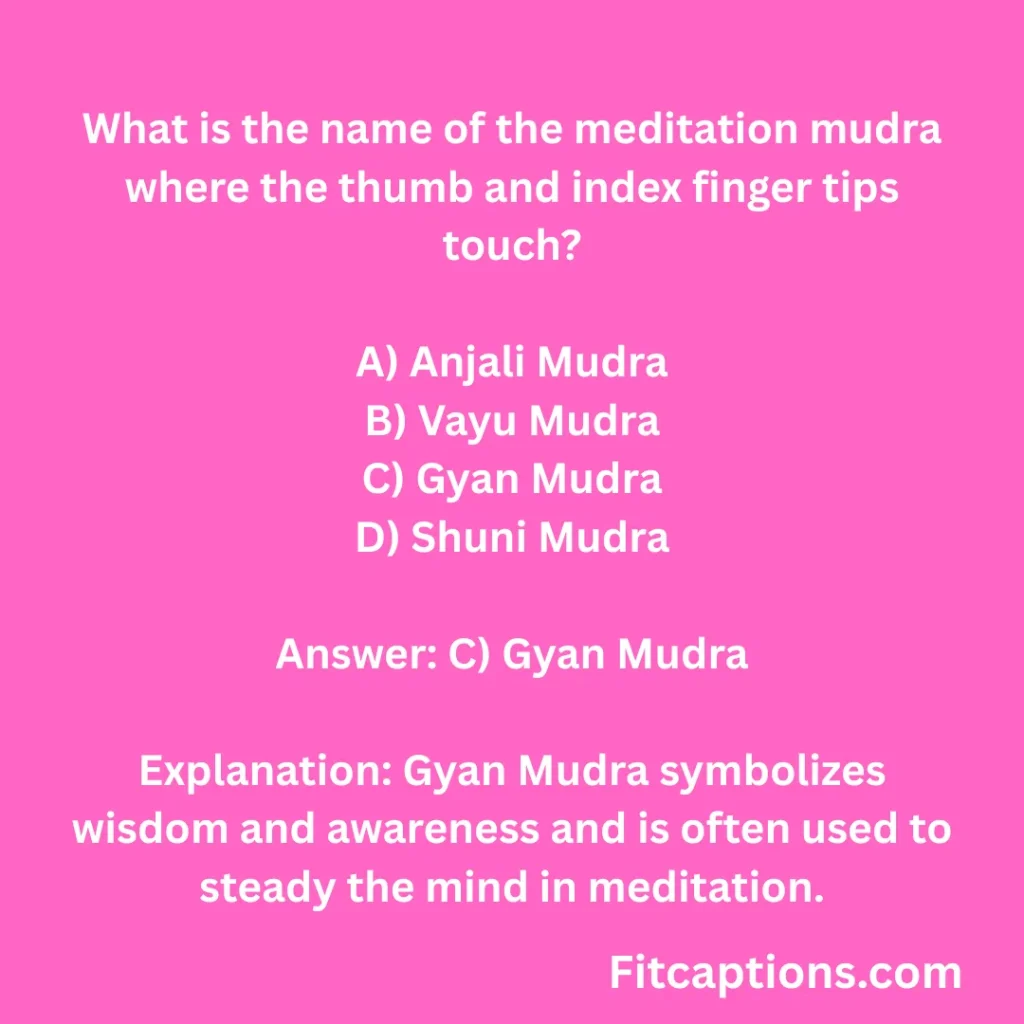
19. What is the name of the meditation mudra where the thumb and index finger tips touch?
A) Anjali Mudra
B) Vayu Mudra
C) Gyan Mudra
D) Shuni Mudra
Answer: C) Gyan Mudra
Explanation: Gyan Mudra symbolizes wisdom and awareness and is often used to steady the mind in meditation.
20. Which yoga style is known for its attention to precise alignment and use of props such as blocks and straps?
A) Kundalini Yoga
B) Ashtanga Yoga
C) Iyengar Yoga
D) Power Yoga
Answer: C) Iyengar Yoga
Explanation: Iyengar Yoga, founded by B.K.S. Iyengar, emphasizes accurate alignment and uses props to help students practice safely and correctly.
Related: 121+ Friends Trivia Questions and Answers
Short Yoga Quiz Questions And Answers
1. Why is Downward-Facing Dog the most popular yoga pose?
A) It’s the only one that lets you check your phone between your legs
B) Dogs do it naturally, and they’re always happy
C) It’s secretly a nap in disguise
D) Gravity finally works in your favor for once
Answer: A
Explanation: Downward Dog is the perfect pose to sneak a peek at your notifications. Also, it’s the only position where your back doesn’t hurt and you can still see the clock.
2. What do you call a yoga instructor who can’t stop talking?
A) A chatter-asana
B) A pranayama pontificator
C) A yogi-pedia
D) A vinyasa-verbosa
Answer: D
Explanation: “Vinyasa-verbosa” is that teacher who gives a 5-minute speech about alignment while you’re sweating in a lunge. They mean well, but your thighs are on fire.
3. Why did the yogi refuse to do Tree Pose?
A) She was afraid of termites
B) She had a root canal and couldn’t ground down
C) She kept falling over and blaming the “breeze”
D) Trees are too mainstream – she’s a cactus person
Answer: C
Explanation: Every yoga class has that one person who wobbles violently in Tree Pose and whispers, “It’s windy in here.” It’s always a still room.
4. What is the official snack of a restorative yoga class?
A) Kale chips (too crunchy, disturbs the calm)
B) A single raisin (mindful eating)
C) Nap – because you fell asleep in Savasana
D) Coconut water (the champagne of yoga)
Answer: C
Explanation: Restorative yoga is 90% lying on blankets and 10% trying not to snore. The official snack is a nap, served with a side of drool.
5. Which pose is most likely to produce an audible fart?
A) Happy Baby (it’s right there in the name)
B) Wind-Relieving Pose (literally called Pawanmuktasana – “gas release”)
C) Child’s Pose (safe and hidden)
D) Headstand (danger zone)
Answer: B
Explanation: Wind-Relieving Pose is not subtle. The name is a promise. Everyone in class will pretend not to notice, but the person next to you is silently dying.
6. Why do yoga pants have such a strong grip?
A) They’re made from recycled climbing ropes
B) They absorb the shame of your last failed arm balance
C) They’re designed to hold in your “I’ll start eating healthy tomorrow” regrets
D) It’s a conspiracy by Lululemon to make you look good while suffering
Answer: D
Explanation: Yoga pants are engineered to make you look like a graceful gazelle, even when you’re sweating like a pig and grunting through Chair Pose. It’s magic and expensive.
7. What is the secret meaning of “Om”?
A) The sound of the universe having a good stretch
B) What you say when you forget the next pose in the sequence
C) A fancy way to say “I need water”
D) The collective groan of 20 tight hamstrings
Answer: A
Explanation: “Om” is the cosmic vibration. But in class, it’s also the sound of people wondering if class is almost over. Either way, it’s very soothing.
8. Why do hot yoga studios smell the way they do?
A) Essential oils and desperation
B) Sweat and overpriced mats
C) The faint hope that you’ll touch your toes someday
D) A mix of Eucalyptus and regret
Answer: B
Explanation: Hot yoga is 105°F of “why did I sign up for this.” The smell is 60% sweat, 30% rubber mat, and 10% tears of joy when it’s finally over.
9. What is the most advanced yoga pose?
A) Savasana (lying still without falling asleep)
B) Crow Pose (balance on your hands like a bird)
C) Being on time to class
D) Not comparing yourself to the person in the front row
Answer: A
Explanation: Savasana sounds easy until you try to keep your mind from making a grocery list. True mastery is lying still for 5 minutes without planning dinner.
10. Why did the yogi bring a towel to class?
A) To wipe away the tears after a tough flow
B) To cover their face when the instructor calls on them
C) To mop up the puddle under their mat (see: hot yoga)
D) As a prop for the “pretend I’m a burrito” pose
Answer: C
Explanation: In hot yoga, towels aren’t optional. They’re flood control. Without one, you’ll slip off your mat and slide into the person next to you. Liability.
11. What is the difference between a yogi and a pretzel?
A) A pretzel has more salt
B) A yogi gets paid to twist into painful shapes
C) A pretzel is delicious with mustard
D) Both are delicious with cheese, but yogis complain less
Answer: B
Explanation: Yogis twist, fold, and bend themselves into geometric nightmares. Pretzels do the same, but they don’t have to pay $20 for a class.
12. What is the unofficial yoga pose for checking your phone during class?
A) Sneaky Savasana (arm hiding under thigh)
B) Stealth Downward Dog (peek between legs)
C) Culprit’s Pose (face down, phone tucked)
D) All of the above, plus the “I’m just adjusting my mat” reach
Answer: D
Explanation: Every yoga class has a phone-checker. They’re masters of disguise. The “adjusting my mat” is the oldest trick in the book – we see you.
13. Why do yoga instructors always say “listen to your body”?
A) Your body is wise and knows best
B) It’s code for “don’t sue us if you hurt yourself”
C) Your body is screaming “stop” but you’re not listening
D) They want you to hear your stomach growling
Answer: B
Explanation: “Listen to your body” is yoga-ese for “I warned you.” If you ignore it and pull a hamstring, that’s on you. The waiver is in the fine print.
14. What is the most common sound in a beginner yoga class?
A) “Is this supposed to hurt?”
B) The instructor saying “relax your jaw”
C) A loud THUD (someone falling out of balance)
D) All of the above, plus a nervous giggle
Answer: D
Explanation: Beginners are a symphony of self-doubt, thuds, and awkward laughter. The instructor’s job is to pretend it’s all part of the journey.
15. Why do advanced yogis wear shirts with motivational phrases?
A) To inspire the noobs
B) To distract from their own suffering
C) So they have something to read during long holds
D) It’s a secret code for free kombucha
Answer: C
Explanation: When you’re stuck in a 2-minute plank, you need something to read. “Breathe” on your shirt becomes a lifeline. Also, it’s a cry for help.
16. What do you call a yoga class that focuses entirely on arm balances?
A) A recipe for disaster (and bruises)
B) Crow-nastics
C) The “I can’t lift my arms tomorrow” special
D) All of the above, plus a chiropractor’s retirement fund
Answer: D
Explanation: Arm balance classes are where egos go to die. You’ll leave with sore wrists, a bruised knee, and a newfound respect for gravity. Chiropractors love them.
17. Why do some yogis avoid eating before class?
A) It interferes with their fasting protocol
B) They’re afraid of burping during Om
C) The thought of a burrito and a twist is a dangerous combination
D) They forgot to pack a snack (again)
Answer: C
Explanation: Twisting poses + a full stomach = a bad time. The burrito wants revenge. No one wants to be that person who has to run out mid-class.
18. What is the best way to survive a 60-minute hot yoga class?
A) Drink water, then more water, then cry
B) Lie down in Child’s Pose and refuse to move
C) Become one with the puddle of sweat under your mat
D) All of the above, plus consider your life choices
Answer: D
Explanation: Hot yoga is a test of will, hydration, and marriage. The final pose is always “Why did I do this?” Followed by “When is the next class?”
19. What does “namaste” really mean?
A) The light in me honors the light in you
B) I see you, and I also see you forgot your deodorant
C) Class is over, please leave
D) My student discount code is expired
Answer: C
Explanation: “Namaste” is a beautiful sentiment, but in a yoga studio, it’s universally understood as “Thank you for coming, now please roll up your mat and go.”
20. Why did the yogi quit yoga after one class?
A) They couldn’t touch their toes and felt personally attacked
B) The instructor said “find your edge” and they fell off
C) They spent the whole Savasana planning revenge on their hamstrings
D) All of the above, plus they preferred napping on a couch
Answer: D
Explanation: Yoga isn’t for everyone. Some people discover that their true calling is the couch, a remote, and zero downward dogs. And that’s okay – naps are a valid spiritual practice.
Related: 123+ World Capitals Quiz Questions And Answers
Cute Yoga Quiz Questions And Answers
1. What does the word “Yoga” mean in Sanskrit?
A) Union
B) Breath
C) Stretch
D) Peace
Answer: A) Union
Explanation: Yoga means union of body, mind, and spirit.
2. Which country is the birthplace of Yoga?
A) China
B) India
C) Japan
D) Nepal
Answer: B) India
Explanation: Yoga originated in ancient India thousands of years ago.
3. What is the main focus of Hatha Yoga?
A) Meditation
B) Physical postures
C) Chanting
D) Breathing only
Answer: B) Physical postures
Explanation: Hatha emphasizes asanas (poses) and balance.
4. Which Yoga style is known as “Power Yoga”?
A) Ashtanga
B) Kundalini
C) Yin
D) Restorative
Answer: A) Ashtanga
Explanation: Ashtanga is vigorous and physically demanding.
5. What does “Pranayama” mean?
A) Body posture
B) Breath control
C) Meditation
D) Relaxation
Answer: B) Breath control
Explanation: Pranayama is the practice of controlling breathing.
6. Which Yoga pose is also called “Tree Pose”?
A) Tadasana
B) Vrikshasana
C) Bhujangasana
D) Shavasana
Answer: B) Vrikshasana
Explanation: Balancing on one leg like a tree.
7. Which Yoga pose is known as “Downward Dog”?
A) Adho Mukha Svanasana
B) Vrikshasana
C) Padmasana
D) Tadasana
Answer: A) Adho Mukha Svanasana
Explanation: A classic inverted V-shape pose.
8. What is “Shavasana” also called?
A) Cobra Pose
B) Corpse Pose
C) Lotus Pose
D) Warrior Pose
Answer: B) Corpse Pose
Explanation: A relaxation pose lying flat on the back.
9. Which Yoga style focuses on slow, deep stretches?
A) Yin Yoga
B) Ashtanga Yoga
C) Bikram Yoga
D) Kundalini Yoga
Answer: A) Yin Yoga
Explanation: Yin targets deep connective tissues.
10. Which Yoga style uses heat in the room?
A) Bikram Yoga
B) Yin Yoga
C) Restorative Yoga
D) Hatha Yoga
Answer: A) Bikram Yoga
Explanation: Practiced in a heated environment.
11. Which Yoga pose is called “Lotus Pose”?
A) Padmasana
B) Tadasana
C) Bhujangasana
D) Vrikshasana
Answer: A) Padmasana
Explanation: A seated meditation posture with crossed legs.
12. What is the purpose of “Namaste” in Yoga?
A) Greeting with respect
B) Ending a class
C) Both A and B
D) None
Answer: C) Both A and B
Explanation: Namaste means “I bow to you.”
13. Which Yoga pose is known as “Cobra Pose”?
A) Bhujangasana
B) Padmasana
C) Vrikshasana
D) Tadasana
Answer: A) Bhujangasana
Explanation: Backbend resembling a cobra lifting its hood.
14. Which Yoga style awakens spiritual energy?
A) Kundalini Yoga
B) Yin Yoga
C) Bikram Yoga
D) Ashtanga Yoga
Answer: A) Kundalini Yoga
Explanation: Focuses on energy at the base of the spine.
15. What is the main goal of Yoga Nidra?
A) Deep relaxation
B) Strength building
C) Flexibility
D) Balance
Answer: A) Deep relaxation
Explanation: A guided meditation practice for rest.
16. Which Yoga pose is called “Mountain Pose”?
A) Tadasana
B) Padmasana
C) Bhujangasana
D) Vrikshasana
Answer: A) Tadasana
Explanation: Standing tall like a mountain.
17. Which Yoga practice combines movement with breath?
A) Vinyasa
B) Yin
C) Restorative
D) Bikram
Answer: A) Vinyasa
Explanation: Flowing sequences linked with breathing.
18. Which Yoga pose is known as “Warrior Pose”?
A) Virabhadrasana
B) Padmasana
C) Bhujangasana
D) Tadasana
Answer: A) Virabhadrasana
Explanation: Strong stance symbolizing a warrior.
19. What is the purpose of chanting “Om” in Yoga?
A) To relax
B) To connect with universal energy
C) To focus the mind
D) All of the above
Answer: D) All of the above
Explanation: Om is a sacred sound symbolizing the universe.
20. Which Yoga pose is best for meditation?
A) Padmasana
B) Bhujangasana
C) Tadasana
D) Vrikshasana
Answer: A) Padmasana
Explanation: Lotus Pose is ideal for meditation.
Related: 123+ Women’s World Cup Quiz Questions And Answers
Yoga Quiz Questions And Answers In English
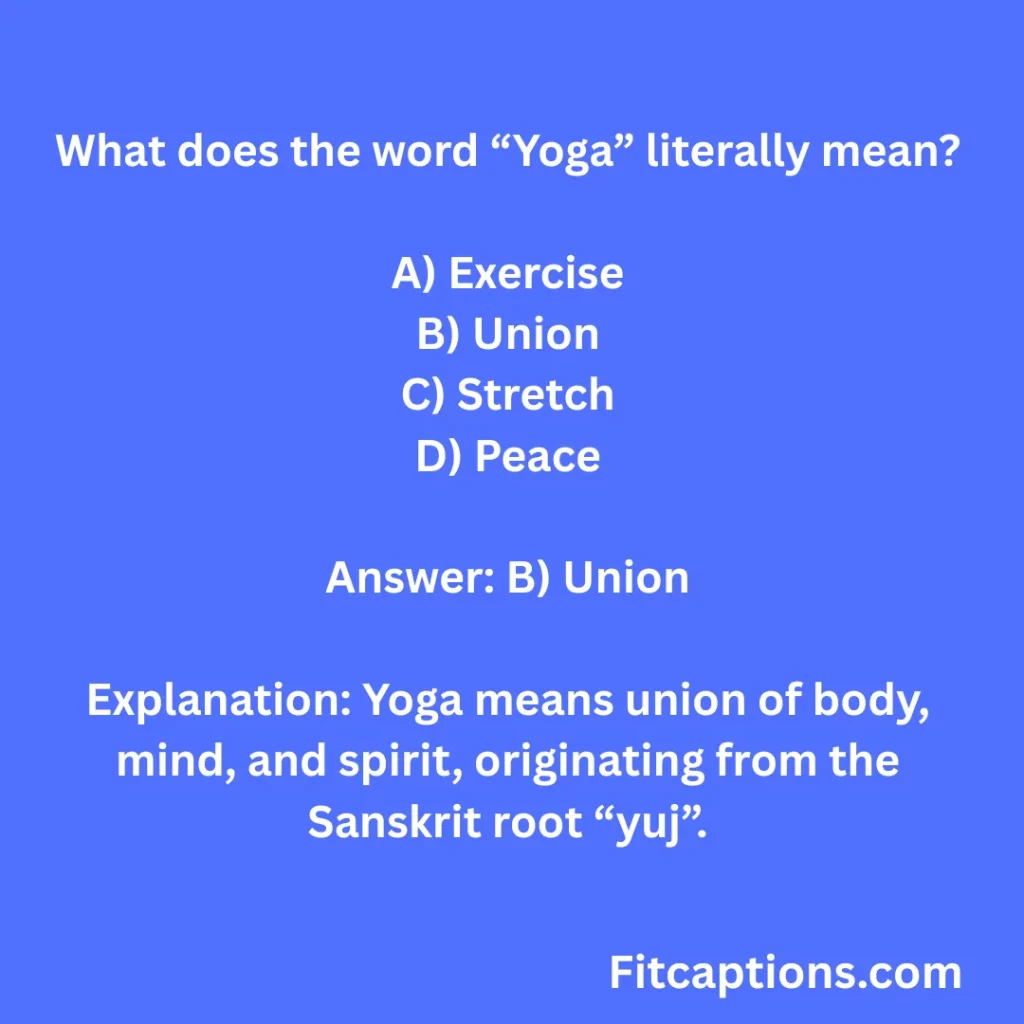
1. What does the word “Yoga” literally mean?
A) Exercise
B) Union
C) Stretch
D) Peace
Answer: B) Union
Explanation: Yoga means union of body, mind, and spirit, originating from the Sanskrit root “yuj”.
2. Which ancient text is considered the foundational scripture of Yoga?
A) Bhagavad Gita
B) Yoga Sutras of Patanjali
C) Upanishads
D) Ramayana
Answer: B) Yoga Sutras of Patanjali
Explanation: Patanjali’s Yoga Sutras, compiled around 400 CE, define the eight limbs of yoga.
3. What is the Sanskrit name for the Corpse Pose?
A) Balasana
B) Savasana
C) Tadasana
D) Adho Mukha Svanasana
Answer: B) Savasana
Explanation: Savasana is the final relaxation pose practiced at the end of most yoga sessions.
4. How many limbs (Ashtanga) are outlined in classical yoga?
A) 4
B) 6
C) 8
D) 10
Answer: C) 8
Explanation: The eight limbs include yama, niyama, asana, pranayama, pratyahara, dharana, dhyana, and samadhi.
5. Which yoga pose is known as the “King of Asanas”?
A) Headstand
B) Shoulder Stand
C) Downward Dog
D) Warrior Pose
Answer: A) Headstand
Explanation: Sirsasana (Headstand) is often called the king of asanas due to its numerous benefits.
6. What is the main focus of Hatha Yoga?
A) Meditation only
B) Physical postures and breath control
C) Chanting
D) Fasting
Answer: B) Physical postures and breath control
Explanation: Hatha Yoga balances the body through asanas and pranayama.
7. Which breathing technique is also called “Victorious Breath”?
A) Nadi Shodhana
B) Ujjayi
C) Bhramari
D) Kapalabhati
Answer: B) Ujjayi
Explanation: Ujjayi pranayama creates an ocean-like sound and is commonly used in vinyasa yoga.
8. What does “Namaste” mean?
A) Hello
B) The divine in me bows to the divine in you
C) Thank you
D) Goodbye
Answer: B) The divine in me bows to the divine in you
Explanation: Namaste is a respectful greeting used at the beginning or end of yoga classes.
9. Which pose is commonly called “Warrior II”?
A) Virabhadrasana II
B) Trikonasana
C) Parsvakonasana
D) Uttanasana
Answer: A) Virabhadrasana II
Explanation: Virabhadrasana II strengthens the legs and opens the hips and chest.
10. Who is known as the “Father of Modern Yoga”?
A) B.K.S. Iyengar
B) Pattabhi Jois
C) Tirumalai Krishnamacharya
D) Swami Vivekananda
Answer: C) Tirumalai Krishnamacharya
Explanation: Krishnamacharya taught many influential modern yoga masters in the 20th century.
11. What is the Sanskrit name for the Tree Pose?
A) Vrksasana
B) Natarajasana
C) Garudasana
D) Bakasana
Answer: A) Vrksasana
Explanation: Vrksasana improves balance and concentration.
12. Which type of yoga is known for its flowing sequence linked with breath?
A) Iyengar Yoga
B) Vinyasa Yoga
C) Yin Yoga
D) Restorative Yoga
Answer: B) Vinyasa Yoga
Explanation: Vinyasa connects movement with breath in a dynamic flow.
13. What is the purpose of Pranayama?
A) Build muscle
B) Control and expand life force energy through breath
C) Improve flexibility only
D) Increase heart rate
Answer: B) Control and expand life force energy through breath
Explanation: Pranayama is the fourth limb of yoga focused on breath regulation.
14. Which chakra is associated with the heart?
A) Root Chakra
B) Third Eye Chakra
C) Heart Chakra (Anahata)
D) Crown Chakra
Answer: C) Heart Chakra (Anahata)
Explanation: Anahata governs love, compassion, and emotional balance.
15. What is the most common mantra chanted at the start or end of a yoga class?
A) Gayatri Mantra
B) Om
C) Shanti Mantra
D) Lokah Samastah
Answer: B) Om
Explanation: Om is considered the primordial sound representing universal consciousness.
16. Which yoga pose is known as the “Pigeon Pose”?
A) Eka Pada Rajakapotasana
B) Kapotasana
C) Both A and B
D) Supta Kapotasana
Answer: A) Eka Pada Rajakapotasana
Explanation: Pigeon Pose deeply opens the hip flexors and glutes.
17. What style of yoga is practiced in a heated room (around 40°C)?
A) Hot Vinyasa
B) Bikram Yoga
C) Power Yoga
D) Ashtanga Yoga
Answer: B) Bikram Yoga
Explanation: Bikram Yoga consists of 26 fixed poses practiced in a hot studio.
18. Which asana is called the “Cobra Pose”?
A) Bhujangasana
B) Urdhva Mukha Svanasana
C) Both A and B
D) Matsyasana
Answer: A) Bhujangasana
Explanation: Bhujangasana strengthens the back and opens the chest.
19. What does the term “Ahimsa” mean in yoga philosophy?
A) Truth
B) Non-violence
C) Discipline
D) Contentment
Answer: B) Non-violence
Explanation: Ahimsa is the first yama, promoting non-violence in thought, word, and deed.
20. Which famous yoga guru popularized yoga in the West through television in the 1960s-70s?
A) Indra Devi
B) Swami Satchidananda
C) B.K.S. Iyengar
D) All of the above
Answer: D) All of the above
Explanation: These gurus played key roles in bringing yoga to a global audience.
Yoga Quiz Questions And Answers For Kids
1. Which pose is like lying down and resting like a “dead” body?
A) Downward Dog
B) Cat Pose
C) Savasana
D) Tree Pose
Answer: C) Savasana
Explanation: Savasana, or “Corpse Pose,” is a resting pose where kids lie on their backs and relax at the end of class.
2. Which animal do we pretend to be in “Cat‑Cow” pose?
A) Dog and Cow
B) Cat and Cow
C) Monkey and Cow
D) Cat and Bird
Answer: B) Cat and Cow
Explanation: In Cat‑Cow, kids move between rounding like a cat and arching like a cow to warm up the spine.
3. In which pose do you sit on your knees and stretch your arms out like a little turtle?
A) Child’s Pose
B) Downward Dog
C) Frog Pose
D) Warrior Pose
Answer: A) Child’s Pose
Explanation: Child’s Pose (Balasana) looks like a turtle hiding in its shell, with knees bent and arms reaching forward.
4. Which pose is all about standing tall like a tree with one foot off the ground?
A) Mountain Pose
B) Tree Pose
C) Chair Pose
D) Cobra Pose
Answer: B) Tree Pose
Explanation: Tree Pose (Vrksasana) helps kids practice balance by standing on one leg and lifting the other foot.
5. Which pose is like lying on your belly and lifting your chest up, like a snake?
A) Cobra Pose
B) Butterfly Pose
C) Star Pose
D) Eagle Pose
Answer: A) Cobra Pose
Explanation: Cobra Pose (Bhujangasana) is often called “Snake Pose” for kids and strengthens the back.
6. In which pose do you spread your arms and legs out like a big star?
A) Butterfly Pose
B) Star Pose
C) Table Pose
D) Bridge Pose
Answer: B) Star Pose
Explanation: Star Pose is a fun, open‑arm pose that helps kids feel strong and wide, like a star.
7. Which pose do you start in before many yoga flows, standing up straight and tall?
A) Child’s Pose
B) Mountain Pose
C) Forward Fold
D) Boat Pose
Answer: B) Mountain Pose
Explanation: Mountain Pose (Tadasana) is the basic standing pose, teaching kids good posture and focus.
8. In which pose do you sit and bring your feet together like a butterfly’s wings?
A) Frog Pose
B) Star Pose
C) Butterfly Pose
D) Table Pose
Answer: C) Butterfly Pose
Explanation: Butterfly Pose (Baddha Konasana) opens the hips and looks like a butterfly flapping its wings.
9. Which pose has you sitting on your heels and resting your head down, like a sleepy turtle?
A) Child’s Pose
B) Downward Dog
C) Cat Pose
D) Cobra Pose
Answer: A) Child’s Pose
Explanation: Child’s Pose is a relaxing, resting pose that gently stretches the back and hips.
10. Which pose is like sitting on an imaginary chair with your knees bent?
A) Chair Pose
B) Mountain Pose
C) Boat Pose
D) Frog Pose
Answer: A) Chair Pose
Explanation: Chair Pose (Utkatasana) looks like sitting in an invisible chair and builds leg strength.
11. Which pose involves lying on your back and lifting your legs up like a little boat?
A) Boat Pose
B) Bridge Pose
C) Star Pose
D) Cat Pose
Answer: A) Boat Pose
Explanation: Boat Pose (Navasana) strengthens the core and looks like a boat floating on the water.
12. In which pose do you lie on your back and lift your hips up, like a little bridge?
A) Cobra Pose
B) Bridge Pose
C) Downward Dog
D) Tree Pose
Answer: B) Bridge Pose
Explanation: Bridge Pose (Setu Bandha Sarvangasana) gently arches the back and stretches the front of the body.
13. Which pose is all about lying on your back and hugging your knees like a big ball?
A) Butterfly Pose
B) Child’s Pose
C) Hugging‑Knees Pose (Apanasana)
D) Star Pose
Answer: C) Hugging‑Knees Pose (Apanasana)
Explanation: This pose gently massages the belly and helps relieve tummy troubles.
14. Which pose is like walking on all fours, like a cat and a cow together?
A) Cat‑Cow Pose
B) Table Pose
C) Frog Pose
D) Snake Pose
Answer: A) Cat‑Cow Pose
Explanation: Cat‑Cow is a gentle warm‑up that moves the spine up and down on all fours.
15. Which pose uses your hands and knees to look like a table, with a flat back?
A) Cat Pose
B) Cow Pose
C) Table Pose
D) Frog Pose
Answer: C) Table Pose
Explanation: Table Pose is a stable position on hands and knees that helps kids learn alignment.
16. In which pose do you squat down low with your feet wide and elbows pressing your knees apart?
A) Frog Pose
B) Butterfly Pose
C) Star Pose
D) Chair Pose
Answer: A) Frog Pose
Explanation: Frog Pose opens the hips and groin and looks like a frog hopping around.
17. Which pose is great for calming the mind by lying down and breathing slowly?
A) Cobra Pose
B) Star Pose
C) Savasana
D) Warrior Pose
Answer: C) Savasana
Explanation: Savasana gives kids a chance to relax, listen to their breath, and feel calm.
18. Which pose is all about standing with feet hip‑width apart, arms by your sides, and spine tall?
A) Tree Pose
B) Moon Pose
C) Mountain Pose
D) Boat Pose
Answer: C) Mountain Pose
Explanation: Mountain Pose teaches kids how to stand with a strong, steady base.
19. In which pose do you pretend to be a strong warrior with one leg forward and arms out?
A) Tree Pose
B) Warrior Pose
C) Cat Pose
D) Frog Pose
Answer: B) Warrior Pose
Explanation: Warrior Pose (Virabhadrasana) builds strength and confidence, just like a brave warrior.
20. Which pose is like stretching your arms up high to touch the sky, like a tall tree?
A) Star Pose
B) Mountain Pose
C) Tree Pose
D) All of the above
Answer: D) All of the above
Explanation: In many of these poses, kids reach their arms up to the sky to feel strong and tall.
Yoga Quiz Questions And Answers For Adults
1. Which ancient text is considered the foundation of Yoga philosophy?
A) Bhagavad Gita
B) Yoga Sutras of Patanjali
C) Rig Veda
D) Upanishads
Answer: B) Yoga Sutras of Patanjali
Explanation: Patanjali compiled the Yoga Sutras around 400 CE, outlining the eight limbs of yoga.
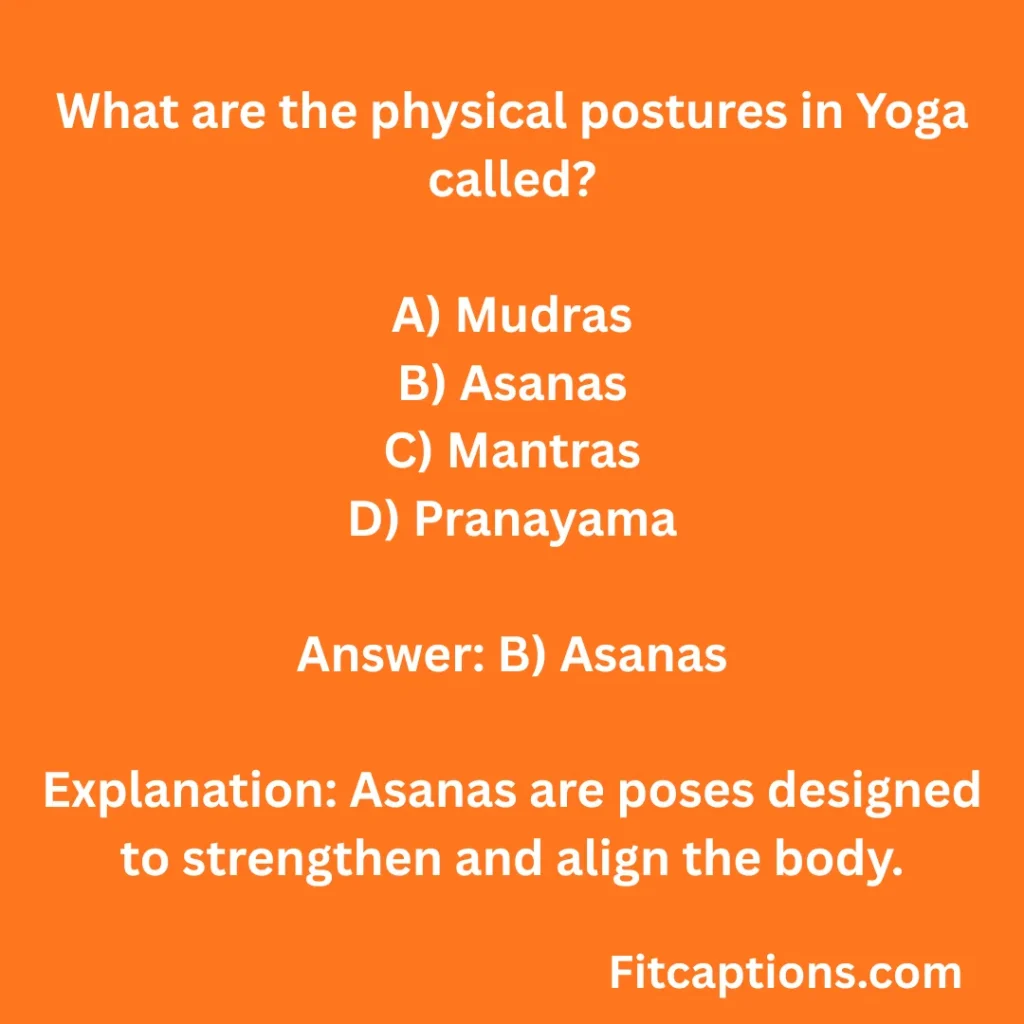
2. What are the physical postures in Yoga called?
A) Mudras
B) Asanas
C) Mantras
D) Pranayama
Answer: B) Asanas
Explanation: Asanas are poses designed to strengthen and align the body.
3. Which limb of Yoga focuses on ethical discipline?
A) Yamas
B) Niyamas
C) Pranayama
D) Dhyana
Answer: A) Yamas
Explanation: Yamas are moral guidelines like non-violence and truthfulness.
4. Which Yoga practice involves controlling the breath?
A) Asana
B) Pranayama
C) Dhyana
D) Samadhi
Answer: B) Pranayama
Explanation: Pranayama regulates energy through breath control.
5. What does “Om” symbolize in Yoga?
A) Peace
B) Universe
C) Strength
D) Silence
Answer: B) Universe
Explanation: Om represents the sound of creation and universal energy.
6. Which Yoga style is known for 26 postures practiced in a heated room?
A) Ashtanga
B) Bikram
C) Vinyasa
D) Kundalini
Answer: B) Bikram
Explanation: Bikram Yoga uses heat to promote flexibility and detoxification.
7. Which Yoga style emphasizes flowing movement linked with breath?
A) Vinyasa
B) Yin
C) Restorative
D) Hatha
Answer: A) Vinyasa
Explanation: Vinyasa means “to place in a special way,” linking poses with breath.
8. Which Yoga style focuses on awakening energy at the spine’s base?
A) Kundalini
B) Yin
C) Bikram
D) Iyengar
Answer: A) Kundalini
Explanation: Kundalini Yoga uses breath, movement, and chanting to awaken energy.
9. Which Yoga pose is known as “Child’s Pose”?
A) Balasana
B) Tadasana
C) Padmasana
D) Bhujangasana
Answer: A) Balasana
Explanation: A resting pose that calms the mind and stretches the back.
10. Which Yoga pose is called “Warrior II”?
A) Virabhadrasana II
B) Tadasana
C) Vrikshasana
D) Padmasana
Answer: A) Virabhadrasana II
Explanation: Strengthens legs and improves focus.
11. Which Yoga practice involves meditation?
A) Dhyana
B) Pranayama
C) Asana
D) Yama
Answer: A) Dhyana
Explanation: Dhyana is the practice of focused meditation.
12. Which Yoga style uses props like blocks and straps for alignment?
A) Iyengar
B) Ashtanga
C) Bikram
D) Kundalini
Answer: A) Iyengar
Explanation: Iyengar Yoga emphasizes precision and support.
13. Which Yoga pose is known as “Bridge Pose”?
A) Setu Bandhasana
B) Bhujangasana
C) Padmasana
D) Tadasana
Answer: A) Setu Bandhasana
Explanation: Strengthens the back and opens the chest.
14. Which Yoga practice aims for ultimate absorption or enlightenment?
A) Samadhi
B) Pratyahara
C) Dhyana
D) Niyama
Answer: A) Samadhi
Explanation: The final limb of Yoga, union with the divine.
15. Which Yoga pose is called “Camel Pose”?
A) Ustrasana
B) Vrikshasana
C) Tadasana
D) Padmasana
Answer: A) Ustrasana
Explanation: A deep backbend that opens the chest.
16. Which Yoga style is often referred to as “meditation in motion”?
A) Tai Chi
B) Vinyasa Yoga
C) Yin Yoga
D) Restorative Yoga
Answer: B) Vinyasa Yoga
Explanation: Continuous flow creates a meditative rhythm.
17. Which Yoga practice involves withdrawal of the senses?
A) Pratyahara
B) Dhyana
C) Samadhi
D) Yama
Answer: A) Pratyahara
Explanation: Turning inward by detaching from external stimuli.
18. Which Yoga pose is known as “Plank Pose”?
A) Phalakasana
B) Tadasana
C) Padmasana
D) Balasana
Answer: A) Phalakasana
Explanation: Builds core strength and stability.
19. Which Yoga style was popularized by K. Pattabhi Jois?
A) Ashtanga Yoga
B) Iyengar Yoga
C) Bikram Yoga
D) Kundalini Yoga
Answer: A) Ashtanga Yoga
Explanation: A structured, vigorous sequence of poses.
20. Which Yoga pose is called “Corpse Pose”?
A) Shavasana
B) Padmasana
C) Tadasana
D) Bhujangasana
Answer: A) Shavasana
Explanation: Final relaxation pose to integrate practice.
Final Thoughts
We hope these yoga quiz questions and answers helped you expand your knowledge and discover interesting facts about yoga. Quizzes are a great way to test what you know while learning something new about yoga poses, breathing exercises, meditation, and wellness principles.
Keep practicing, stay curious, and continue exploring the world of yoga to improve both your mind and body. Don’t forget to share these yoga trivia questions with friends and fellow yoga enthusiasts for even more fun learning!
Recommended:
123+ Tightrope Trivia Questions And Answers
119+ Naughty Trivia Questions and Answers